Planet jupiter atmosphere
1344×768 · AVIF · CC BY 4.0
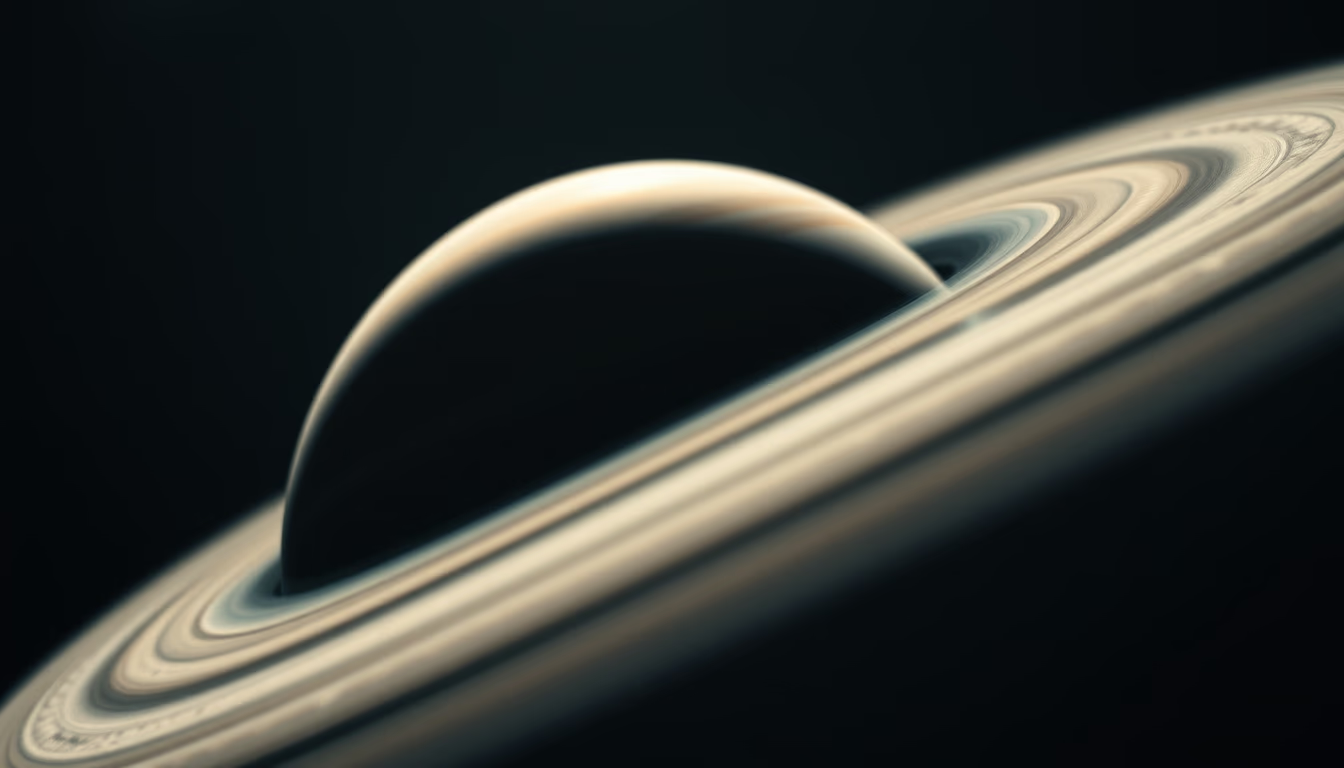
Jupiter, the largest planet in the Solar System, has a turbulent atmosphere composed mainly of hydrogen and helium, with colorful bands and giant storms.
About this subject
Jupiter's atmosphere is the most massive among the planets of the Solar System, extending thousands of kilometers. Composed of approximately 90% molecular hydrogen and 10% helium, with traces of methane, ammonia, and water vapor, it displays a characteristic pattern of bands parallel to the equator. These bands are bright zones and dark belts, resulting from different chemical compositions and temperatures. Zones are high-pressure regions with ammonia ice clouds, while belts are low-pressure areas with darker, more complex clouds.
The most famous feature is the Great Red Spot, a persistent anticyclonic storm larger than Earth, observed for at least 350 years. Recently, NASA's Juno probe revealed that the spot extends hundreds of kilometers below the cloud tops. In addition, Jupiter has other storms, such as hexagonal patterns at the poles and various white and brown spots that form and dissipate over the years.
Jovian atmospheric dynamics are driven by the planet's rapid rotation (about 10 hours) and internal heat, which generates violent convection currents. Winds can reach speeds of up to 600 km/h. The Galileo probe in the 1990s detected lightning up to a thousand times more energetic than Earth's, confirming intense electrical activity. Studying Jupiter's atmosphere helps scientists understand meteorological processes on extreme scales and the evolution of gas giant planets.
Frequently Asked Questions
Why does Jupiter have colorful bands in its atmosphere?
The bands are caused by differences in chemical composition, temperature, and pressure. The bright zones consist of ammonia ice clouds, while the dark belts contain more complex compounds such as ammonium hydrosulfide. The planet's rapid rotation also contributes to the formation of these bands parallel to the equator.
Is Jupiter's Great Red Spot shrinking?
Yes, observations show that the Great Red Spot has decreased in size over the centuries. In the 19th century, its diameter was estimated at about 40,000 km, but today it is approximately 16,000 km. It is still unknown whether it will disappear completely or stabilize.
Which probes have studied Jupiter's atmosphere?
Several missions, including Pioneer 10 and 11, Voyager 1 and 2, Galileo, Juno (NASA), and the Cassini probe (which performed a flyby). Galileo released an atmospheric probe in 1995, which collected data for about an hour before being destroyed by pressure. Juno, since 2016, maps the planet's atmosphere and magnetic field.
Direct URL
https://pub-c7d6a6ea828543ac903a74a341ccb2e1.r2.dev/imagens/planet-jupiter-atmosphere-macro-closeup-p2.avifHow to credit
Include a visible link back to UtilizAí. Copy one of the snippets below:
<a href="https://xn--utiliza-eza.com/en/midia/imagens/planet-jupiter-atmosphere-macro-closeup-p2">Planet jupiter atmosphere</a> by <a href="https://xn--utiliza-eza.com">UtilizAí</a>, licensed under <a href="https://creativecommons.org/licenses/by/4.0/">CC BY 4.0</a>.
[Planet jupiter atmosphere](https://xn--utiliza-eza.com/en/midia/imagens/planet-jupiter-atmosphere-macro-closeup-p2) by [UtilizAí](https://xn--utiliza-eza.com), CC BY 4.0
License: CC-BY-4.0