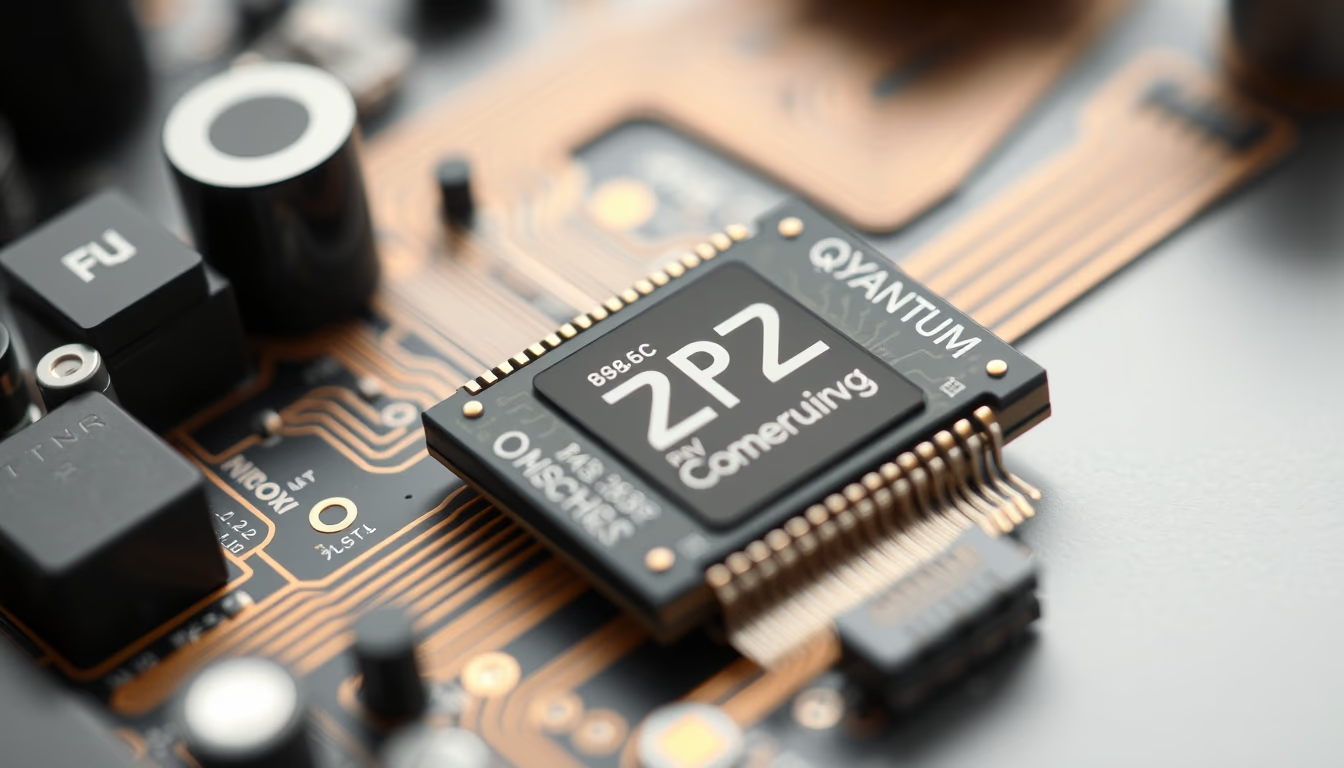
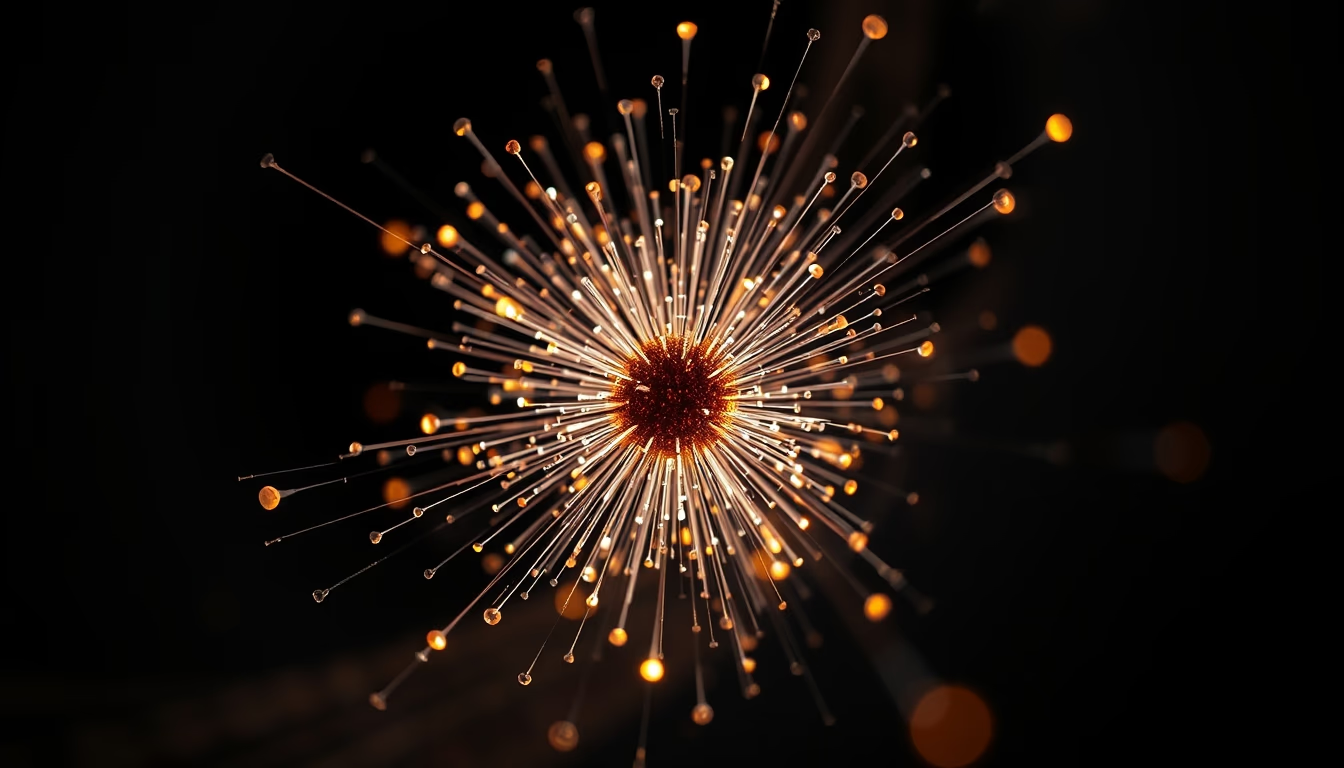
Photon wave particle
1344×768 · AVIF · CC BY 4.0
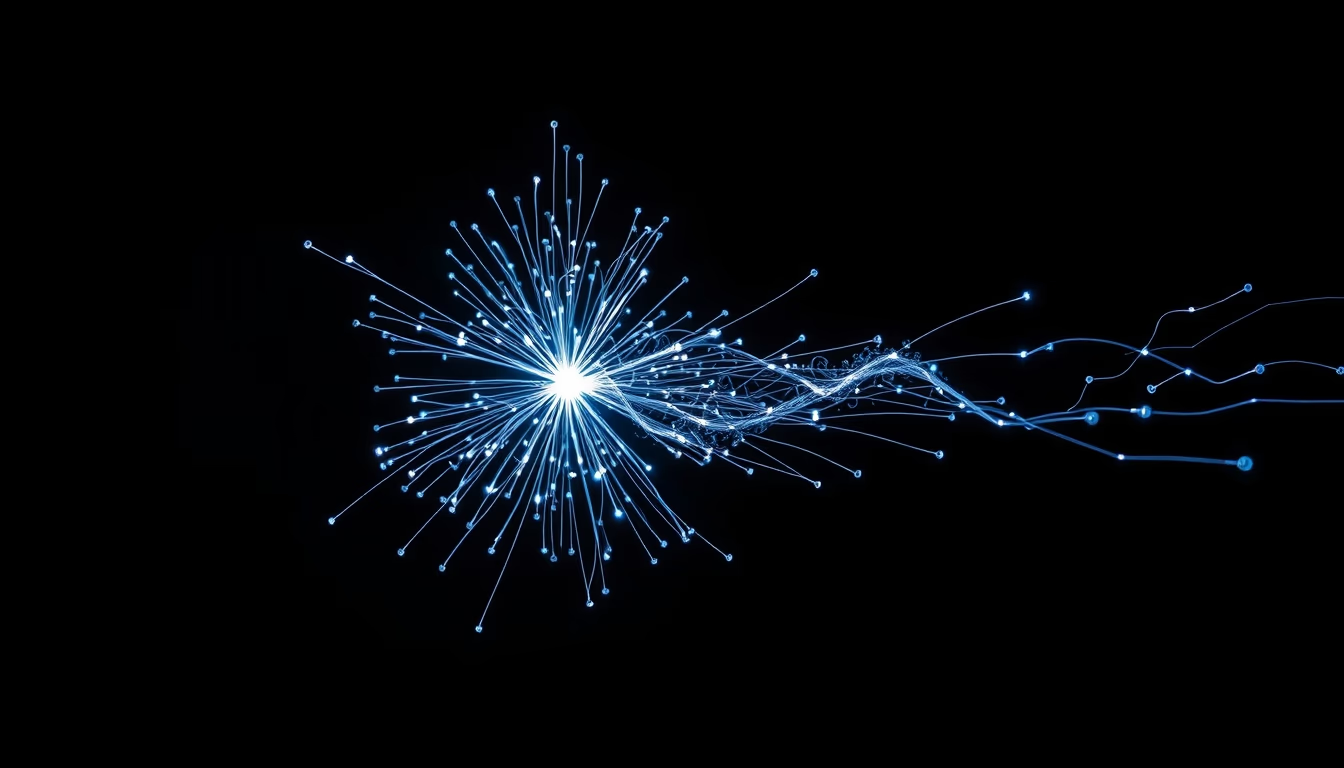
The photon is a fundamental particle that behaves both as a wave and as a particle, revealing the duality of quantum mechanics.
About this subject
The wave-particle duality concept is a cornerstone of quantum mechanics, and the photon is its most emblematic example. Historically, the nature of light was debated for centuries: Newton believed in particles, while Huygens advocated waves. In the 19th century, interference and diffraction experiments, such as Young's double-slit, seemed to confirm wave behavior. However, in 1905, Einstein explained the photoelectric effect by postulating that light is composed of discrete quanta of energy, photons, which behave as particles when colliding with electrons. This duality is not a contradiction but a complementary description: in certain situations, the photon exhibits wave properties (such as wavelength and frequency), and in others, particle properties (such as discrete energy and momentum). Modern experiments, such as the double-slit with detectors, show that an individual photon interferes with itself, challenging classical intuition. The duality is mathematically described by the quantum mechanical wave function, which gives the probability of finding the photon at a given location. This behavior is fundamental for technologies like lasers, semiconductors, and quantum computing.
Frequently Asked Questions
What is wave-particle duality?
It is the quantum mechanical principle that entities like photons can behave as waves or particles depending on the experiment. For example, they show wave patterns in diffraction but act as discrete particles in the photoelectric effect.
What is a photon?
A photon is the elementary particle that constitutes light and all forms of electromagnetic radiation. It has no mass and travels at the speed of light. Its energy is proportional to its frequency, given by E = hf, where h is Planck's constant.
How was the dual nature of light discovered?
The duality was demonstrated by experiments such as Young's double-slit (wave) and the photoelectric effect explained by Einstein (particle). Later, quantum mechanics formalized this duality with the wave function.
Direct URL
https://pub-c7d6a6ea828543ac903a74a341ccb2e1.r2.dev/imagens/photon-wave-particle-studio-still-life-p6.avifHow to credit
Include a visible link back to UtilizAí. Copy one of the snippets below:
<a href="https://xn--utiliza-eza.com/en/midia/imagens/photon-wave-particle-studio-still-life-p6">Photon wave particle</a> by <a href="https://xn--utiliza-eza.com">UtilizAí</a>, licensed under <a href="https://creativecommons.org/licenses/by/4.0/">CC BY 4.0</a>.
[Photon wave particle](https://xn--utiliza-eza.com/en/midia/imagens/photon-wave-particle-studio-still-life-p6) by [UtilizAí](https://xn--utiliza-eza.com), CC BY 4.0
License: CC-BY-4.0