Photon wave particle
1344×768 · AVIF · CC BY 4.0
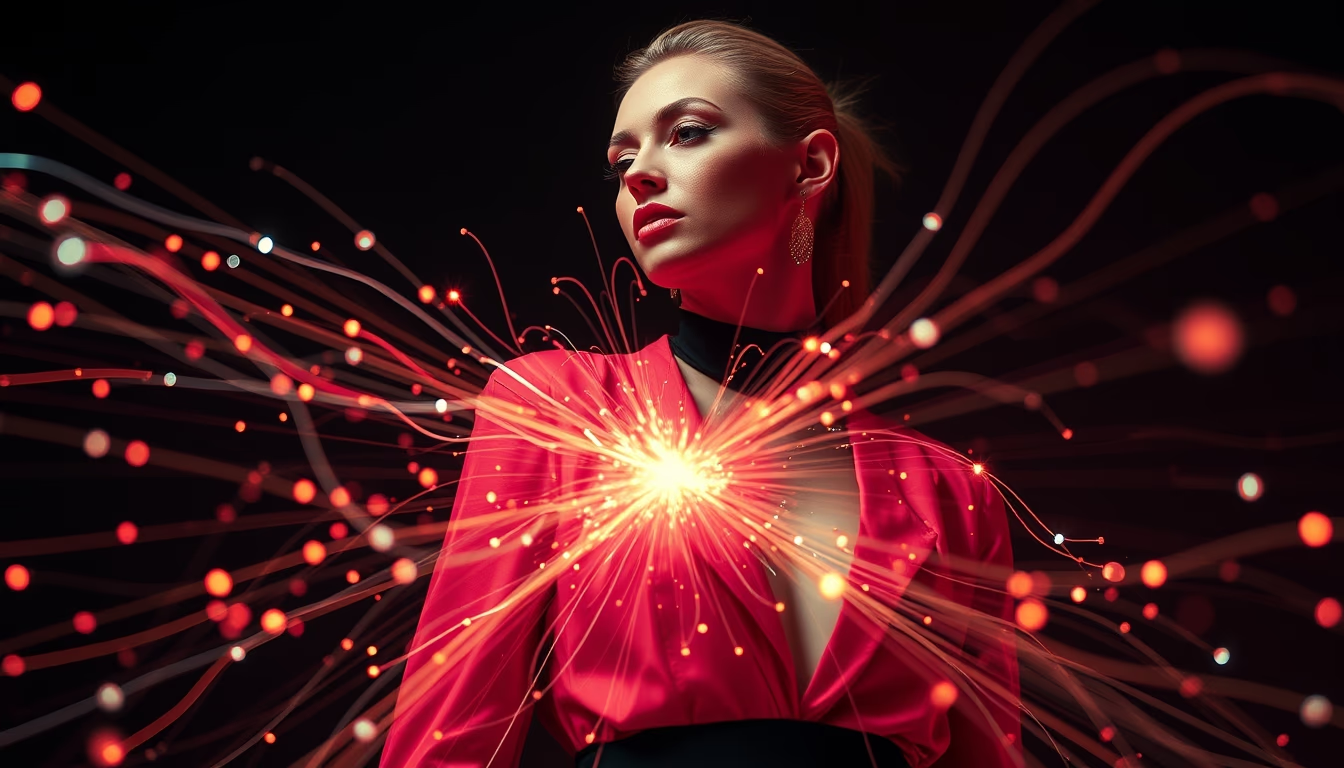
The wave-particle duality of the photon is one of the most fascinating concepts in quantum physics, challenging classical intuition about the nature of light.
About this subject
Wave-particle duality is a cornerstone of quantum mechanics, and photons are its most iconic example. Historically, the debate about the nature of light dates back to Newton (particles) and Huygens (waves). In the 19th century, interference experiments like Young's double-slit confirmed wave behavior. However, the photoelectric effect, explained by Einstein in 1905, showed that light also behaves as discrete energy particles: photons. This paradox was resolved by Bohr's complementarity principle: a photon exhibits wave or particle aspects depending on the experimental setup, but never both simultaneously.
Modern experiments, such as the Mach-Zehnder interferometer and the double-slit with detectors, eloquently illustrate this duality. When we do not observe which path a photon takes, it interferes like a wave; when we measure its trajectory, it behaves like a particle. This phenomenon is not limited to light: electrons, atoms, and even large molecules exhibit duality, as shown in experiments with fullerenes. Wave-particle duality is the foundation of quantum mechanics and underpins technologies like lasers, semiconductors, and quantum computing.
Interestingly, the image that inspired this description combines science and fashion, reflecting how the concept of duality permeates contemporary culture. High-fashion aesthetics can symbolize the elegance and complexity of the quantum world, where a photon transitions between complementary states. This fusion of art and physics helps popularize abstract ideas, making them accessible to a broader audience.
Frequently Asked Questions
What is photon wave-particle duality?
It is the quantum property that photons can behave both as waves (interference, diffraction) and as particles (photoelectric effect, collisions), depending on how they are measured.
Who proposed the idea that light consists of photons?
Albert Einstein, in 1905, while explaining the photoelectric effect, suggested that light is quantized into discrete packets of energy, later called photons.
Which classic experiment demonstrates duality?
The double-slit experiment: when photons pass through two slits without detection, they form an interference pattern (wave); when detected at a slit, they behave as particles.
Direct URL
https://pub-c7d6a6ea828543ac903a74a341ccb2e1.r2.dev/imagens/photon-wave-particle-high-fashion-editorial-p2.avifHow to credit
Include a visible link back to UtilizAí. Copy one of the snippets below:
<a href="https://xn--utiliza-eza.com/en/midia/imagens/photon-wave-particle-high-fashion-editorial-p2">Photon wave particle</a> by <a href="https://xn--utiliza-eza.com">UtilizAí</a>, licensed under <a href="https://creativecommons.org/licenses/by/4.0/">CC BY 4.0</a>.
[Photon wave particle](https://xn--utiliza-eza.com/en/midia/imagens/photon-wave-particle-high-fashion-editorial-p2) by [UtilizAí](https://xn--utiliza-eza.com), CC BY 4.0
License: CC-BY-4.0