Photon wave particle
1344×768 · AVIF · CC BY 4.0
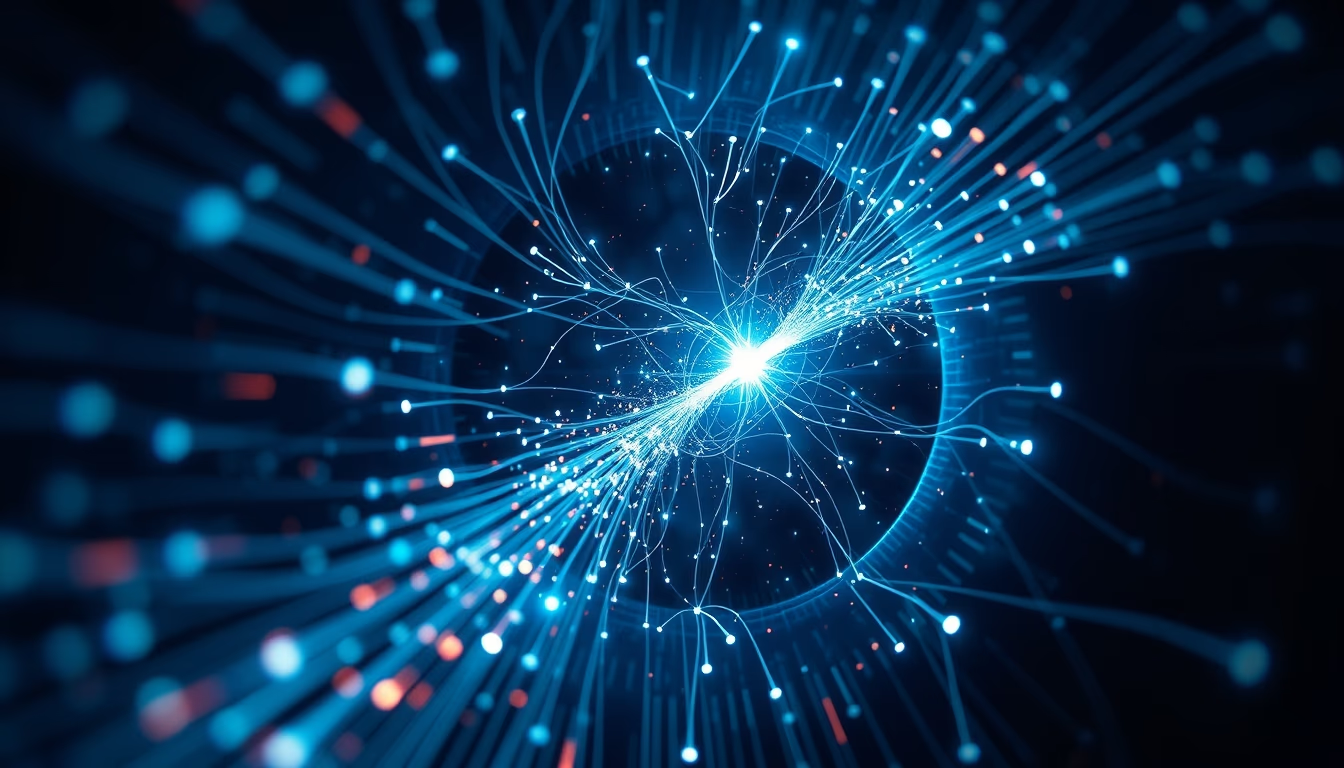
The wave-particle duality of the photon is a fundamental concept in quantum mechanics, revealing that light behaves as both a wave and a particle depending on the experiment.
About this subject
The photon, the quantum of light, is the prime example of wave-particle duality. This principle, established in the early 20th century, states that quantum entities can exhibit both wave-like and particle-like properties. Light, classically described as an electromagnetic wave by Maxwell, also manifests as a particle in phenomena like the photoelectric effect, explained by Einstein in 1905, for which he won the Nobel Prize. In this effect, photons transfer energy to electrons, typical particle behavior.
A landmark experiment is the double-slit setup. When photons are fired one by one at two slits, an interference pattern appears on the screen, characteristic of waves. However, if one slit is closed or a detector identifies which slit the photon went through, the interference pattern disappears and discrete spots appear, as if they were particles. This shows that the act of measurement collapses the wave function, defining the observed behavior.
This duality is not limited to light; it applies to all matter, such as electrons and atoms, following de Broglie's hypothesis (1924). The wavelength associated with a particle is inversely proportional to its momentum. The photon, massless, has momentum p = h/λ, unifying wave and particle natures. This concept underlies quantum mechanics and has applications in lasers, semiconductors, and quantum computing, where superposition of states is exploited.
Curiously, even as particles, photons can be "entangled," sharing quantum states, enabling experiments in teleportation and quantum cryptography. The duality challenges classical intuition but is confirmed by countless experiments, solidifying our understanding of the subatomic world.
Frequently Asked Questions
What is the wave-particle duality of the photon?
Wave-particle duality of the photon is the quantum property that light behaves as a wave in some experiments (like interference) and as a particle in others (like the photoelectric effect).
How does the double-slit experiment demonstrate this duality?
In the double-slit experiment, photons create an interference pattern typical of waves, but if detected individually, they appear as discrete points, revealing particle-like behavior.
Who proposed the existence of the photon?
Albert Einstein proposed the photon in 1905 to explain the photoelectric effect, where light acts as a particle with quantized energy. He received the Nobel Prize for this discovery.
Direct URL
https://pub-c7d6a6ea828543ac903a74a341ccb2e1.r2.dev/imagens/photon-wave-particle-fish-eye-wide-angle-p9.avifHow to credit
Include a visible link back to UtilizAí. Copy one of the snippets below:
<a href="https://xn--utiliza-eza.com/en/midia/imagens/photon-wave-particle-fish-eye-wide-angle-p9">Photon wave particle</a> by <a href="https://xn--utiliza-eza.com">UtilizAí</a>, licensed under <a href="https://creativecommons.org/licenses/by/4.0/">CC BY 4.0</a>.
[Photon wave particle](https://xn--utiliza-eza.com/en/midia/imagens/photon-wave-particle-fish-eye-wide-angle-p9) by [UtilizAí](https://xn--utiliza-eza.com), CC BY 4.0
License: CC-BY-4.0