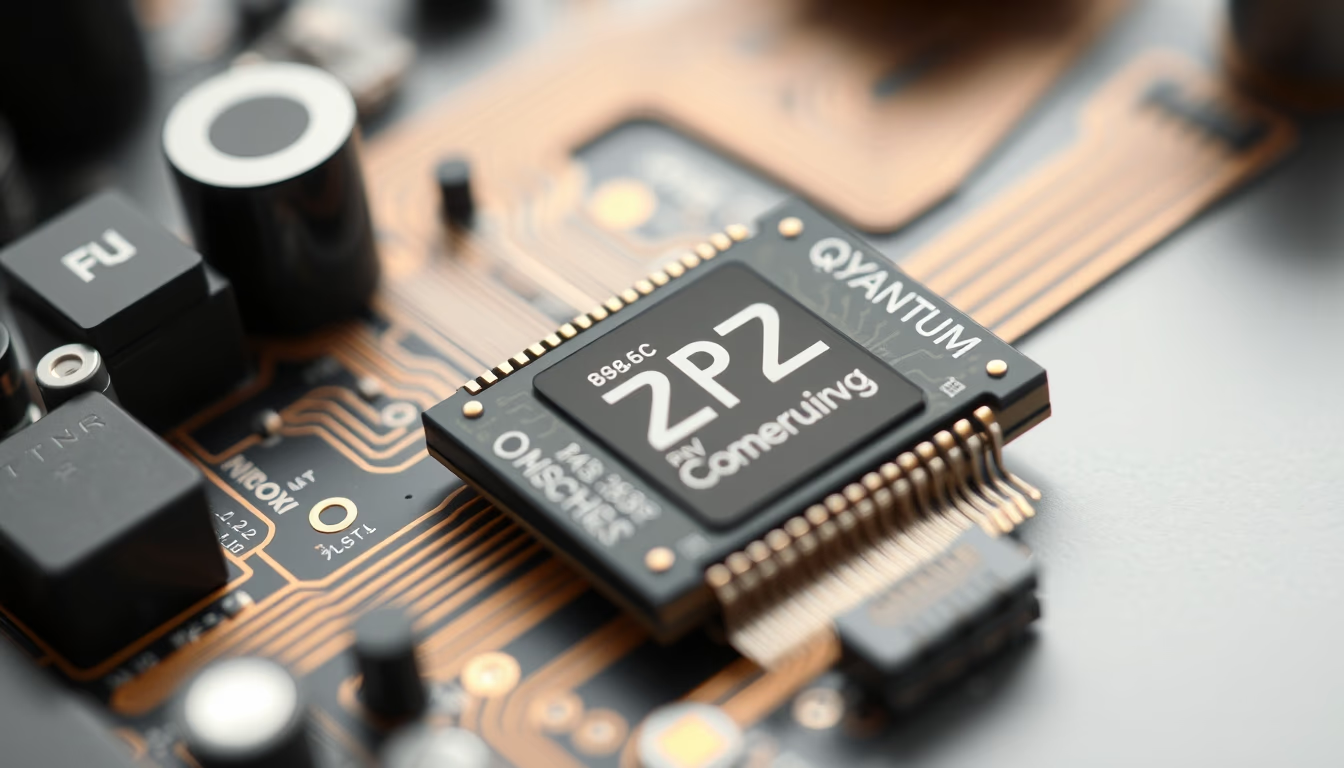
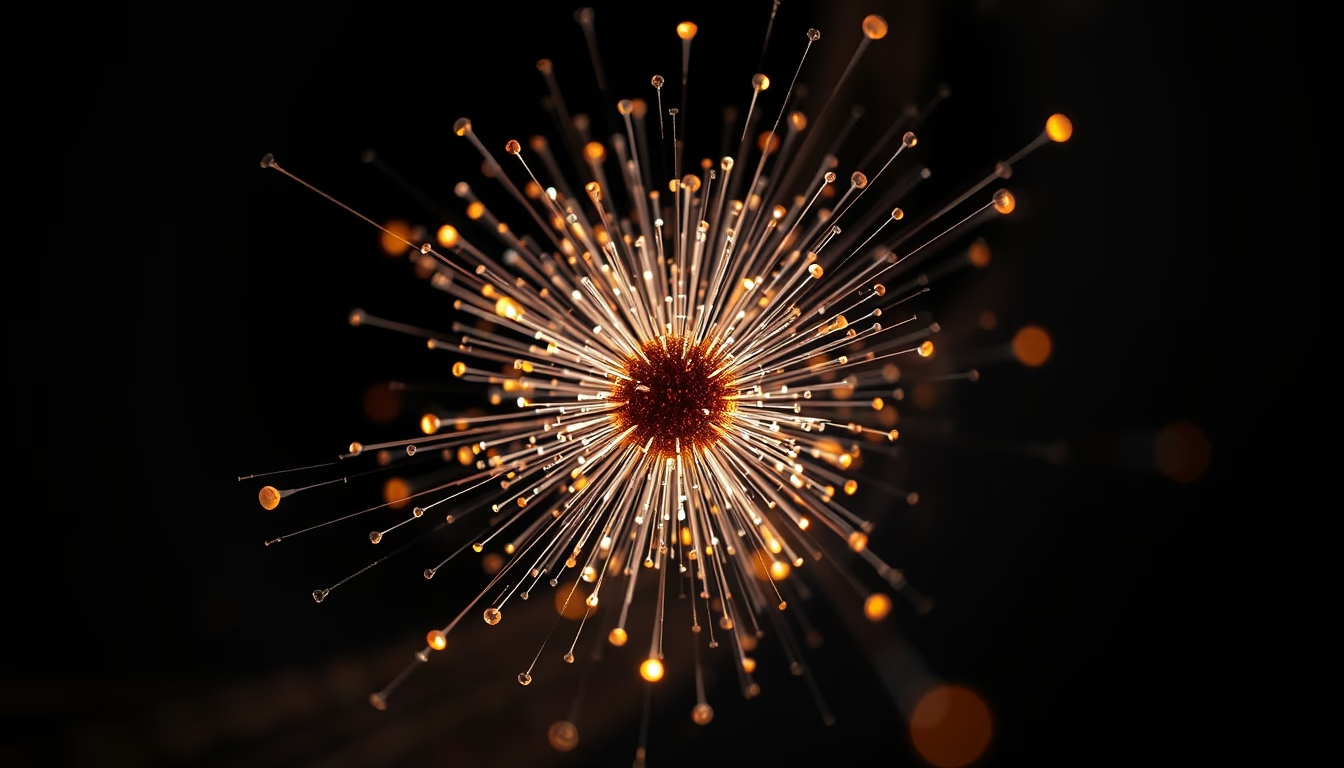
Photon wave particle
1344×768 · AVIF · CC BY 4.0

The photon exhibits wave-particle duality, behaving as both particle and wave, a central phenomenon in quantum mechanics and modern physics.
About this subject
Wave-particle duality is a cornerstone of quantum mechanics, strikingly exemplified by the photon, the quantum of light. This phenomenon implies that light, and other quantum entities, can exhibit characteristics of either localized particles or spread-out waves, depending on the experimental setup. Historically, the debate over light's nature dates back to Isaac Newton (particle theory) and Christiaan Huygens (wave theory). However, it was Albert Einstein who, in 1905, proposed that light consists of discrete quanta (photons) to explain the photoelectric effect. Later, in 1909, he suggested that photons also have a wave aspect. Experimental confirmation came from the double-slit experiment: when light passes through two narrow slits, it produces an interference pattern (wave behavior), but if detected photon by photon, each impact is localized (particle behavior). This puzzling behavior led Niels Bohr to formulate the complementarity principle: wave and particle aspects are complementary and mutually exclusive. Duality is not limited to light; electrons, protons, and other particles also exhibit it. The famous electron double-slit experiment by Claus Jönsson in 1961 demonstrated electron interference. Today, duality underpins technologies such as lasers, semiconductors, and quantum computing. A curious fact: G. I. Taylor's 1909 double-slit experiment with individual photons already produced an interference pattern even at very low intensity, highlighting the probabilistic nature of quantum mechanics.
Frequently Asked Questions
What does it mean for a photon to be both wave and particle?
Not simultaneously: the photon behaves as a wave or particle depending on the measurement. Quantum nature is described by a wavefunction with probabilistic information; the act of measurement forces a specific manifestation.
Which experiment proves the wave-particle duality of the photon?
The double-slit experiment is the most iconic. When light passes through two slits, it forms an interference pattern (wave behavior). If detected photon by photon, each impact is localized, but the accumulated pattern still shows interference.
Does wave-particle duality apply to particles other than photons?
Yes. Electrons, neutrons, and even large molecules have exhibited wave-like behavior in double-slit experiments, confirming that duality is universal in quantum mechanics.
Direct URL
https://pub-c7d6a6ea828543ac903a74a341ccb2e1.r2.dev/imagens/photon-wave-particle-documentary-photography-p11.avifHow to credit
Include a visible link back to UtilizAí. Copy one of the snippets below:
<a href="https://xn--utiliza-eza.com/en/midia/imagens/photon-wave-particle-documentary-photography-p11">Photon wave particle</a> by <a href="https://xn--utiliza-eza.com">UtilizAí</a>, licensed under <a href="https://creativecommons.org/licenses/by/4.0/">CC BY 4.0</a>.
[Photon wave particle](https://xn--utiliza-eza.com/en/midia/imagens/photon-wave-particle-documentary-photography-p11) by [UtilizAí](https://xn--utiliza-eza.com), CC BY 4.0
License: CC-BY-4.0