Periodic table elements glow
1344×768 · AVIF · CC BY 4.0
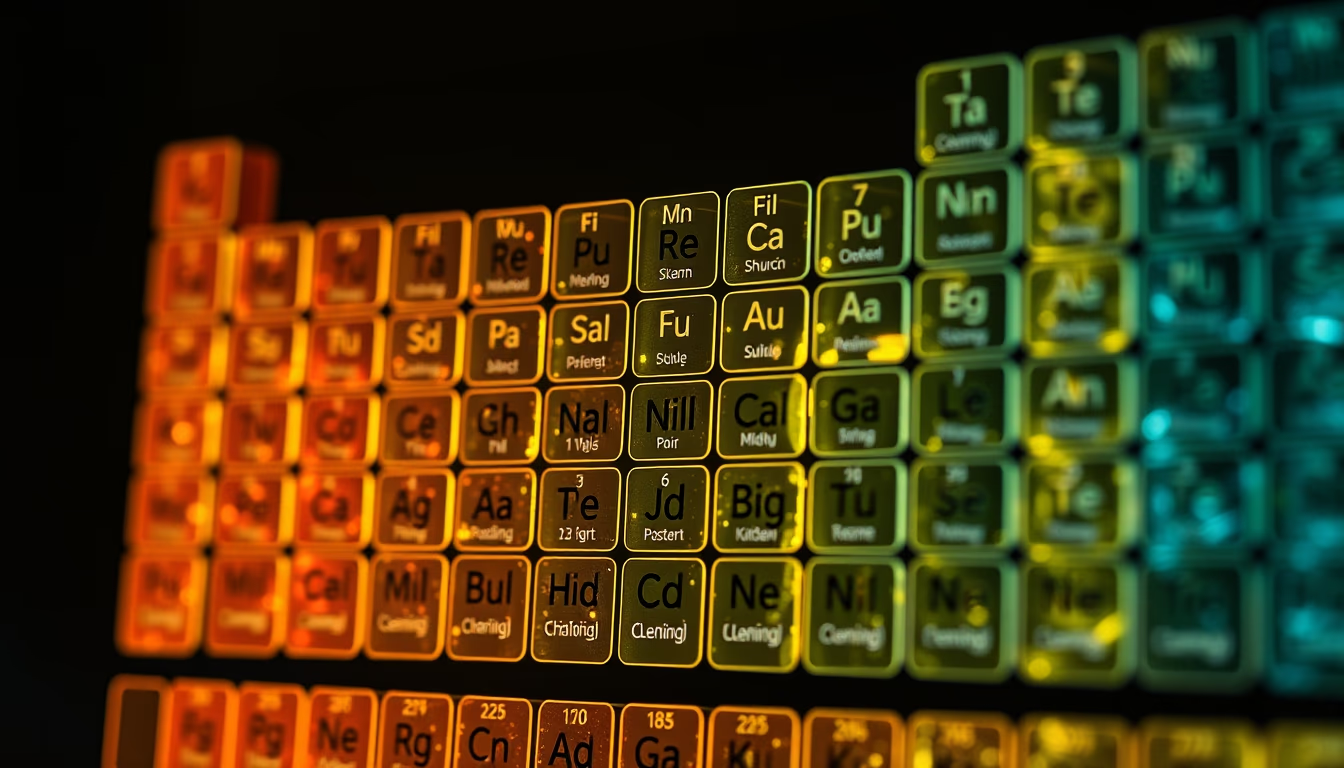
Elements of the periodic table emit vibrant colors when exposed to high temperatures or electrical discharges, a phenomenon explained by quantum physics and widely used in spectroscopy.
About this subject
The colorful glow of chemical elements, observed in flame tests, discharge lamps, or fireworks, results from electronic excitation. When an atom absorbs energy (heat or electricity), its electrons jump to higher energy levels. As they return to the ground state, they release the excess energy as photons of visible light. Each element has a unique set of energy levels, producing a characteristic emission spectrum, such as the green line of copper or the yellow of sodium.
Spectroscopy, the study of these spectra, was crucial for discovering new elements in the 19th century. Robert Bunsen and Gustav Kirchhoff, for example, identified cesium and rubidium by analyzing unknown spectral lines. Today, the technique has applications ranging from astrophysics (determining stellar composition) to medicine (atomic absorption spectrometry for metal analysis in blood).
In the context of the periodic table, elements are organized by atomic number, but their optical properties also follow periodic trends. Alkali metals, such as lithium (carmine red) and potassium (violet), produce intense colors in flames, while halogens like chlorine and fluorine do not emit visible light in such tests because their transitions are in the ultraviolet. Rare earths, like europium and terbium, are known for their luminescence in fluorescent materials, such as those used in TV screens and LED lamps.
Interestingly, the glow of elements has also inspired art and pyrotechnics. Colorful fireworks rely on metallic salts: strontium gives red, barium green, sodium yellow. The purity and safety of chemical compounds are crucial to achieve desired colors without toxic emissions. Thus, the glow of elements is not just a visual spectacle but a phenomenon that connects quantum mechanics, the history of science, and everyday technological applications.
Frequently Asked Questions
Why do different elements emit different colors when heated?
Each element has unique electronic energy levels. When excited, an electron jumps to a higher level and, upon returning, releases a photon with a specific wavelength, determining the observed color.
What is spectroscopy and how does it relate to the glow of elements?
Spectroscopy is the study of the interaction between matter and electromagnetic radiation. It analyzes the spectral lines emitted by elements, enabling the identification of their chemical composition. It was essential for discovering new elements and is now used in astronomy, chemistry, and medicine.
How is the glow of elements used in fireworks?
Specific metal salts are added to pyrotechnic compositions. When burned, the excited metal atoms emit characteristic colors: strontium for red, copper for blue, barium for green, sodium for yellow. The purity of the compounds is crucial for color intensity and uniformity.
Direct URL
https://pub-c7d6a6ea828543ac903a74a341ccb2e1.r2.dev/imagens/periodic-table-elements-glow-national-geographic-style-p3.avifHow to credit
Include a visible link back to UtilizAí. Copy one of the snippets below:
<a href="https://xn--utiliza-eza.com/en/midia/imagens/periodic-table-elements-glow-national-geographic-style-p3">Periodic table elements glow</a> by <a href="https://xn--utiliza-eza.com">UtilizAí</a>, licensed under <a href="https://creativecommons.org/licenses/by/4.0/">CC BY 4.0</a>.
[Periodic table elements glow](https://xn--utiliza-eza.com/en/midia/imagens/periodic-table-elements-glow-national-geographic-style-p3) by [UtilizAí](https://xn--utiliza-eza.com), CC BY 4.0
License: CC-BY-4.0