Periodic table elements glow
1344×768 · AVIF · CC BY 4.0
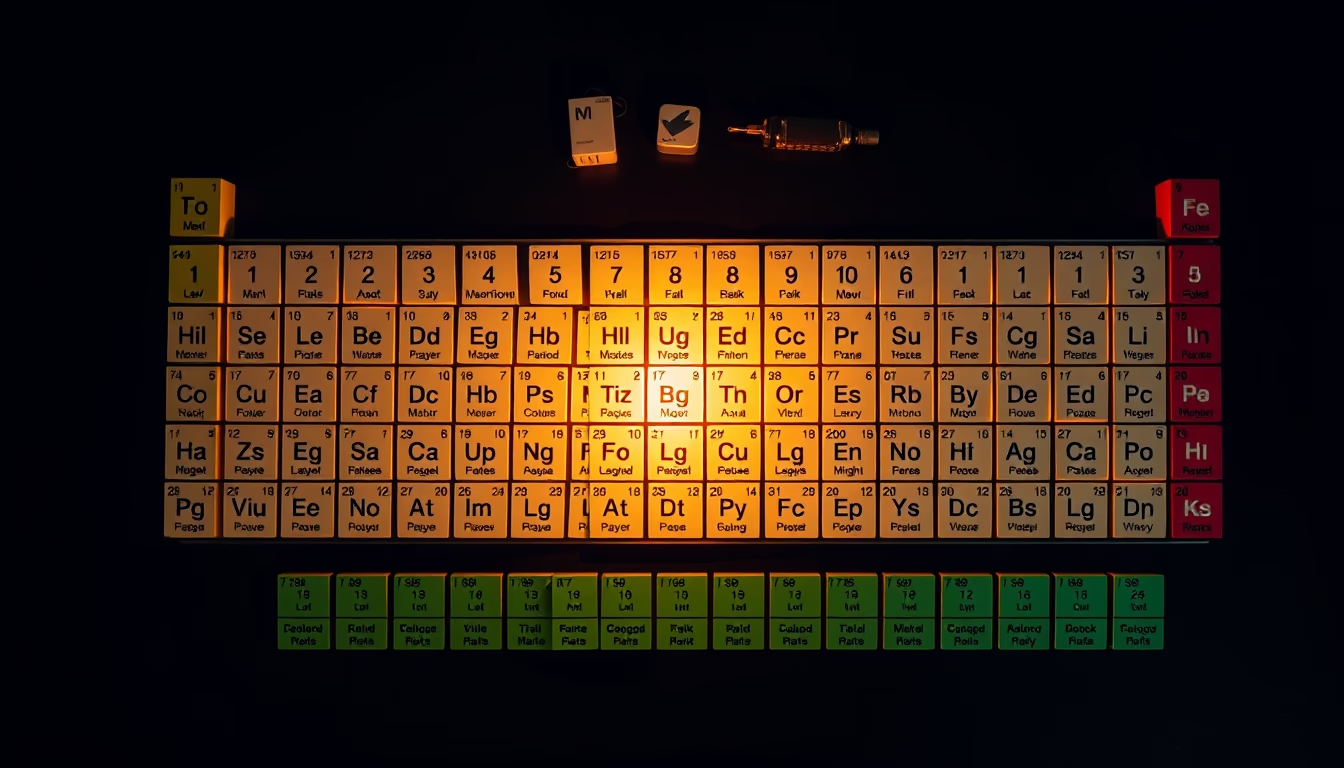
Chemical elements that glow in the dark reveal fascinating properties of matter, from luminescence to technological applications.
About this subject
The glow emitted by certain chemical elements in the dark is a phenomenon known as luminescence, which includes fluorescence and phosphorescence. In the periodic table, elements such as phosphorus (P), radium (Ra), and rare earths like europium (Eu) and terbium (Tb) are famous for their ability to emit light after absorbing energy. Phosphorus, for instance, was discovered in the 17th century and its name derives from Greek “light-bearer”, due to its property of glowing when exposed to oxygen. Radium, a radioactive element discovered by Marie Curie, emits a continuous blue-green glow due to its nuclear decay.
Luminescence has essential practical applications. In safety, zinc sulfide paints activated with copper or silver are used in emergency exits and watch dials. In medicine, europium and terbium compounds are employed as fluorescent markers for imaging tests. In television screens and monitors, phosphors (luminescent substances) convert ultraviolet radiation into visible light, creating the colors we see. The efficiency of these materials depends on the crystal structure and controlled impurities, called activators.
The periodic table organizes elements by properties, but luminescence does not follow a simple trend. Transition metals and lanthanides concentrate most luminescent elements. Neodymium and dysprosium, for example, are used in high-power lasers. Modern research seeks new luminescent materials for white LEDs and solar cells, exploring quantum dots and perovskites. The glow of elements is not merely aesthetic: it reveals information about electronic energy levels and quantum transitions.
Interestingly, bioluminescence in living organisms, such as fireflies and jellyfish, also involves chemical reactions that produce cold light. Although not a pure element, luciferin and the enzyme luciferase are studied for applications in biosensors. Thus, the glow in the periodic table connects inorganic chemistry to biology and everyday technology.
Frequently Asked Questions
Why do some elements glow in the dark?
They glow due to luminescence, a process where they absorb energy (light or radiation) and re-emit it as visible light. In fluorescence, the glow stops when the energy source is removed; in phosphorescence, it persists longer.
Which elements in the periodic table are known to glow?
Phosphorus (P), radium (Ra), europium (Eu), terbium (Tb), dysprosium (Dy), and many lanthanides. Compounds like zinc sulfide (ZnS) are also widely used in luminescent applications.
How is luminescence used in everyday life?
In safety paints, watch dials, TV and monitor screens (phosphors), fluorescent lamps, white LEDs, and biomedical markers for imaging tests.
Direct URL
https://pub-c7d6a6ea828543ac903a74a341ccb2e1.r2.dev/imagens/periodic-table-elements-glow-isometric-flat-lay-p10.avifHow to credit
Include a visible link back to UtilizAí. Copy one of the snippets below:
<a href="https://xn--utiliza-eza.com/en/midia/imagens/periodic-table-elements-glow-isometric-flat-lay-p10">Periodic table elements glow</a> by <a href="https://xn--utiliza-eza.com">UtilizAí</a>, licensed under <a href="https://creativecommons.org/licenses/by/4.0/">CC BY 4.0</a>.
[Periodic table elements glow](https://xn--utiliza-eza.com/en/midia/imagens/periodic-table-elements-glow-isometric-flat-lay-p10) by [UtilizAí](https://xn--utiliza-eza.com), CC BY 4.0
License: CC-BY-4.0