Pcie expansion slot
1344×768 · AVIF · CC BY 4.0
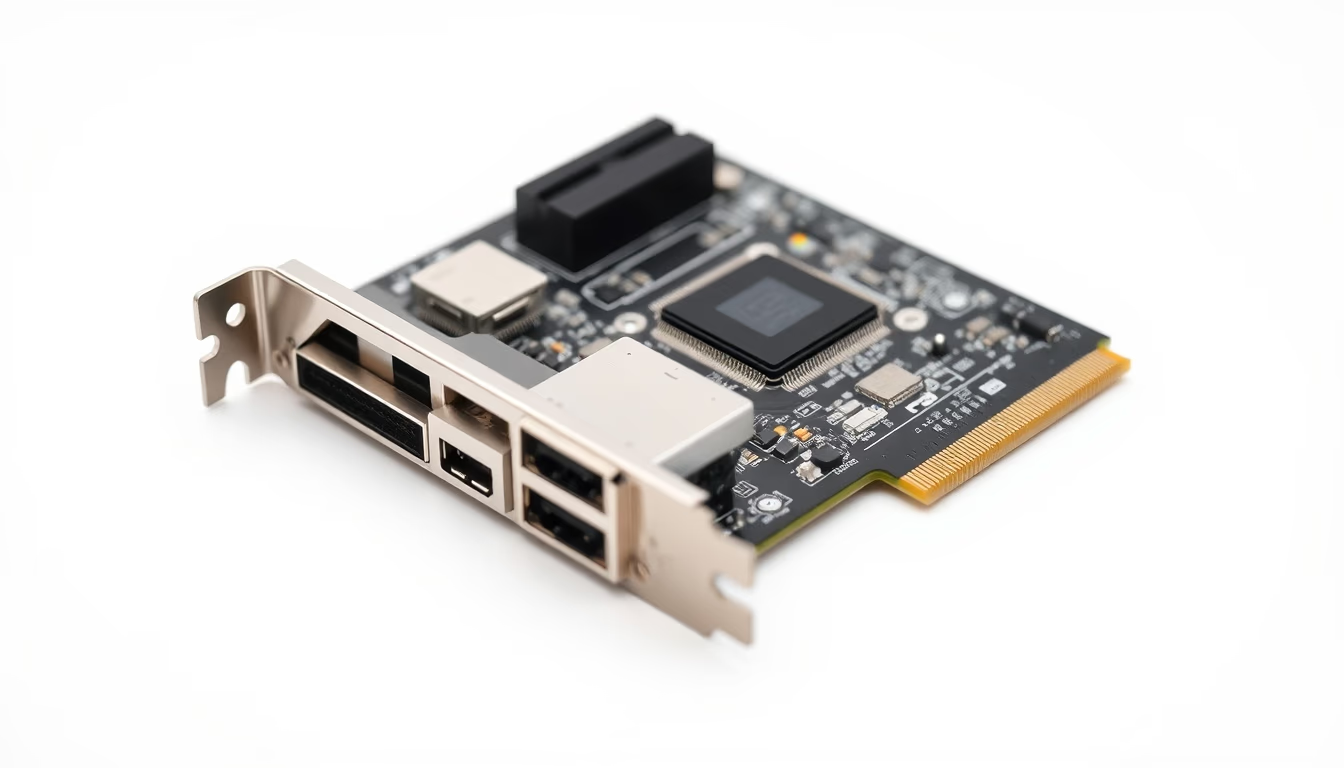
The PCI Express (PCIe) expansion slot is the current standard for connecting high-performance cards, such as GPUs and NVMe SSDs, to motherboards.
About this subject
PCI Express (PCIe) was introduced in 2003 by Intel to replace PCI and AGP buses, offering higher bandwidth and a point-to-point topology. A PCIe slot can have different numbers of lanes, such as x1, x4, x8, and x16. Each lane consists of two differential pairs, one for transmission and one for reception, enabling full-duplex communication. The number of lanes determines the slot's total bandwidth: a x16 slot provides 16 times the capacity of a x1 slot.
PCIe versions have evolved rapidly. Generation 1.0 provided 250 MB/s per lane, while generation 5.0 already reaches 4 GB/s per lane. Modern motherboards support PCIe 4.0 and 5.0, and the 6.0 specification is under development, targeting 8 GB/s per lane. This scalability allows peripherals like graphics cards, NVMe controllers, and 10G/100G network interfaces to operate efficiently.
PCIe is ubiquitous in personal computers, servers, and embedded systems. In gaming desktops and workstations, x16 slots are used for GPUs, while smaller slots (x1, x4) accommodate sound cards, capture cards, and SSDs. In servers, RAID controllers and NICs often use x8 slots. Backward compatibility is a key advantage: a PCIe 4.0 card works in a 3.0 slot, though limited to the slot's generation. Hot-plug capabilities are supported in advanced configurations, allowing card replacement without powering down the system.
Frequently Asked Questions
What is the difference between PCIe x16 and x8?
A x16 slot has 16 lanes and offers higher bandwidth (up to 64 GB/s on PCIe 5.0), ideal for GPUs and accelerators. A x8 slot has 8 lanes and half the bandwidth, used for RAID controllers and network cards. A card designed for x16 can work in a x8 slot, but with reduced performance.
What PCIe versions exist and how to identify them?
The main versions are PCIe 1.0, 2.0, 3.0, 4.0, and 5.0. Version 6.0 is upcoming. The generation can be identified via motherboard documentation or software like GPU-Z. Each newer version doubles the bandwidth per lane compared to the previous one.
What does 'lane' mean in PCIe?
A lane is a pair of data wires (transmit and receive) operating in full-duplex. The number of lanes (x1, x4, x8, x16) determines the slot's total bandwidth. For example, PCIe 3.0 x1 provides about 1 GB/s in each direction.
Direct URL
https://pub-c7d6a6ea828543ac903a74a341ccb2e1.r2.dev/imagens/pcie-expansion-slot-commercial-product-photography-p7.avifHow to credit
Include a visible link back to UtilizAí. Copy one of the snippets below:
<a href="https://xn--utiliza-eza.com/en/midia/imagens/pcie-expansion-slot-commercial-product-photography-p7">Pcie expansion slot</a> by <a href="https://xn--utiliza-eza.com">UtilizAí</a>, licensed under <a href="https://creativecommons.org/licenses/by/4.0/">CC BY 4.0</a>.
[Pcie expansion slot](https://xn--utiliza-eza.com/en/midia/imagens/pcie-expansion-slot-commercial-product-photography-p7) by [UtilizAí](https://xn--utiliza-eza.com), CC BY 4.0
License: CC-BY-4.0