Pcie expansion slot
1344×768 · AVIF · CC BY 4.0
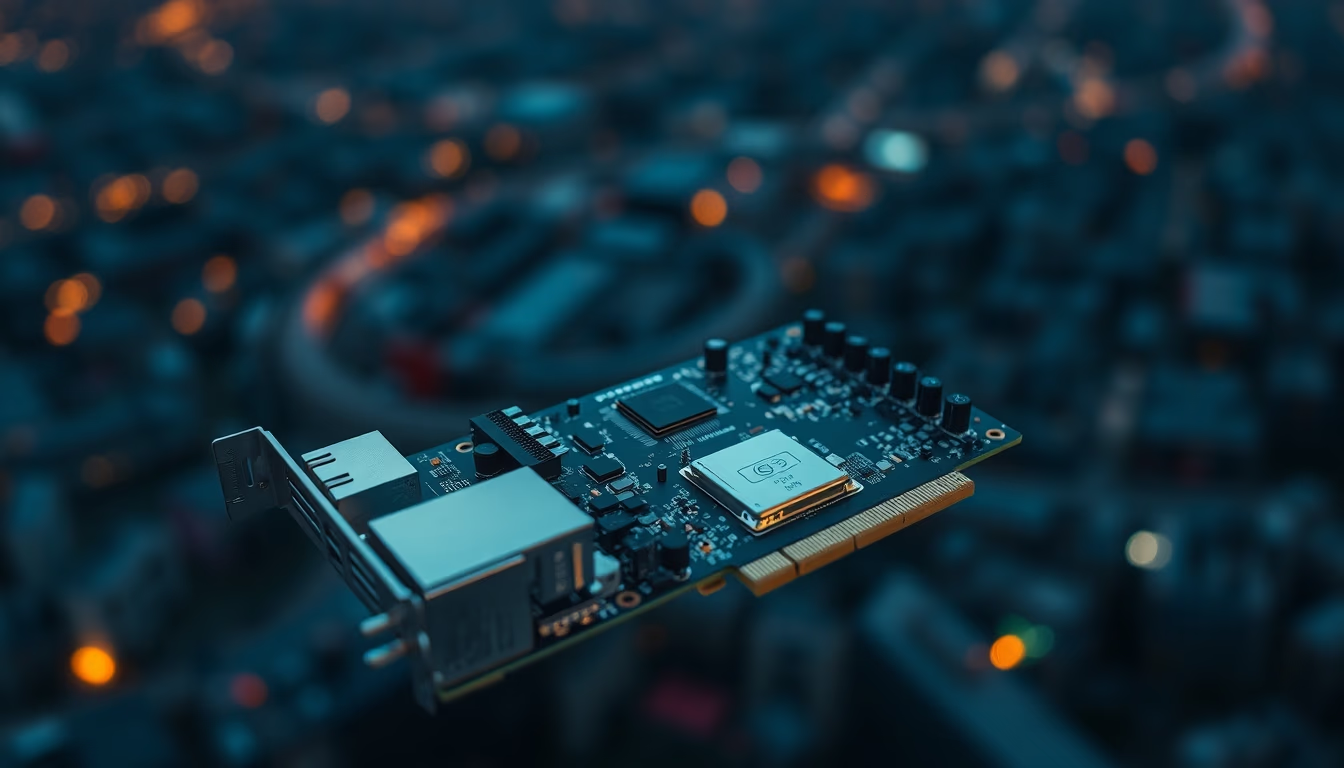
PCIe expansion slot: the standard interface for graphics cards and other add-in boards. Learn about its versions, lane configurations, and uses.
About this subject
The PCI Express (PCIe) expansion slot is the standard interface on computer motherboards for connecting high-performance peripherals such as graphics cards, NVMe SSDs, network cards, and additional controllers. Introduced by Intel in 2003, PCIe replaced the older PCI and AGP buses, offering greater bandwidth and a point-to-point topology.
Each PCIe slot consists of one or more lanes, each containing two wire pairs for data transmission and reception. Common configurations include x1, x4, x8, and x16, with x16 typically used for graphics cards. Bandwidth doubled with each generation: PCIe 1.0 provides 250 MB/s per lane, while PCIe 5.0 reaches 2 GB/s per lane. As of 2025, PCIe 5.0 is current, with PCIe 6.0 under development.
PCIe versatility extends beyond desktops, being used in servers, laptops (miniaturized versions like M.2), and even gaming consoles. Backward compatibility exists across generations, though performance is limited by the older standard. Factors like trace length and signal quality affect performance at high speeds.
Interesting fact: the PCIe specification supports hot-plugging and can deliver up to 75W power through the x16 slot, eliminating extra cables for many expansion cards. However, modern graphics cards still require dedicated power supplies. The evolution to PCIe 6.0 promises PAM-4 signaling and low latency, ensuring the bus's relevance for decades to come.
Frequently Asked Questions
What is the difference between PCIe x1, x4, x8, and x16?
The number indicates the number of lanes. More lanes provide higher bandwidth. Graphics cards typically use x16, while network or sound cards use x1 or x4. Larger slots can accept smaller cards, but not the other way around.
Can I use a PCIe 4.0 card in a PCIe 3.0 slot?
Yes. PCIe is backward compatible. The card will work at the maximum speed supported by the slot, i.e., PCIe 3.0 speeds. The same applies to newer versions: a 5.0 card in a 3.0 slot runs at 3.0.
How can I identify the PCIe generation of a slot on my motherboard?
Check the motherboard manual or manufacturer. On Windows, utilities like GPU-Z or HWiNFO can help. Physically, slots of different generations may have minor differences, but there is no universal visual identification standard.
Direct URL
https://pub-c7d6a6ea828543ac903a74a341ccb2e1.r2.dev/imagens/pcie-expansion-slot-aerial-drone-shot-p2.avifHow to credit
Include a visible link back to UtilizAí. Copy one of the snippets below:
<a href="https://xn--utiliza-eza.com/en/midia/imagens/pcie-expansion-slot-aerial-drone-shot-p2">Pcie expansion slot</a> by <a href="https://xn--utiliza-eza.com">UtilizAí</a>, licensed under <a href="https://creativecommons.org/licenses/by/4.0/">CC BY 4.0</a>.
[Pcie expansion slot](https://xn--utiliza-eza.com/en/midia/imagens/pcie-expansion-slot-aerial-drone-shot-p2) by [UtilizAí](https://xn--utiliza-eza.com), CC BY 4.0
License: CC-BY-4.0