Patch cable bundle
1344×768 · AVIF · CC BY 4.0
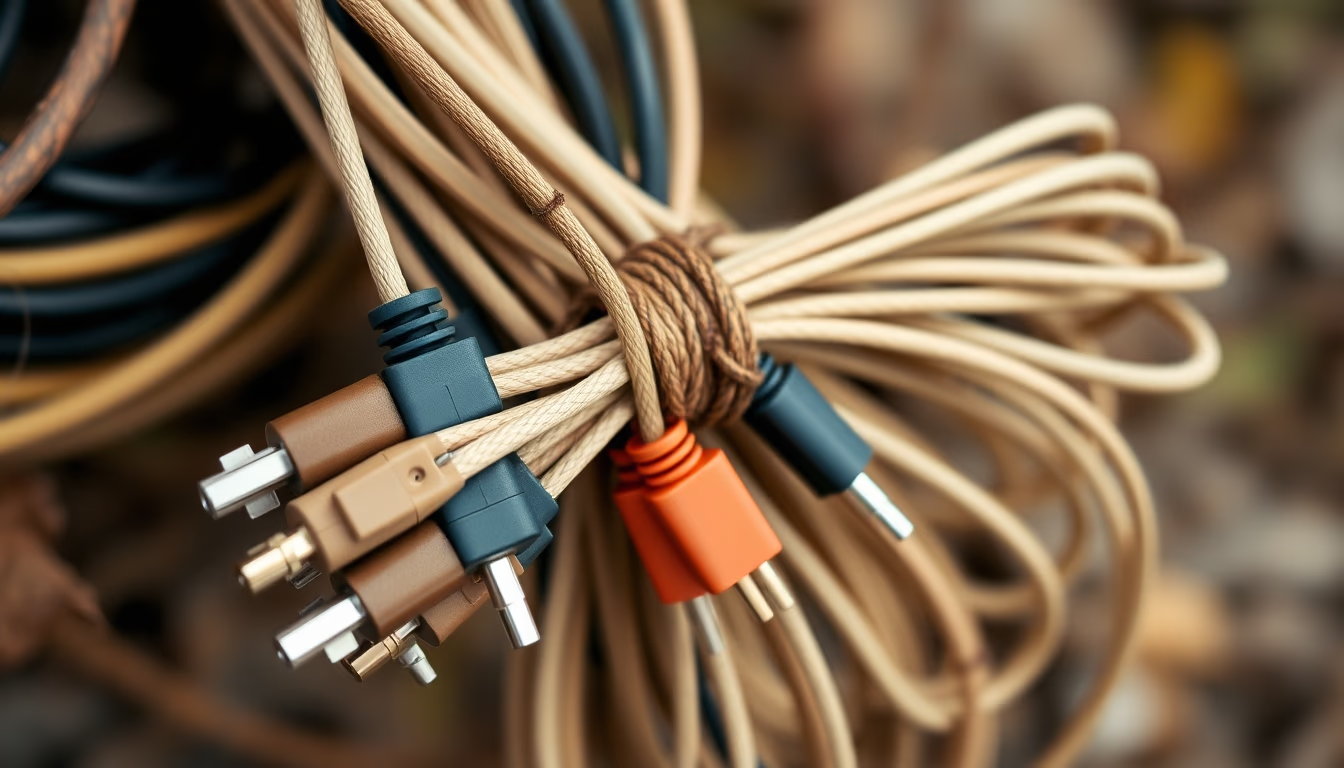
Patch cables are essential for connecting devices in local area networks, ensuring fast and stable data transmission.
About this subject
Patch cables, also known as network cables or patch cords, are short twisted-pair cables used to connect network devices such as computers, switches, and routers. They are a fundamental part of local area network (LAN) infrastructure, responsible for data transmission between active equipment. Different categories, such as Cat5e, Cat6, and Cat6a, support speeds ranging from 1 Gbps to 10 Gbps, with frequencies up to 500 MHz. The choice of category depends on the application: Cat5e is sufficient for common home networks, while Cat6a is recommended for corporate environments requiring greater bandwidth.
Creating a bundle of patch cables is common in data centers and server racks, where dozens or hundreds of cables need to be organized to avoid tangles and facilitate maintenance. Cable management techniques, such as using Velcro straps, raceways, and trays, help maintain organization and proper airflow. Patch cable lengths typically range from 0.5 to 10 meters, with 1 to 3 meters being the most common for nearby connections.
An important detail is that although patch cables are manufactured with RJ45 connectors, shielding can vary: UTP (unshielded) is widely used in residential projects, while FTP or STP (shielded) are preferred in environments with electromagnetic interference. Cable colors also have meaning in professional installations: for example, blue for data, green for local network, and yellow for security. This standardization aids visual identification in large infrastructures.
The future of patch cables includes the transition to faster standards like Cat8, supporting up to 40 Gbps over short distances. Despite the advancement of Wi-Fi, patch cables remain irreplaceable for applications requiring low latency and high reliability, such as online gaming, 4K streaming, and corporate servers.
Frequently Asked Questions
What is the difference between Cat5e and Cat6 cables?
Cat5e supports up to 1 Gbps over 100 meters, while Cat6 can reach up to 10 Gbps over shorter distances (up to 55 meters for 10 Gbps). Cat6 offers better shielding against interference.
Can I use different colored patch cables in the same rack?
Yes, it is common to use standardized colors to identify functions: blue for data, green for local network, yellow for security, red for VoIP, among others.
Are shielded patch cables (STP) always better than UTP?
Not necessarily. STP is better in environments with high electromagnetic interference, but it is stiffer and more expensive. For typical home use, UTP is sufficient and more flexible.
Direct URL
https://pub-c7d6a6ea828543ac903a74a341ccb2e1.r2.dev/imagens/patch-cable-bundle-documentary-nature-style-fresh5.avifHow to credit
Include a visible link back to UtilizAí. Copy one of the snippets below:
<a href="https://xn--utiliza-eza.com/en/midia/imagens/patch-cable-bundle-documentary-nature-style-fresh5">Patch cable bundle</a> by <a href="https://xn--utiliza-eza.com">UtilizAí</a>, licensed under <a href="https://creativecommons.org/licenses/by/4.0/">CC BY 4.0</a>.
[Patch cable bundle](https://xn--utiliza-eza.com/en/midia/imagens/patch-cable-bundle-documentary-nature-style-fresh5) by [UtilizAí](https://xn--utiliza-eza.com), CC BY 4.0
License: CC-BY-4.0