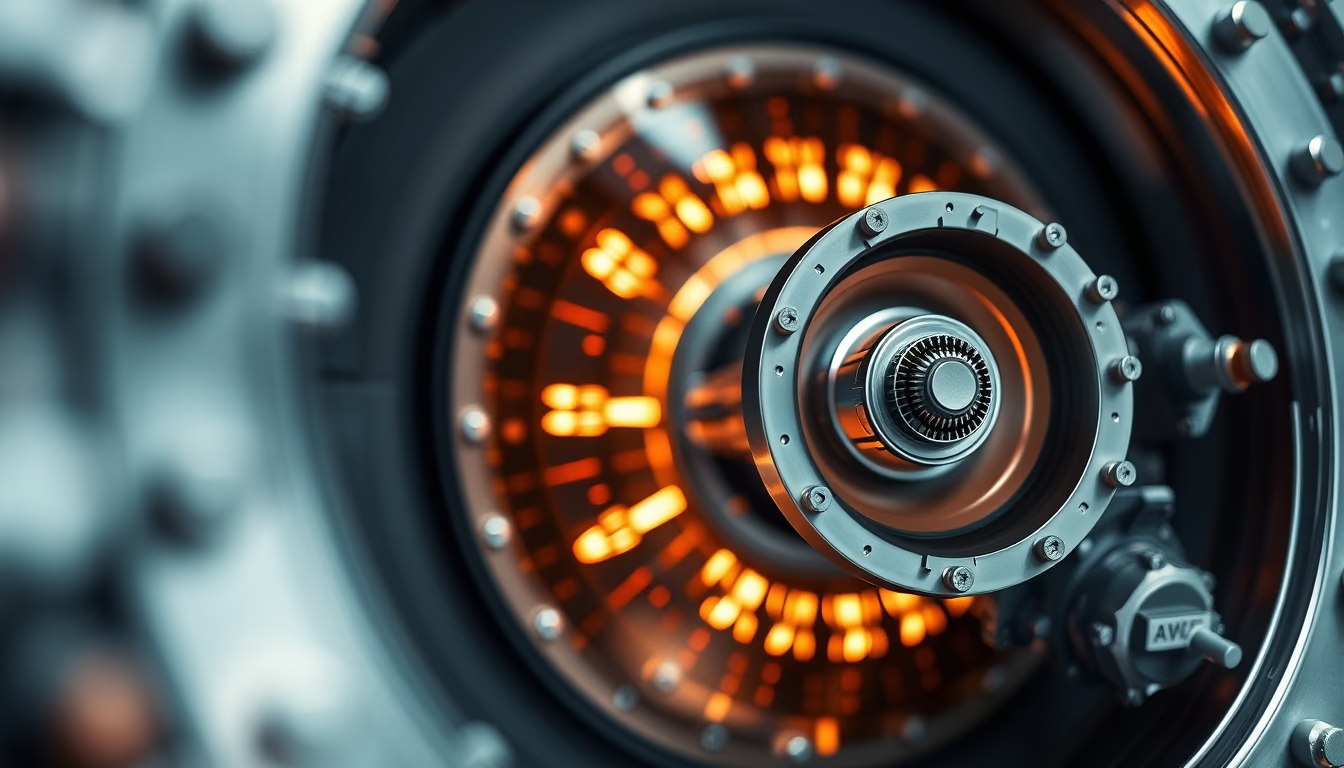
Particle accelerator interior cern
1344×768 · AVIF · CC BY 4.0
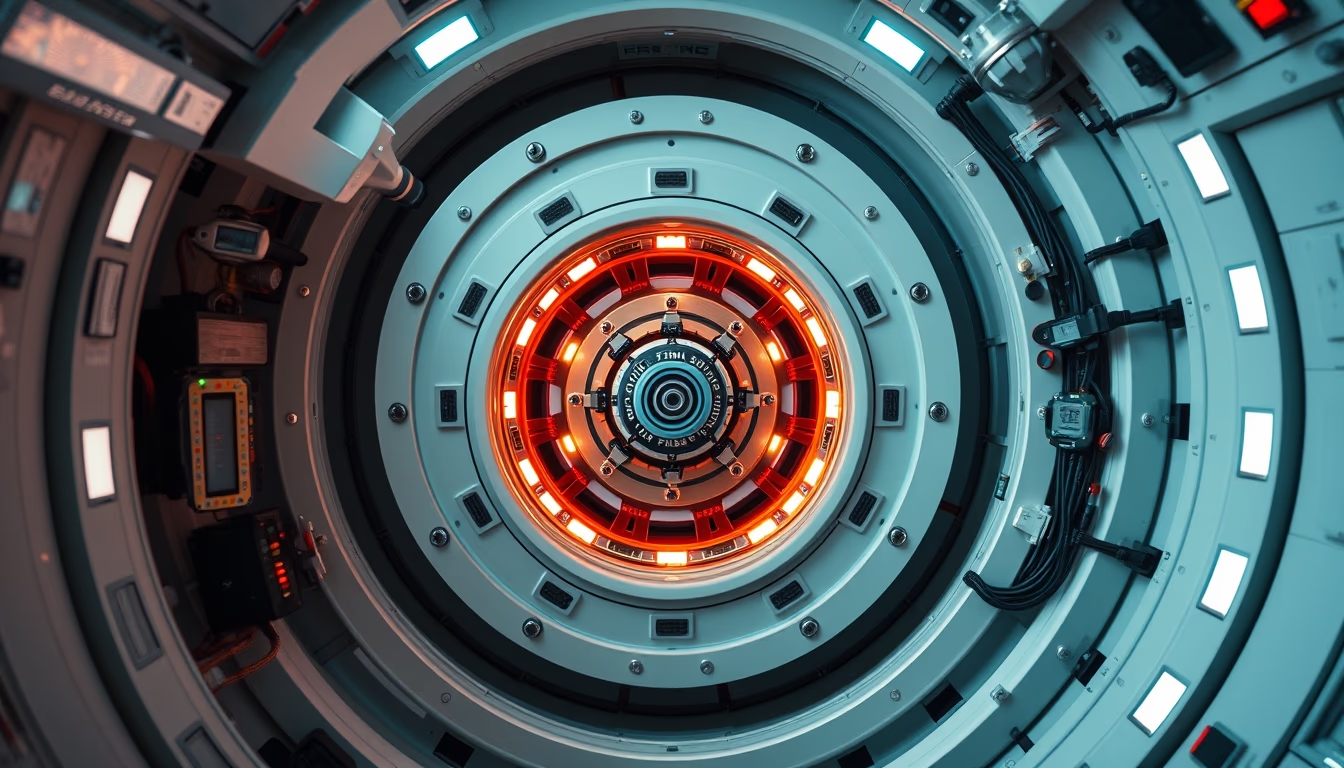
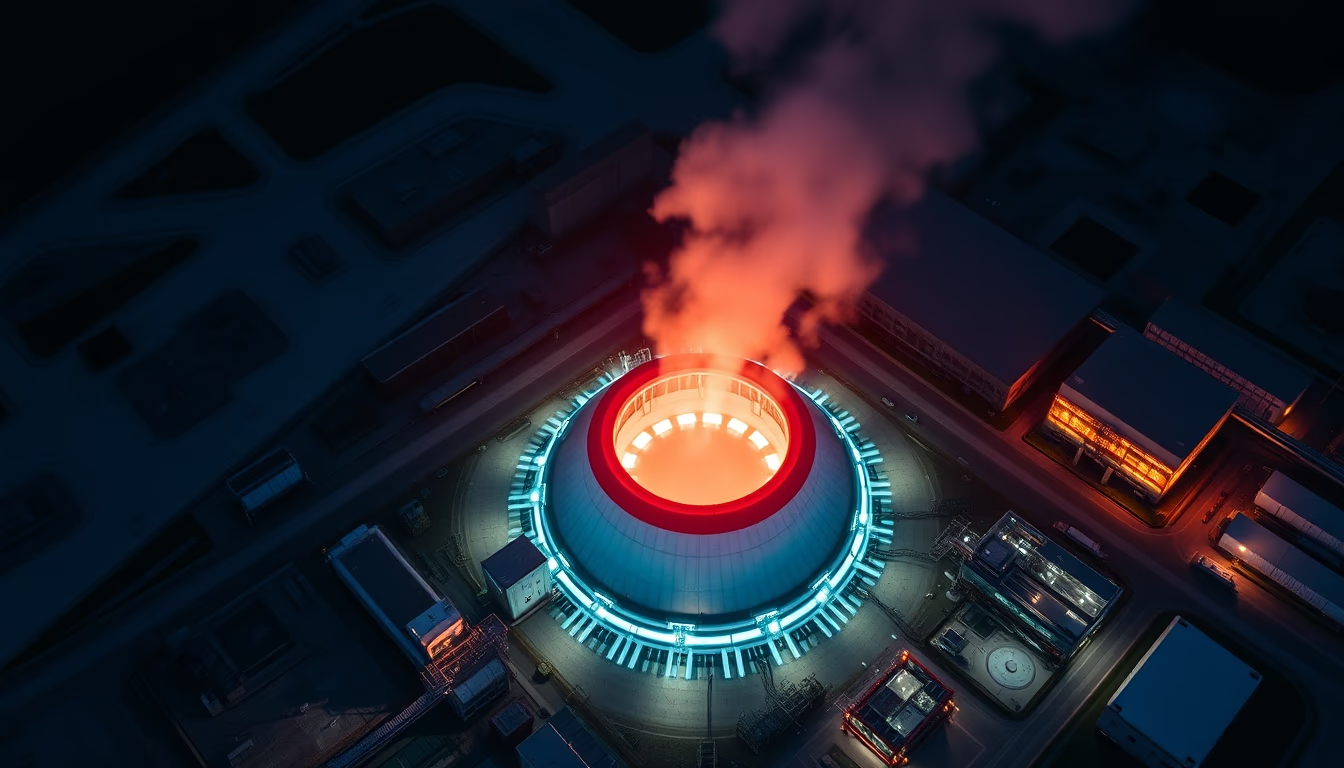
The interior of CERN's Large Hadron Collider (LHC) reveals the complexity of detectors and superconducting magnets that accelerate particles to near-light speeds.
About this subject
Located on the border between France and Switzerland, CERN houses the world's largest and most powerful particle accelerator: the Large Hadron Collider (LHC). With a 27-kilometer circular tunnel buried about 100 meters underground, its interior is an environment of extreme engineering. Over 9,000 superconducting magnets, cooled to temperatures lower than outer space (-271.3 °C), guide beams of protons or heavy ions in opposite directions, accelerating them to 99.9999991% of the speed of light.
Inside the LHC, four massive detectors, ATLAS, CMS, ALICE, and LHCb, record head-on collisions between particles. Each detector is a complex structure the size of a multi-story building, composed of layers of sensors, calorimeters, and muon chambers. They capture the subatomic fragments produced in collisions that occur 40 million times per second, generating petabytes of data analyzed by a global grid of computers.
The LHC's discoveries have revolutionized particle physics. In 2012, the ATLAS and CMS experiments announced the observation of the Higgs boson, the particle that gives mass to other fundamental particles, completing the Standard Model. Additionally, the LHC investigates dark matter, matter-antimatter asymmetry, and the quark-gluon plasma, recreating conditions of the early universe just after the Big Bang.
Maintaining and operating the tunnel requires millimeter precision and ultra-high vacuum systems equivalent to the vacuum on the lunar surface. CERN collaborates with over 10,000 scientists from 100 countries, making the LHC one of the largest scientific endeavors in human history.
Frequently Asked Questions
What is the LHC and where is it located?
The LHC is the world's largest particle accelerator, located at CERN on the border between France and Switzerland, in a 27 km circular tunnel.
What was the main discovery of the LHC?
In 2012, the LHC confirmed the existence of the Higgs boson, a fundamental particle predicted by the Standard Model of particle physics.
How do the LHC detectors work?
The detectors record particle collisions, capturing data on generated particles such as energy, momentum, and trajectory using layers of specialized sensors.
Direct URL
https://pub-c7d6a6ea828543ac903a74a341ccb2e1.r2.dev/imagens/particle-accelerator-interior-cern-isometric-flat-lay-p12.avifHow to credit
Include a visible link back to UtilizAí. Copy one of the snippets below:
<a href="https://xn--utiliza-eza.com/en/midia/imagens/particle-accelerator-interior-cern-isometric-flat-lay-p12">Particle accelerator interior cern</a> by <a href="https://xn--utiliza-eza.com">UtilizAí</a>, licensed under <a href="https://creativecommons.org/licenses/by/4.0/">CC BY 4.0</a>.
[Particle accelerator interior cern](https://xn--utiliza-eza.com/en/midia/imagens/particle-accelerator-interior-cern-isometric-flat-lay-p12) by [UtilizAí](https://xn--utiliza-eza.com), CC BY 4.0
License: CC-BY-4.0