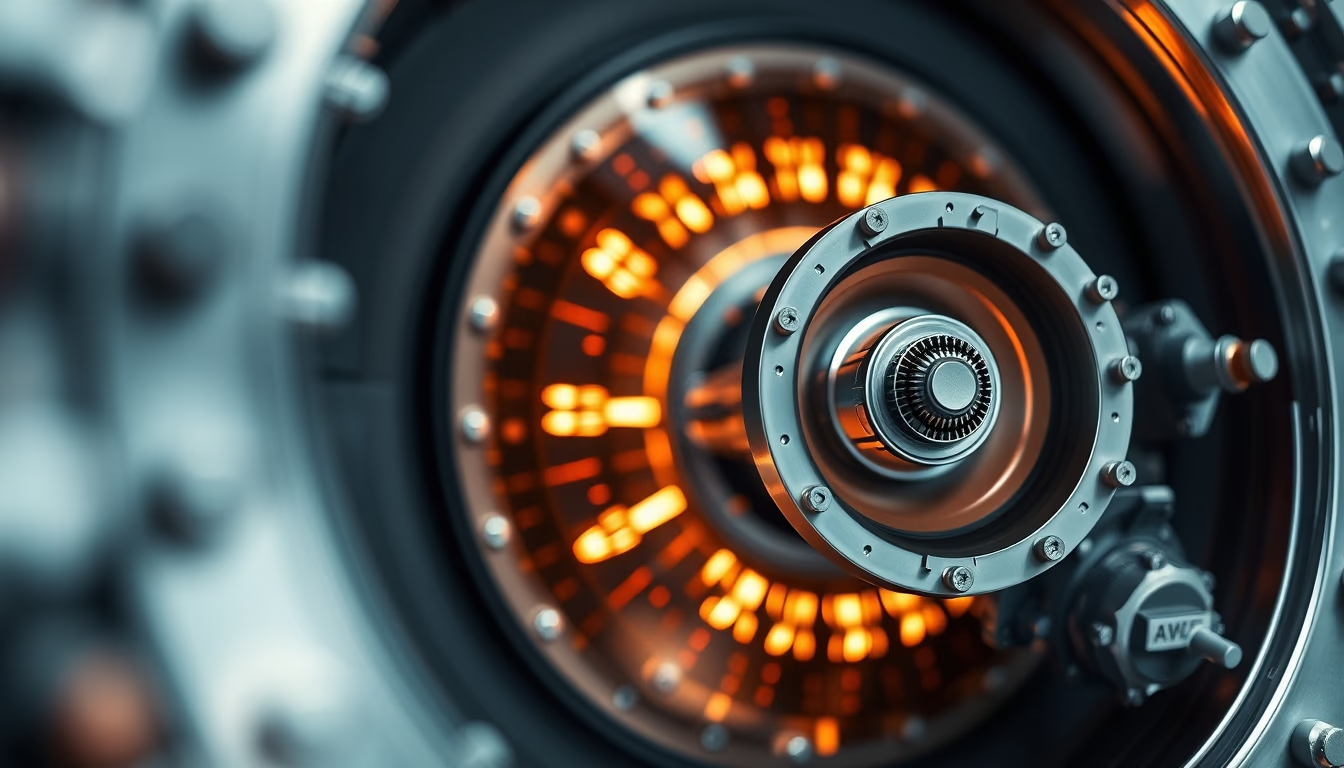
Particle accelerator interior cern
1344×768 · AVIF · CC BY 4.0

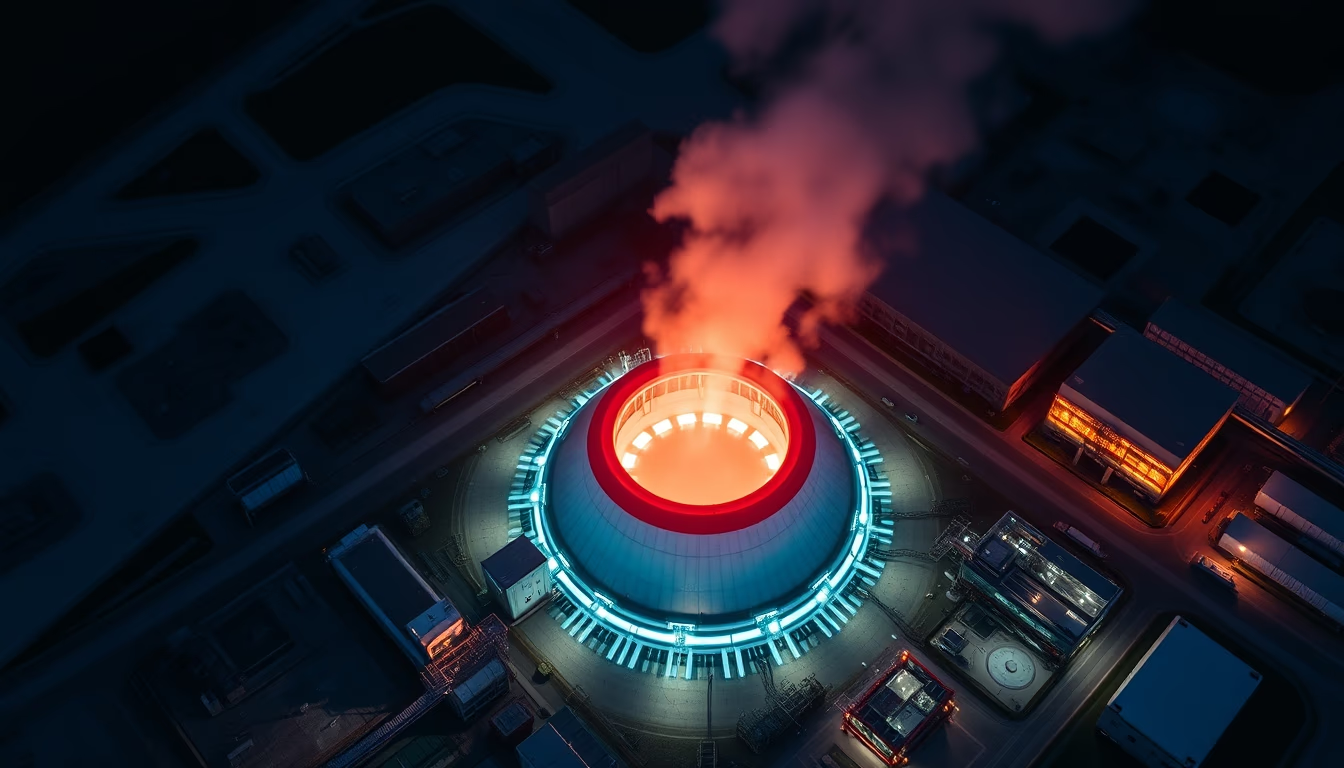
The interior of CERN's Large Hadron Collider, the world's largest particle accelerator, reveals the complexity of modern particle physics.
About this subject
The Large Hadron Collider (LHC) at CERN, located on the border between France and Switzerland, is the largest and most powerful particle accelerator ever built. Its circular tunnel measures 27 kilometers in circumference, buried about 100 meters underground. Inside, beams of protons or heavy ions are accelerated to near light speed, guided by over 9,600 superconducting magnets cooled to temperatures below -271°C. This extreme environment allows scientists to recreate conditions similar to those just after the Big Bang.
Particle collisions at the LHC generate data analyzed by scientists worldwide, leading to fundamental discoveries such as the Higgs boson in 2012. Each experiment inside the accelerator tracks particle paths, energy, and momentum using detectors like ATLAS, CMS, ALICE, and LHCb. The complex also includes smaller accelerators that feed the LHC, such as the Proton Synchrotron and the Super Proton Synchrotron, forming an injection chain.
The construction cost about 4.6 billion euros and involved over 10,000 scientists and engineers from 100 countries. Operating the collider requires energy consumption equivalent to that of a small city, plus cryogenic systems using liquid helium to cool the magnets. Despite technical challenges, the LHC remains central to particle physics, with planned upgrades to increase its luminosity by 2029.
The interior of the accelerator is not open to the public for safety reasons, but visitors can see full-scale replicas at CERN's visitor centers. This meticulously engineered environment symbolizes the frontier of human knowledge, where theory and engineering unite to explore the fundamental laws of nature.
Frequently Asked Questions
What is CERN and what is its main function?
CERN, the European Organization for Nuclear Research, is the world's largest particle physics laboratory. Its main function is to operate accelerators like the LHC to study fundamental particles and the forces that govern them.
How does CERN's particle accelerator achieve such high speeds?
Using oscillating electric fields in radio-frequency cavities and magnetic fields from superconducting magnets, particles gain energy with each lap around the tunnel, reaching speeds close to light.
What are the major discoveries made with the LHC?
The most famous discovery is the Higgs boson in 2012, confirming the mechanism that gives particles mass. Other results include studies on dark matter, quark-gluon plasma, and precise tests of the Standard Model.
Direct URL
https://pub-c7d6a6ea828543ac903a74a341ccb2e1.r2.dev/imagens/particle-accelerator-interior-cern-film-grain-authentic-p8.avifHow to credit
Include a visible link back to UtilizAí. Copy one of the snippets below:
<a href="https://xn--utiliza-eza.com/en/midia/imagens/particle-accelerator-interior-cern-film-grain-authentic-p8">Particle accelerator interior cern</a> by <a href="https://xn--utiliza-eza.com">UtilizAí</a>, licensed under <a href="https://creativecommons.org/licenses/by/4.0/">CC BY 4.0</a>.
[Particle accelerator interior cern](https://xn--utiliza-eza.com/en/midia/imagens/particle-accelerator-interior-cern-film-grain-authentic-p8) by [UtilizAí](https://xn--utiliza-eza.com), CC BY 4.0
License: CC-BY-4.0