Osmosis membrane diagram
1344×768 · AVIF · CC BY 4.0
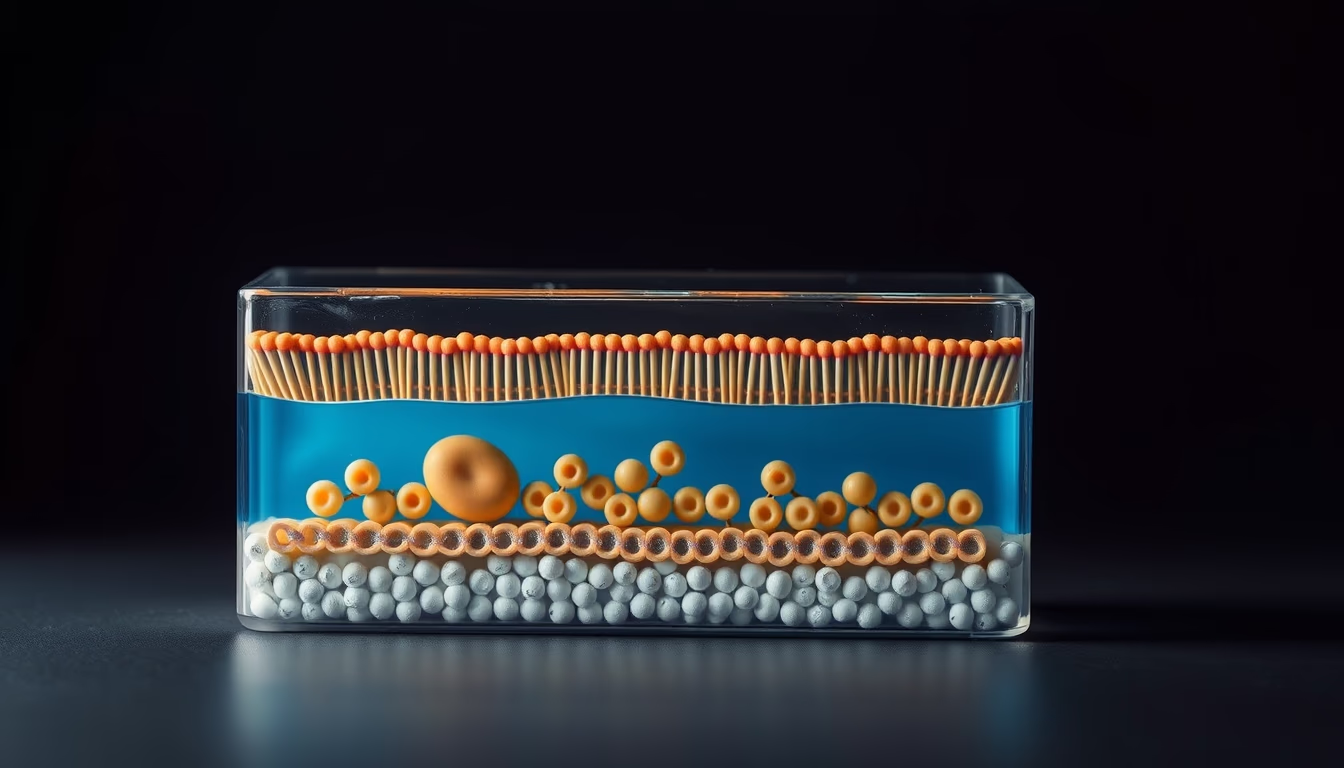
Diagram illustrating water movement across a semipermeable membrane by osmosis, demonstrating the principle of concentration gradient.
About this subject
Osmosis is a fundamental physicochemical phenomenon in which solvent molecules, usually water, spontaneously cross a semipermeable membrane from a region of lower solute concentration to one of higher concentration. This process continues until concentration equilibrium is reached, equalizing the chemical potential on both sides. The semipermeable membrane selectively allows water passage while blocking most dissolved solutes like ions and large molecules.
The concept was first described by Abbé Jean-Antoine Nollet in 1748, but Wilhelm Pfeffer conducted systematic experiments in the 19th century, laying the groundwork for understanding osmotic pressure. Later, Jacobus Henricus van't Hoff formalized the relationship between osmotic pressure and concentration, analogous to the ideal gas law. Osmosis plays a crucial role in biological systems, such as water absorption by plant roots, cell volume regulation, and human kidney function.
In plants, osmosis maintains cell turgidity, essential for structural support. When a plant cell is placed in a hypertonic solution, it loses water and undergoes plasmolysis. In animals, osmosis regulates water balance; red blood cells in a hypotonic solution swell and may lyse. Technological applications include reverse osmosis, used in seawater desalination and wastewater treatment, where external pressure forces water against the concentration gradient.
Interestingly, osmosis is also harnessed in food preservation, such as salting meat to dehydrate microorganisms, and in osmotic power generation, a renewable energy source exploiting salinity differences between fresh and saltwater. A typical diagram shows a container divided by a membrane, with water molecules (often small circles) moving from the dilute side to the concentrated side, while solutes (larger circles) are retained.
Frequently Asked Questions
What is osmosis?
Osmosis is the spontaneous movement of water molecules across a semipermeable membrane from a region of lower solute concentration to higher solute concentration, aiming to equalize concentrations.
What is the difference between osmosis and simple diffusion?
Simple diffusion occurs without a membrane and involves any particles moving down a concentration gradient, whereas osmosis is restricted to the solvent (water) and requires a semipermeable membrane that blocks solutes.
Where is osmosis applied in daily life?
Osmosis is used in reverse osmosis desalination for drinking water, in food preservation through salting or sugaring, and in drip irrigation systems that slowly release water.
Direct URL
https://pub-c7d6a6ea828543ac903a74a341ccb2e1.r2.dev/imagens/osmosis-membrane-diagram-studio-still-life-p7.avifHow to credit
Include a visible link back to UtilizAí. Copy one of the snippets below:
<a href="https://xn--utiliza-eza.com/en/midia/imagens/osmosis-membrane-diagram-studio-still-life-p7">Osmosis membrane diagram</a> by <a href="https://xn--utiliza-eza.com">UtilizAí</a>, licensed under <a href="https://creativecommons.org/licenses/by/4.0/">CC BY 4.0</a>.
[Osmosis membrane diagram](https://xn--utiliza-eza.com/en/midia/imagens/osmosis-membrane-diagram-studio-still-life-p7) by [UtilizAí](https://xn--utiliza-eza.com), CC BY 4.0
License: CC-BY-4.0