Osmosis membrane diagram
1344×768 · AVIF · CC BY 4.0
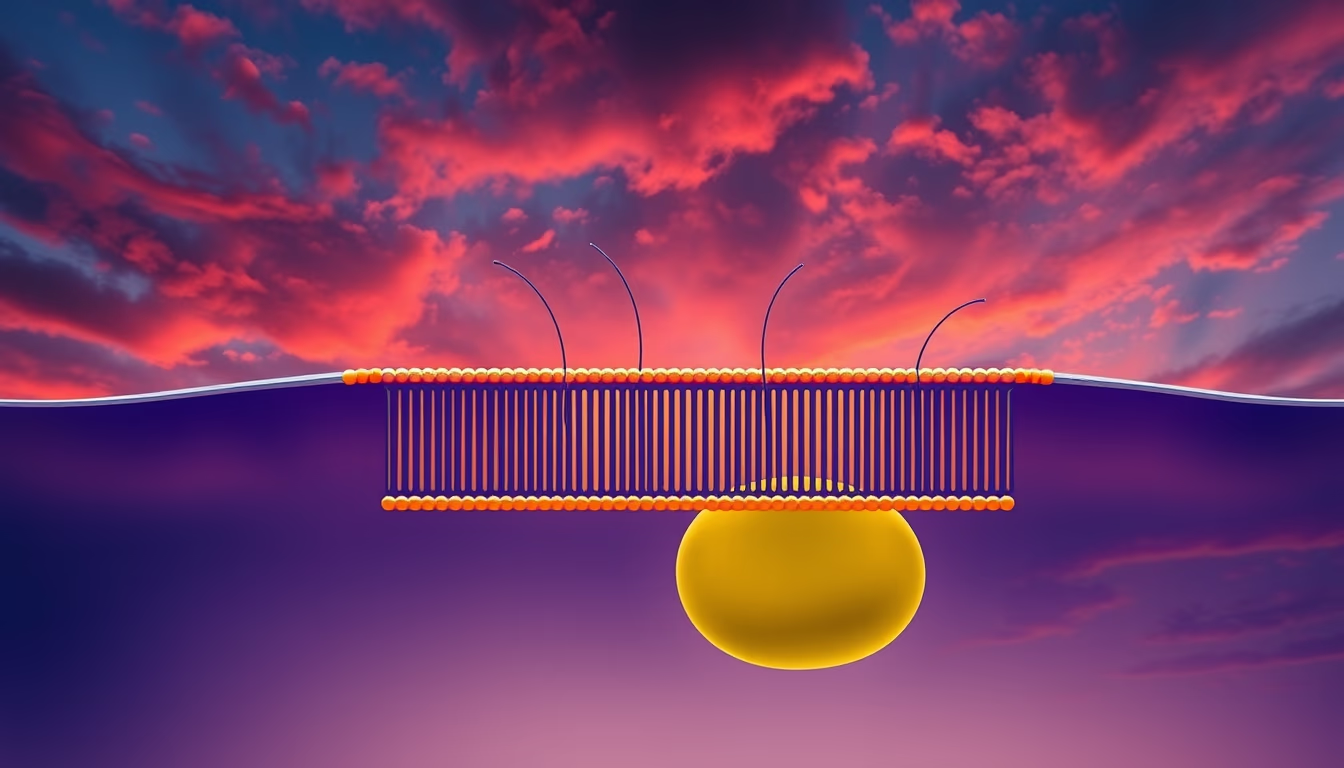
Diagram of osmosis across a semipermeable membrane: a fundamental process in cell biology and water filtration.
About this subject
Osmosis is a physicochemical phenomenon essential for life, consisting of the movement of solvent molecules (usually water) across a semipermeable membrane. This membrane allows the passage of the solvent but blocks larger solutes, such as ions and organic molecules. The movement occurs from a region of lower solute concentration (higher water potential) to a region of higher solute concentration (lower water potential), seeking to balance concentrations on both sides.
In biological systems, osmosis regulates the water balance of cells. For instance, red blood cells maintain their shape due to osmotic control; in a hypertonic medium they shrink, and in a hypotonic medium they swell and may burst (hemolysis). In plants, osmosis is responsible for water absorption by roots and for maintaining cell turgidity, essential for growth and support.
In engineering, osmosis is applied in reverse osmosis desalination processes, where external pressure forces water through a membrane against the concentration gradient, removing salts and impurities. This method is crucial for producing drinking water in arid regions. Diagrams like this illustrate the solvent flow and concentrations, facilitating understanding of equilibria and gradients.
Trivia: osmosis was first described by French scientist Abbé Jean-Antoine Nollet in 1748. The term comes from the Greek "ōsmos," meaning impulse. The osmotic pressure of a solution can be calculated by the van 't Hoff equation, similar to the ideal gas law. Understanding this diagram is useful for students of biology, chemistry, and sanitation engineering.
Frequently Asked Questions
What is osmosis and how does it work?
Osmosis is the movement of water across a semipermeable membrane from a region of lower solute concentration to higher solute concentration until pressures equalize. It is passive and requires no energy.
What is the difference between osmosis and reverse osmosis?
In natural osmosis, water moves spontaneously. In reverse osmosis, external pressure forces water against the gradient, used for purification and desalination.
Why is osmosis important for cells?
Osmosis regulates cell volume and hydration. Without it, cells can shrink or burst. In plants, it also maintains tissue rigidity.
Direct URL
https://pub-c7d6a6ea828543ac903a74a341ccb2e1.r2.dev/imagens/osmosis-membrane-diagram-long-exposure-p8.avifHow to credit
Include a visible link back to UtilizAí. Copy one of the snippets below:
<a href="https://xn--utiliza-eza.com/en/midia/imagens/osmosis-membrane-diagram-long-exposure-p8">Osmosis membrane diagram</a> by <a href="https://xn--utiliza-eza.com">UtilizAí</a>, licensed under <a href="https://creativecommons.org/licenses/by/4.0/">CC BY 4.0</a>.
[Osmosis membrane diagram](https://xn--utiliza-eza.com/en/midia/imagens/osmosis-membrane-diagram-long-exposure-p8) by [UtilizAí](https://xn--utiliza-eza.com), CC BY 4.0
License: CC-BY-4.0