Osmosis membrane diagram
1344×768 · AVIF · CC BY 4.0
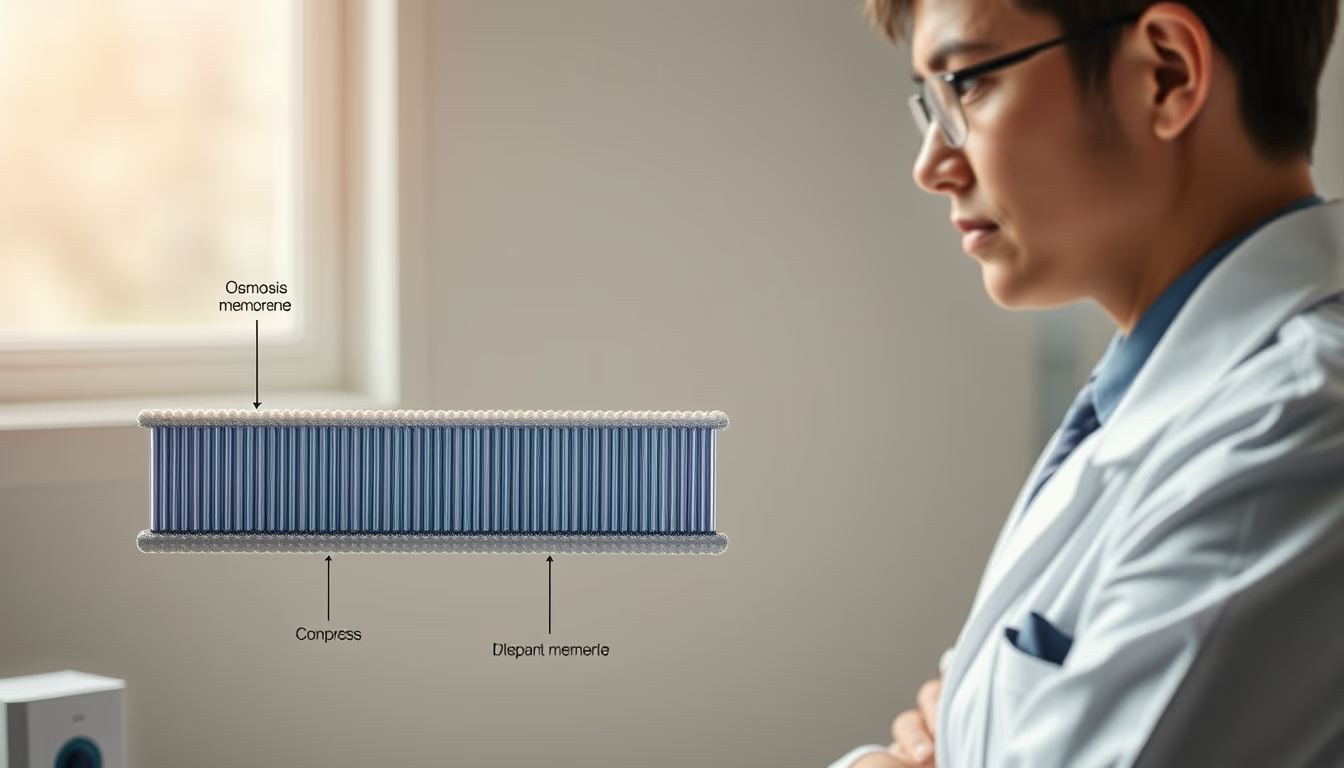
Schematic diagram of osmosis across a semipermeable membrane, illustrating water movement from hypotonic to hypertonic medium.
About this subject
Osmosis is a fundamental physicochemical phenomenon in biology and engineering, first described in 1748 by the French clergyman and scientist Jean-Antoine Nollet. The typical diagram shows two solutions (A and B) separated by a semipermeable membrane, which allows solvent (usually water) to pass but not the solute. Water flows from the region of lower solute concentration (hypotonic) to higher concentration (hypertonic) until osmotic equilibrium is reached.
In biological systems, osmosis regulates cell hydration, turgor in plants, and kidney function. In human kidneys, nephron membranes reabsorb water by osmosis, a process essential for homeostasis. Technologically, reverse osmosis is widely used for seawater desalination and wastewater treatment, applying pressure to reverse the natural flow and retain salts.
A curious fact: the term "osmosis" comes from the Greek "ōsmos" (push), and the concept was refined in the 19th century by scientists such as Thomas Graham and Wilhelm Pfeffer. Osmotic pressure, measured by osmometers, can be calculated using the van 't Hoff equation, analogous to the ideal gas law. In artificial membranes, materials like cellulose acetate and polyamide are common, with pore sizes in the nanometer scale, typically 0.1 to 1 nanometer, enabling selectivity.
For educational purposes, osmosis diagrams are essential teaching tools in science courses. They help visualize the direction of water flow, concentration differences, and the membrane's role. Though simplified, such schematics are accurate enough to explain concepts like tonicity in animal and plant cells, or the basic principle of reverse osmosis systems used in household water purifiers.
Frequently Asked Questions
What is a semipermeable membrane?
It is a selective barrier that allows some molecules (like water) to pass through but blocks others (like salts and sugars). It can be natural (cell membrane) or artificial (polyamide film).
How does osmosis differ from simple diffusion?
In diffusion, particles move down a concentration gradient. In osmosis, only the solvent moves across a semipermeable membrane, also down a chemical potential gradient, but membrane-dependent.
What are the practical applications of reverse osmosis?
Seawater desalination, drinking water purification, juice concentration, and industrial wastewater treatment. It is also used in renal dialysis and in laboratories to prepare samples.
Direct URL
https://pub-c7d6a6ea828543ac903a74a341ccb2e1.r2.dev/imagens/osmosis-membrane-diagram-documentary-photography-p12.avifHow to credit
Include a visible link back to UtilizAí. Copy one of the snippets below:
<a href="https://xn--utiliza-eza.com/en/midia/imagens/osmosis-membrane-diagram-documentary-photography-p12">Osmosis membrane diagram</a> by <a href="https://xn--utiliza-eza.com">UtilizAí</a>, licensed under <a href="https://creativecommons.org/licenses/by/4.0/">CC BY 4.0</a>.
[Osmosis membrane diagram](https://xn--utiliza-eza.com/en/midia/imagens/osmosis-membrane-diagram-documentary-photography-p12) by [UtilizAí](https://xn--utiliza-eza.com), CC BY 4.0
License: CC-BY-4.0