Osmosis membrane diagram
1344×768 · AVIF · CC BY 4.0
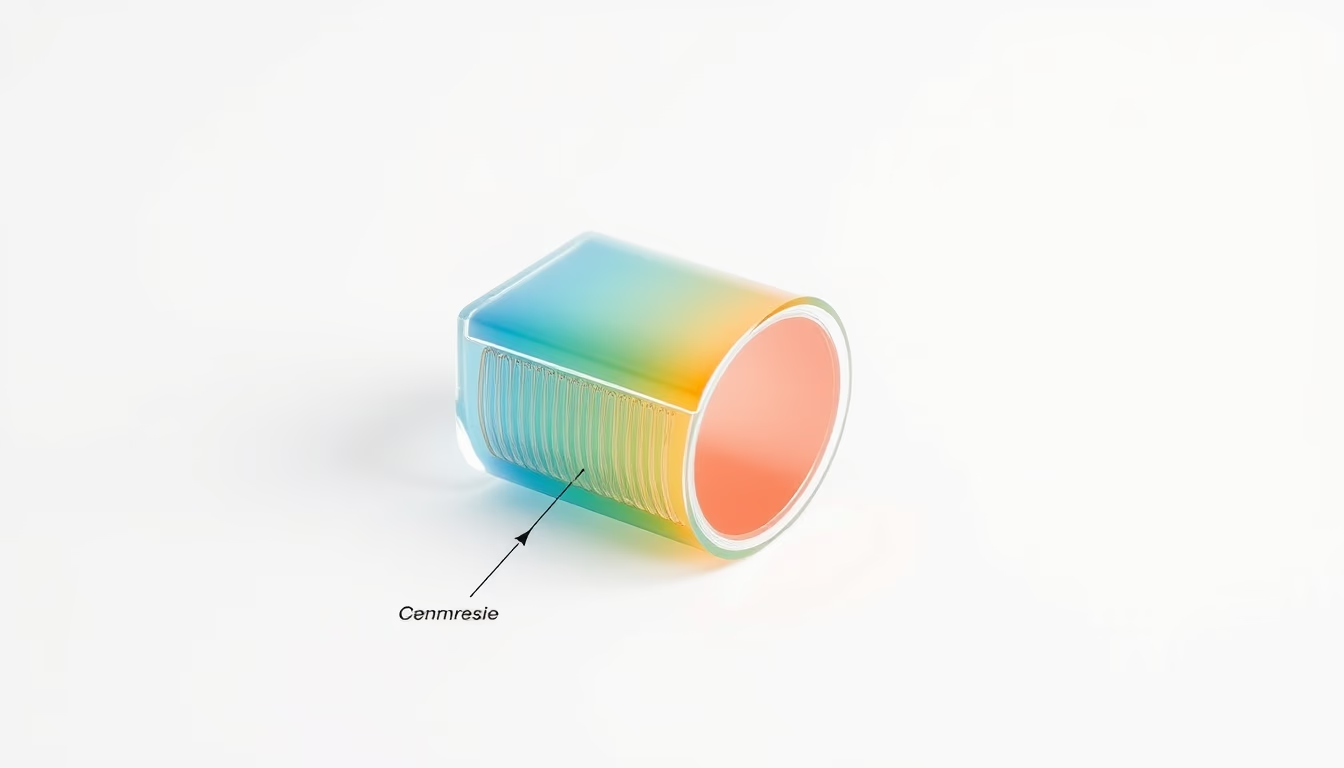
Diagram of a semipermeable membrane illustrating osmosis, the movement of water from a hypotonic to a hypertonic medium.
About this subject
Osmosis is a fundamental physicochemical process where a solvent, usually water, moves across a semipermeable membrane from a region of lower solute concentration (hypotonic) to one of higher solute concentration (hypertonic). This movement occurs spontaneously until equilibrium is reached. The semipermeable membrane allows the passage of the solvent but blocks most solutes, such as ions and large molecules.
In biological systems, osmosis is essential for cellular homeostasis. For instance, plant roots absorb water from the soil through osmosis, and red blood cells rely on osmotic balance to prevent hemolysis or crenation. Osmotic regulation is vital for all organisms, especially those living in aquatic environments with varying salinities.
In industry, reverse osmosis is a widely used technology for water purification and desalination. Pressure is applied to force water through a semipermeable membrane in the opposite direction of natural osmosis, removing impurities. This technique is employed in water treatment plants, production of drinking water, and the food industry, such as in juice concentration.
The concept of osmosis was first described by German physiologist Wilhelm Pfeffer in 1877 and later explained thermodynamically by Jacobus van 't Hoff. Understanding this phenomenon has enabled advances in cell biology, medicine, and chemical engineering, making it a cornerstone of membrane science.
Frequently Asked Questions
What is osmosis?
Osmosis is the movement of water molecules through a semipermeable membrane from a region of low solute concentration to a region of high solute concentration, aiming to balance concentrations.
How is osmosis used in industry?
In industry, reverse osmosis is used to purify water and desalinate seawater. The process applies pressure to force water through a membrane, retaining impurities and salts.
What is the difference between osmosis and simple diffusion?
In simple diffusion, particles move from high to low concentration without needing a membrane. In osmosis, only the solvent crosses a semipermeable membrane, while the solute is retained.
Direct URL
https://pub-c7d6a6ea828543ac903a74a341ccb2e1.r2.dev/imagens/osmosis-membrane-diagram-commercial-product-photography-p0.avifHow to credit
Include a visible link back to UtilizAí. Copy one of the snippets below:
<a href="https://xn--utiliza-eza.com/en/midia/imagens/osmosis-membrane-diagram-commercial-product-photography-p0">Osmosis membrane diagram</a> by <a href="https://xn--utiliza-eza.com">UtilizAí</a>, licensed under <a href="https://creativecommons.org/licenses/by/4.0/">CC BY 4.0</a>.
[Osmosis membrane diagram](https://xn--utiliza-eza.com/en/midia/imagens/osmosis-membrane-diagram-commercial-product-photography-p0) by [UtilizAí](https://xn--utiliza-eza.com), CC BY 4.0
License: CC-BY-4.0