Oscilloscope display waveform
1344×768 · AVIF · CC BY 4.0
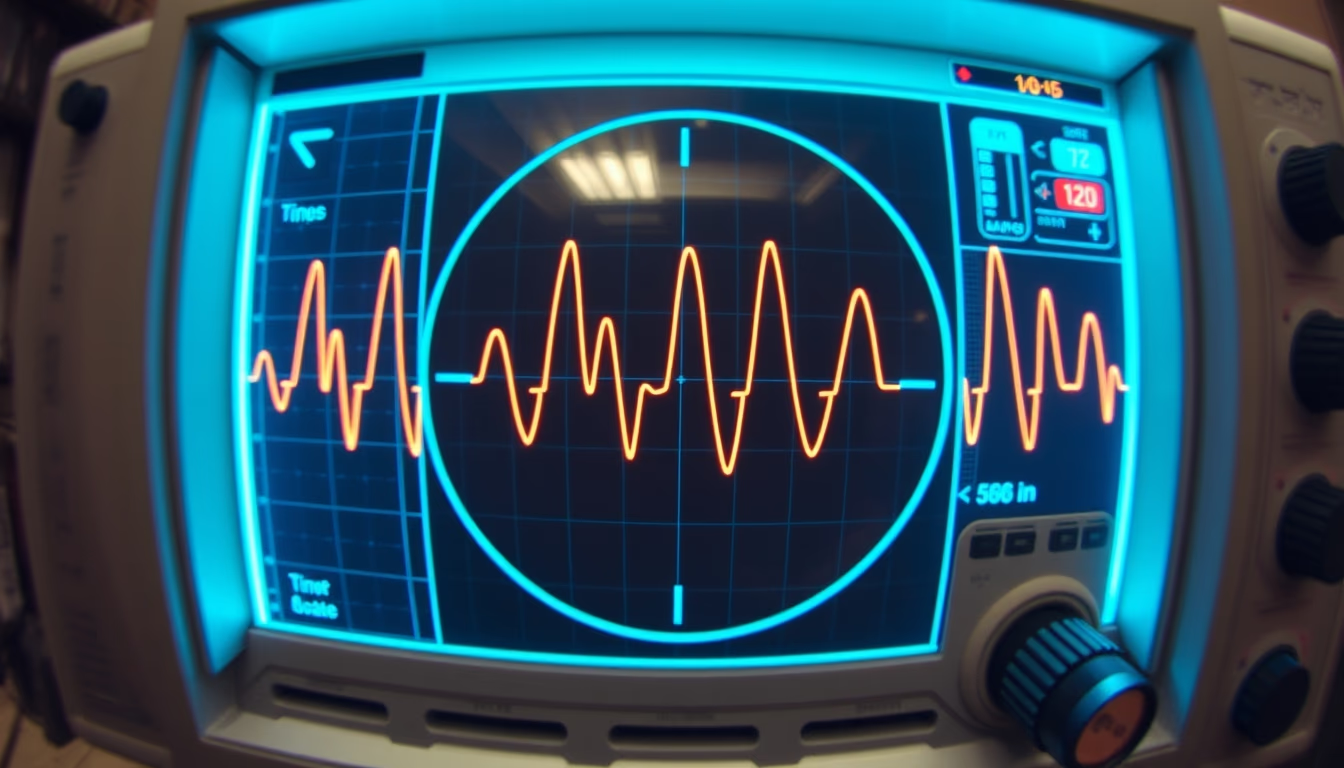
The oscilloscope displays electrical waveforms, an essential tool for engineers and technicians in electronics.
About this subject
An oscilloscope is an electronic measurement instrument that displays voltage variations over time. Originally developed in the early 20th century, modern models use LCD screens or cathode-ray tubes (CRT) to graphically represent electrical signals. The displayed waveform can be sinusoidal, square, triangular, or complex pulses, depending on the circuit being analyzed. In electronics laboratories, the oscilloscope is indispensable for diagnosing equipment problems, measuring frequency, amplitude, and checking distortions.
Common types include analog oscilloscopes, which use electron beams to draw the waveform in real time, and digital oscilloscopes, which convert the signal into numerical data and offer advanced features such as waveform storage and mathematical analysis. Bandwidth, sampling rate, and vertical resolution are crucial specifications when choosing the device. For high-frequency signals, oscilloscopes with bandwidths of hundreds of megahertz are required.
In educational settings, the oscilloscope is used to demonstrate concepts of electrical circuits, such as frequency response and behavior of passive components. A historical curiosity: the first practical oscilloscope was invented by Karl Ferdinand Braun in 1897, using a cathode-ray tube. Today, portable battery-powered oscilloscopes are available, ideal for field work. Moreover, many modern models have USB and Ethernet interfaces for data transfer and remote control.
Frequently Asked Questions
What is an oscilloscope and what is it used for?
It is an instrument that displays electrical signals as a graph, showing voltage versus time. It is used to measure amplitude, frequency, waveform shape, and diagnose faults in electronic circuits.
What is the difference between analog and digital oscilloscopes?
Analog scopes use a cathode-ray tube to draw the waveform in real time; digital scopes convert the signal into binary data, allowing storage, zoom, and advanced analysis.
How to choose a suitable oscilloscope?
Consider bandwidth (at least 5 times the signal frequency), sampling rate (at least 2.5 times the bandwidth), and vertical resolution (8 to 12 bits for general use).
Direct URL
https://pub-c7d6a6ea828543ac903a74a341ccb2e1.r2.dev/imagens/oscilloscope-display-waveform-fish-eye-wide-angle-p5.avifHow to credit
Include a visible link back to UtilizAí. Copy one of the snippets below:
<a href="https://xn--utiliza-eza.com/en/midia/imagens/oscilloscope-display-waveform-fish-eye-wide-angle-p5">Oscilloscope display waveform</a> by <a href="https://xn--utiliza-eza.com">UtilizAí</a>, licensed under <a href="https://creativecommons.org/licenses/by/4.0/">CC BY 4.0</a>.
[Oscilloscope display waveform](https://xn--utiliza-eza.com/en/midia/imagens/oscilloscope-display-waveform-fish-eye-wide-angle-p5) by [UtilizAí](https://xn--utiliza-eza.com), CC BY 4.0
License: CC-BY-4.0