Oscilloscope display waveform
1344×768 · AVIF · CC BY 4.0
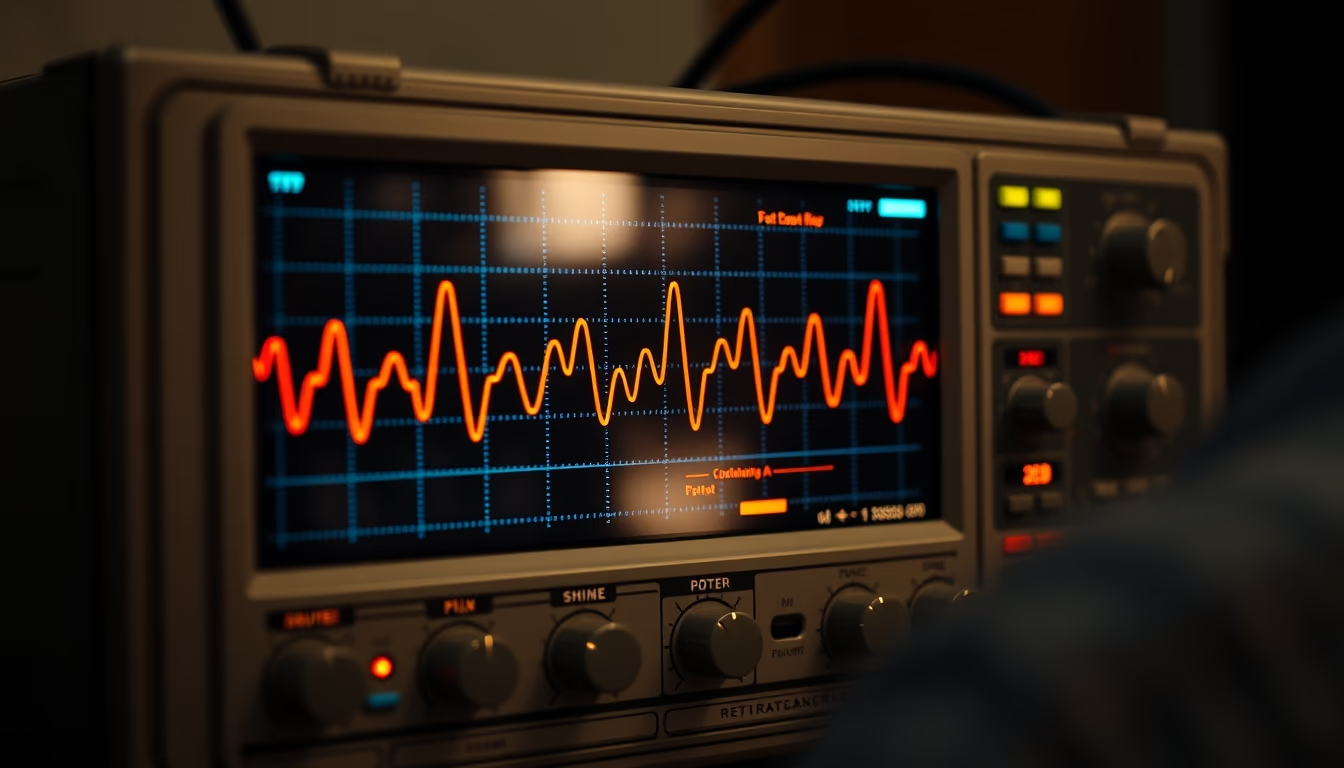
Oscilloscope displays electrical waveforms in real time, essential for signal analysis in electronics.
About this subject
An oscilloscope is an electronic test instrument that displays voltage variations over time. Its fundamental principle dates back to the cathode-ray tube, invented by Karl Ferdinand Braun in 1897. Early analog oscilloscopes used a horizontal sweep to move an electron beam across a phosphorescent screen, while the input voltage deflected the beam vertically, tracing the waveform. This allowed engineers to observe transient and periodic signals, revolutionizing electrical engineering.
With digital technology, digital storage oscilloscopes (DSOs) convert analog signals into digital data and store them in memory. These instruments offer advanced triggering, automatic measurements, and spectrum analysis. Modern DSOs combine high sampling rates, deep memory, and USB or Ethernet interfaces for remote computer analysis. The choice between analog and digital depends on the application: analog scopes excel at displaying repetitive signals and detecting subtle noise; digital scopes are essential for capturing single-shot events and making precise measurements.
In education and industry, the oscilloscope is indispensable in electronics labs, communications, and industrial maintenance. Technicians use it to diagnose circuit faults, verify digital signal timing, and tune audio equipment. The ability to see the actual waveform provides insights that multimeters or logic analyzers cannot. For instance, when adjusting an amplifier, harmonic distortion can be viewed in real time, crucial for sound quality.
Interestingly, the term "oscilloscope" comes from Latin "oscillare" (to swing) and Greek "skopein" (to look at). Portable scopes emerged in the 1960s, and today there are benchtop, handheld, and even PC-based models using sound cards. The film grain effect in some images evokes the aesthetic of old analog CRT scopes, which had a characteristic glow and granular texture, reminiscent of the golden age of electronic instrumentation.
Frequently Asked Questions
What is the difference between analog and digital oscilloscopes?
An analog oscilloscope displays the waveform directly on a phosphor screen using an electron beam, ideal for repetitive signals. A digital oscilloscope converts the signal into binary data, enabling storage, precise measurements, and analysis of single-shot events.
What is the purpose of the trigger in an oscilloscope?
The trigger stabilizes the waveform display by synchronizing the horizontal sweep with a specific point in the signal, such as a rising edge. This allows viewing of complex waveforms and accurate measurement of parameters like period and pulse width.
Why is bandwidth important in an oscilloscope?
Bandwidth determines the range of frequencies the instrument can accurately measure. To avoid distortion, the bandwidth should be at least five times the frequency of the signal under test. Higher bandwidth scopes capture harmonics and fast transients.
Direct URL
https://pub-c7d6a6ea828543ac903a74a341ccb2e1.r2.dev/imagens/oscilloscope-display-waveform-film-grain-authentic-p0.avifHow to credit
Include a visible link back to UtilizAí. Copy one of the snippets below:
<a href="https://xn--utiliza-eza.com/en/midia/imagens/oscilloscope-display-waveform-film-grain-authentic-p0">Oscilloscope display waveform</a> by <a href="https://xn--utiliza-eza.com">UtilizAí</a>, licensed under <a href="https://creativecommons.org/licenses/by/4.0/">CC BY 4.0</a>.
[Oscilloscope display waveform](https://xn--utiliza-eza.com/en/midia/imagens/oscilloscope-display-waveform-film-grain-authentic-p0) by [UtilizAí](https://xn--utiliza-eza.com), CC BY 4.0
License: CC-BY-4.0