Orion nebula glowing
1344×768 · AVIF · CC BY 4.0
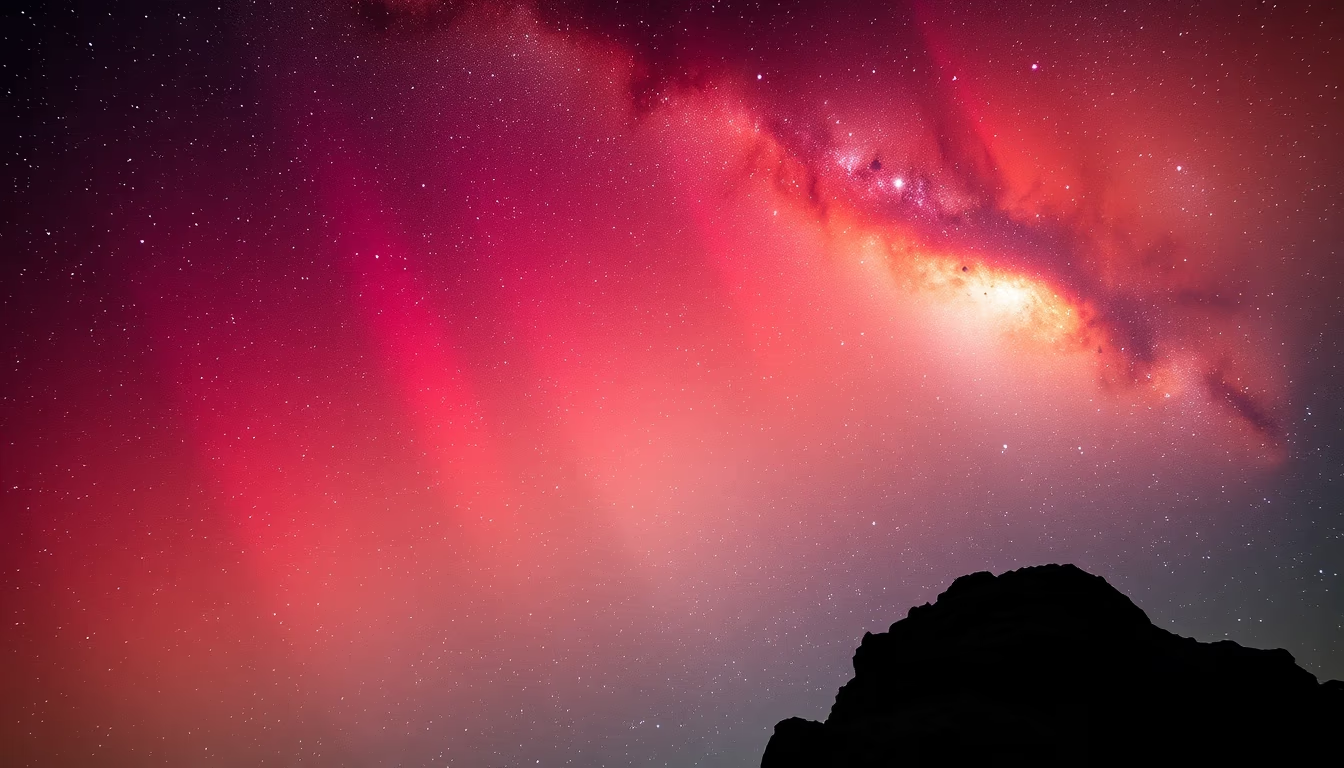
The Orion Nebula, one of the brightest and most studied star-forming regions, is visible to the naked eye in the night sky.
About this subject
The Orion Nebula, also cataloged as Messier 42 or M42, is an emission nebula located in the constellation Orion, just below the three stars of Orion's Belt. It lies approximately 1,344 light-years from Earth, making it one of the closest and most active star-forming regions to our solar system. Inside it, the Trapezium Cluster, composed of young massive stars, illuminates the surrounding gas, creating the vibrant colors seen in long-exposure photographs.
Discovered in 1610 by Nicolas-Claude Fabri de Peiresc, the nebula was one of the first astronomical objects to be photographed, in 1880 by Henry Draper. Its scientific importance is immense: it serves as a natural laboratory for studying the birth of stars and planets. The Hubble Space Telescope has captured detailed images of its pillars of gas and dust, revealing protostars and protoplanetary disks.
Culturally, the Orion Nebula is an icon of amateur astronomy. On winter nights in the Northern Hemisphere, it is easily spotted with the naked eye as a fuzzy patch below Orion's Belt. For observers with binoculars or small telescopes, it reveals a greenish haze with central stars. Long-exposure photography enhances its extensive clouds of ionized hydrogen, oxygen, and sulfur, which emit light at specific wavelengths.
Fun fact: the name "Orion" comes from Greek mythology, representing a hunter. The nebula is part of the hunter's "sword," one of the most recognizable asterisms in the sky. It is estimated to contain enough material to form thousands of stars like the Sun, and its ongoing study helps us understand the processes that led to the formation of our own solar system.
Frequently Asked Questions
What is the Orion Nebula?
It is an emission nebula, a cloud of gas and dust ionized by young stars, located in the constellation Orion. It is one of the closest star-forming regions to Earth.
How can I observe the Orion Nebula?
With the naked eye, it appears as a fuzzy patch below Orion's Belt. With binoculars or a small telescope, you can see its shape and the stars of the Trapezium cluster.
Why is the Orion Nebula important for science?
It allows detailed study of star and planet formation. Observations with telescopes like Hubble have revealed protoplanetary disks and protostars in their early stages.
Direct URL
https://pub-c7d6a6ea828543ac903a74a341ccb2e1.r2.dev/imagens/orion-nebula-glowing-long-exposure-p2.avifHow to credit
Include a visible link back to UtilizAí. Copy one of the snippets below:
<a href="https://xn--utiliza-eza.com/en/midia/imagens/orion-nebula-glowing-long-exposure-p2">Orion nebula glowing</a> by <a href="https://xn--utiliza-eza.com">UtilizAí</a>, licensed under <a href="https://creativecommons.org/licenses/by/4.0/">CC BY 4.0</a>.
[Orion nebula glowing](https://xn--utiliza-eza.com/en/midia/imagens/orion-nebula-glowing-long-exposure-p2) by [UtilizAí](https://xn--utiliza-eza.com), CC BY 4.0
License: CC-BY-4.0