Orion nebula glowing
1344×768 · AVIF · CC BY 4.0
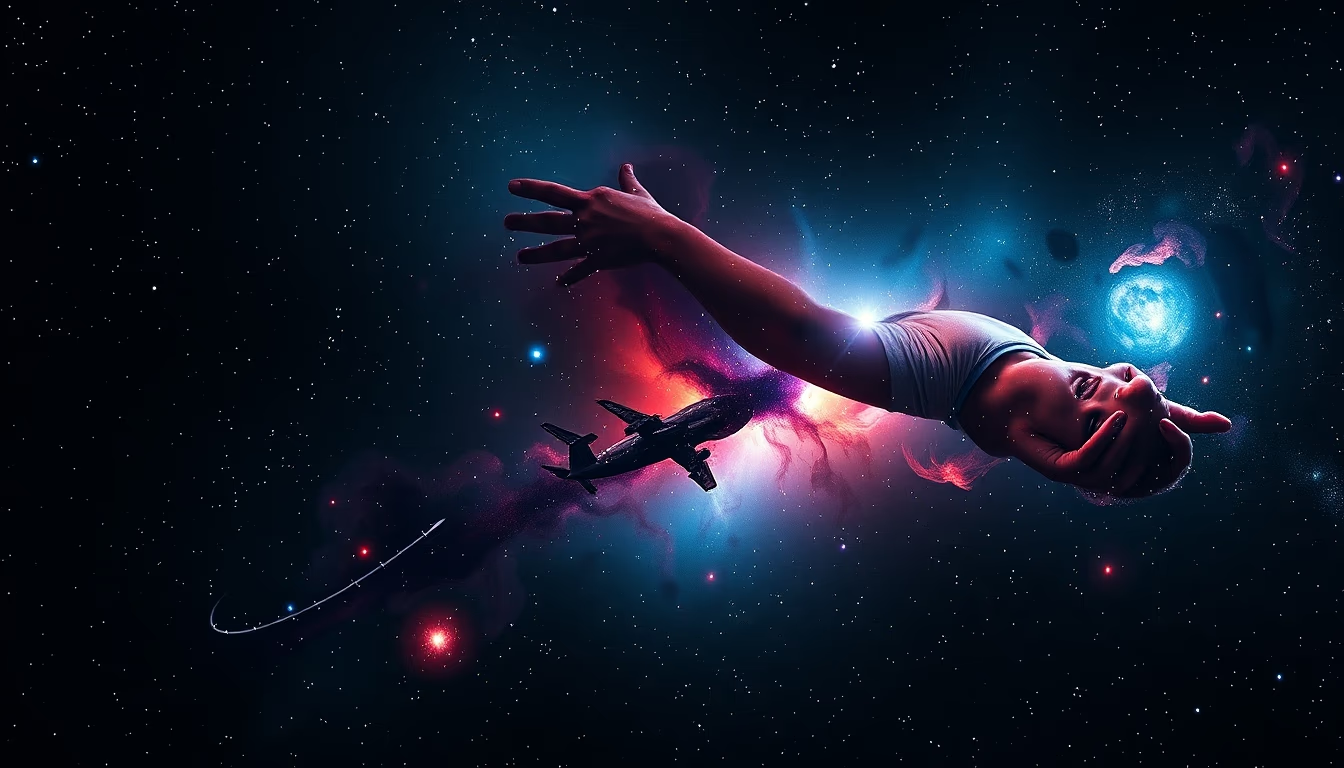
The Orion Nebula, also known as Messier 42, is one of the brightest and most studied stellar nurseries in the night sky, located approximately 1344 light-years from Earth.
About this subject
The Orion Nebula, cataloged as Messier 42, is a diffuse nebula located in the constellation Orion, just below the hunter's belt. With an apparent magnitude of 4.0, it is visible to the naked eye from dark sites, appearing as a fuzzy patch. It is one of the closest star-forming regions to Earth, at about 1344 light-years away, with a diameter of approximately 24 light-years.
The nebula is illuminated by the glow of young, hot stars, especially the Trapezium cluster, consisting of four massive stars that sculpt the surrounding gas and dust cloud with their intense radiation. In the center, ionized gas emits visible light, giving the nebula its characteristic reddish and greenish hues. The Hubble Space Telescope has captured detailed images of the region, revealing protoplanetary disks (proplyds) where new solar systems are forming.
The discovery of the nebula dates back to 1610, when French astronomer Nicolas-Claude Fabri de Peiresc first observed it. Later, Charles Messier included it in his catalog in 1769. The Orion Nebula is a frequent target for amateur and professional astronomers, serving as a natural laboratory for studying star formation and the evolution of interstellar clouds. Its position near the celestial equator allows it to be observed from virtually everywhere on Earth.
Frequently Asked Questions
How far is the Orion Nebula from Earth?
The Orion Nebula is located approximately 1344 light-years from Earth, making it one of the closest star-forming regions to our planet.
Can the Orion Nebula be seen with the naked eye?
Yes, from dark sky locations, the Orion Nebula is visible to the naked eye as a fuzzy patch below Orion's belt. Binoculars or small telescopes reveal more detail.
What is the Trapezium cluster in the Orion Nebula?
The Trapezium is a cluster of four massive, bright stars at the center of the nebula. These stars ionize the surrounding gas and illuminate the nebula, while their intense radiation sculpts the dust cloud.
Direct URL
https://pub-c7d6a6ea828543ac903a74a341ccb2e1.r2.dev/imagens/orion-nebula-glowing-isometric-flat-lay-p3.avifHow to credit
Include a visible link back to UtilizAí. Copy one of the snippets below:
<a href="https://xn--utiliza-eza.com/en/midia/imagens/orion-nebula-glowing-isometric-flat-lay-p3">Orion nebula glowing</a> by <a href="https://xn--utiliza-eza.com">UtilizAí</a>, licensed under <a href="https://creativecommons.org/licenses/by/4.0/">CC BY 4.0</a>.
[Orion nebula glowing](https://xn--utiliza-eza.com/en/midia/imagens/orion-nebula-glowing-isometric-flat-lay-p3) by [UtilizAí](https://xn--utiliza-eza.com), CC BY 4.0
License: CC-BY-4.0