Origami paper folded
1344×768 · AVIF · CC BY 4.0
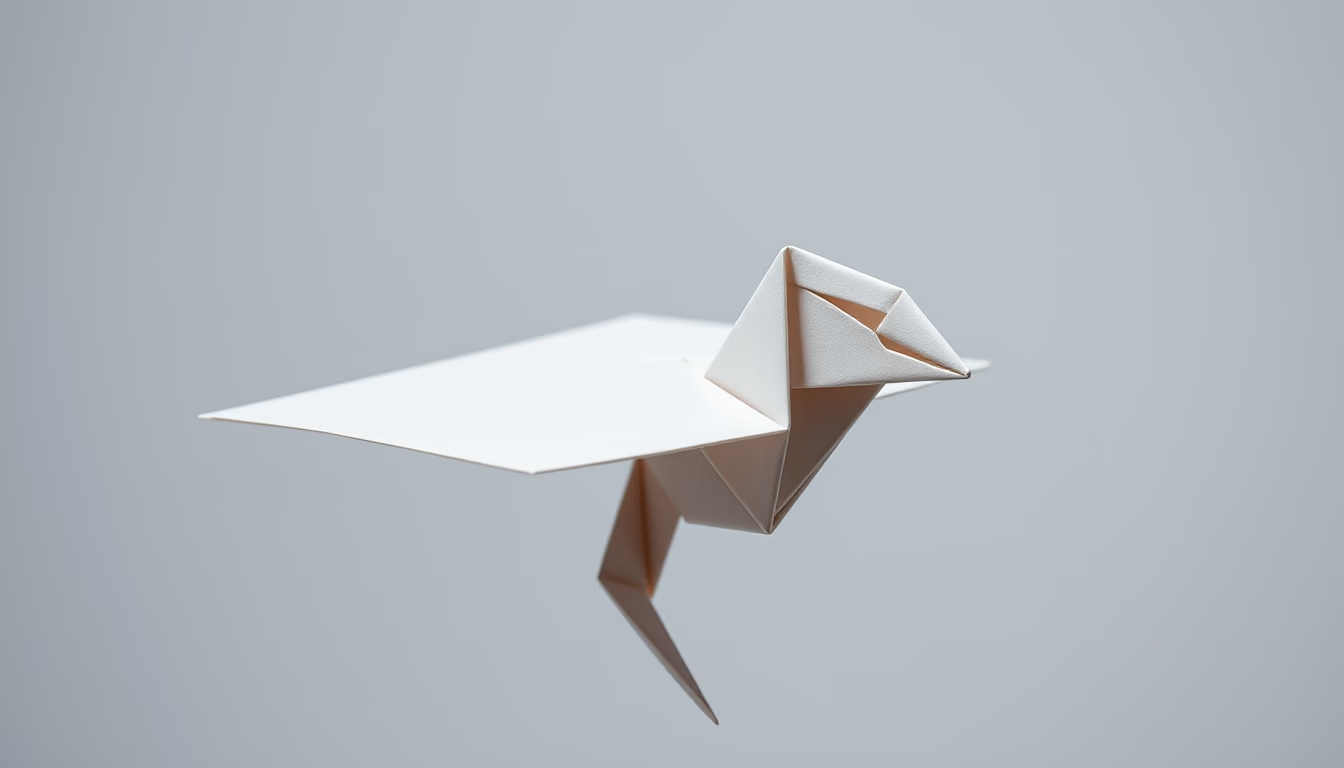
The ancient art of origami transforms simple sheets of paper into three-dimensional sculptures, combining geometry, patience, and creativity.
About this subject
Origami is the Japanese art of folding paper without cuts or glue, creating complex figures from a single square sheet. Its origins trace back to the Edo period in Japan (17th century), when paper became more widely available. Initially used in Shinto religious ceremonies and among samurai, who exchanged origami as symbols of good luck, it evolved into a global phenomenon. Master Akira Yoshizawa revolutionized the practice in the 20th century by inventing a diagramming system for folds, enabling models to be reproduced worldwide.
Basic techniques include valley and mountain folds, forming the foundation for hundreds of models. The tsuru (crane) is the most iconic, associated with the legend of a thousand cranes granting a wish. Other popular models are the frog, lotus flower, and dragon. Modular origami joins multiple folded pieces to create larger structures like kusudamas. Wet-folding uses dampened paper to produce smooth curves and organic shapes, an advanced technique pioneered by Yoshizawa.
Beyond artistic expression, origami has practical applications. In education, it develops spatial skills and concentration. In medicine, it inspires stents that expand inside the body. In aerospace engineering, solar panels and space telescopes use folding principles for compact storage. The world record for smallest origami is a crane measuring just 0.1 mm, created via microscopy. The largest origami is a dragon with a 2.7-meter wingspan, made in 2011.
Frequently Asked Questions
What is the origin of origami?
Origami originated in Japan during the Edo period (17th century), derived from paper brought from China. It became popular among samurai and in religious ceremonies.
What are the types of origami?
Main types include traditional origami (crane, frog), modular (kusudama), wet-folding (for smooth curves), and action origami (that moves).
Does origami have modern applications?
Yes, it is used in architecture (retractable structures), medicine (stents), aerospace engineering (foldable solar panels), and robotics (origami robots).
Direct URL
https://pub-c7d6a6ea828543ac903a74a341ccb2e1.r2.dev/imagens/origami-paper-folded-studio-editorial-portrait-p4.avifHow to credit
Include a visible link back to UtilizAí. Copy one of the snippets below:
<a href="https://xn--utiliza-eza.com/en/midia/imagens/origami-paper-folded-studio-editorial-portrait-p4">Origami paper folded</a> by <a href="https://xn--utiliza-eza.com">UtilizAí</a>, licensed under <a href="https://creativecommons.org/licenses/by/4.0/">CC BY 4.0</a>.
[Origami paper folded](https://xn--utiliza-eza.com/en/midia/imagens/origami-paper-folded-studio-editorial-portrait-p4) by [UtilizAí](https://xn--utiliza-eza.com), CC BY 4.0
License: CC-BY-4.0