Obsidian black volcanic
1344×768 · AVIF · CC BY 4.0
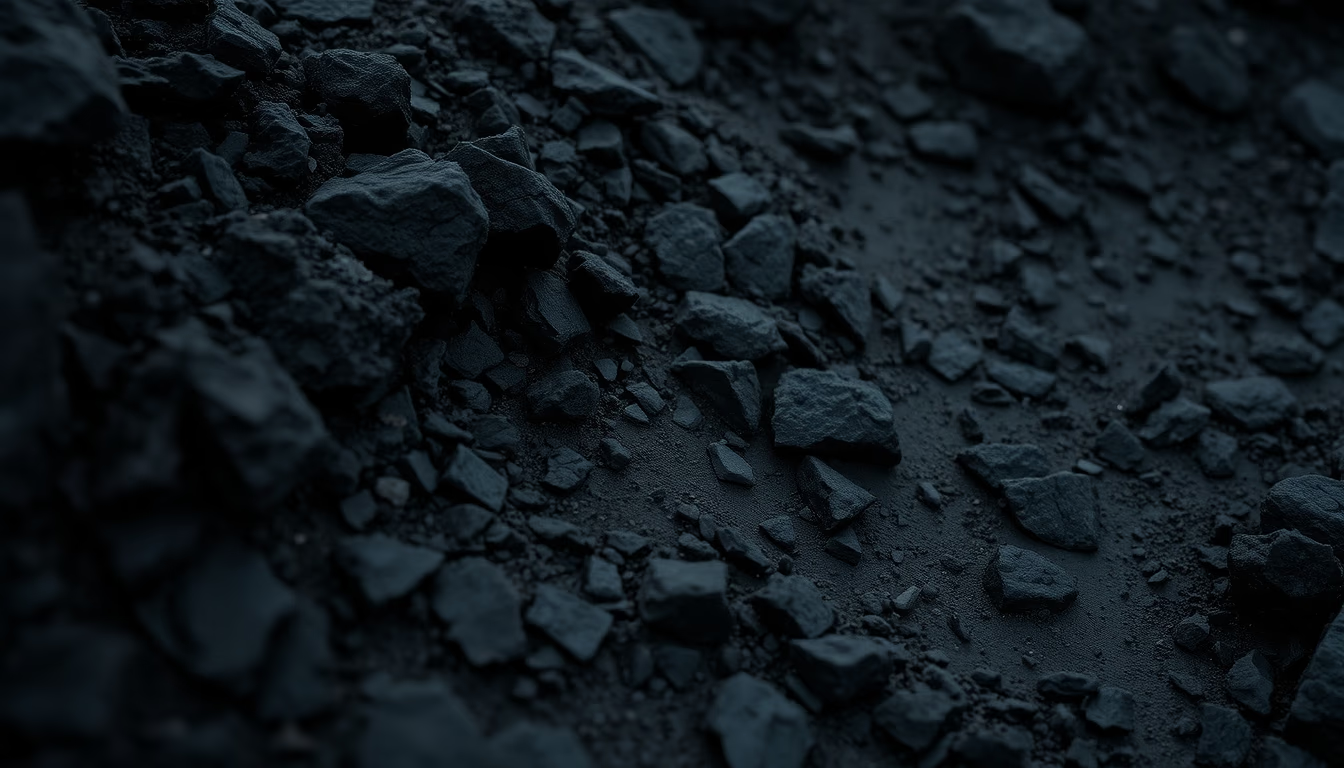
Black obsidian is a natural volcanic glass formed by the rapid cooling of silica-rich lava, known for its intense black color and vitreous luster.
About this subject
Obsidian is an amorphous volcanic glass formed when felsic lava (rich in silica) cools rapidly, preventing crystallization. This process commonly occurs in lava flows or volcanic domes that contact water or cold air. The typical black color is due to impurities like iron and magnesium oxides, although green, brown, or banded varieties exist.
Historically, obsidian was one of the first raw materials used by human societies to make sharp cutting tools and arrowheads because it can produce extremely thin and sharp edges. Civilizations such as the Aztecs and Mayas in Mesoamerica, as well as peoples in Ethiopia and Oceania, traded and worked obsidian. In modern times, the rock was also used for mirrors and decorative objects.
Geologically, black obsidian is found in recent volcanic regions worldwide, such as Mexico (especially Hidalgo state), Iceland, the United States (Oregon and California), Scotland, Italy, and Ethiopia. In Brazil, it occurs in Paraná and Rio Grande do Sul, associated with basaltic formations. Texture and purity vary depending on the extraction site.
Today, obsidian is valued in jewelry and lapidary, but its most surprising use is in medicine: obsidian scalpel blades can be made with edges 10 times sharper than steel, used in high-precision surgeries, especially ophthalmology. Its conchoidal fracture and lack of crystalline structure enable extremely clean cuts.
Frequently Asked Questions
What is the difference between obsidian and common glass?
Both are glasses, but obsidian is natural, formed by the rapid cooling of volcanic lava, containing impurities that give it color. Common glass is artificially manufactured from sand and other components.
Where can I find black obsidian?
In active or recent volcanic areas such as Mexico (Pachuca region), Iceland, the United States (Oregon), Scotland, Ethiopia. In Brazil, it occurs in Paraná and Rio Grande do Sul.
What physical properties stand out in obsidian?
Very sharp conchoidal fracture, hardness between 5 and 5.5 on the Mohs scale, vitreous luster, and absence of crystalline structure (amorphous). It may contain inclusions like feldspar crystals or gas bubbles.
Direct URL
https://pub-c7d6a6ea828543ac903a74a341ccb2e1.r2.dev/imagens/obsidian-black-volcanic-film-grain-authentic-p3.avifHow to credit
Include a visible link back to UtilizAí. Copy one of the snippets below:
<a href="https://xn--utiliza-eza.com/en/midia/imagens/obsidian-black-volcanic-film-grain-authentic-p3">Obsidian black volcanic</a> by <a href="https://xn--utiliza-eza.com">UtilizAí</a>, licensed under <a href="https://creativecommons.org/licenses/by/4.0/">CC BY 4.0</a>.
[Obsidian black volcanic](https://xn--utiliza-eza.com/en/midia/imagens/obsidian-black-volcanic-film-grain-authentic-p3) by [UtilizAí](https://xn--utiliza-eza.com), CC BY 4.0
License: CC-BY-4.0