Obsidian black volcanic
1344×768 · AVIF · CC BY 4.0
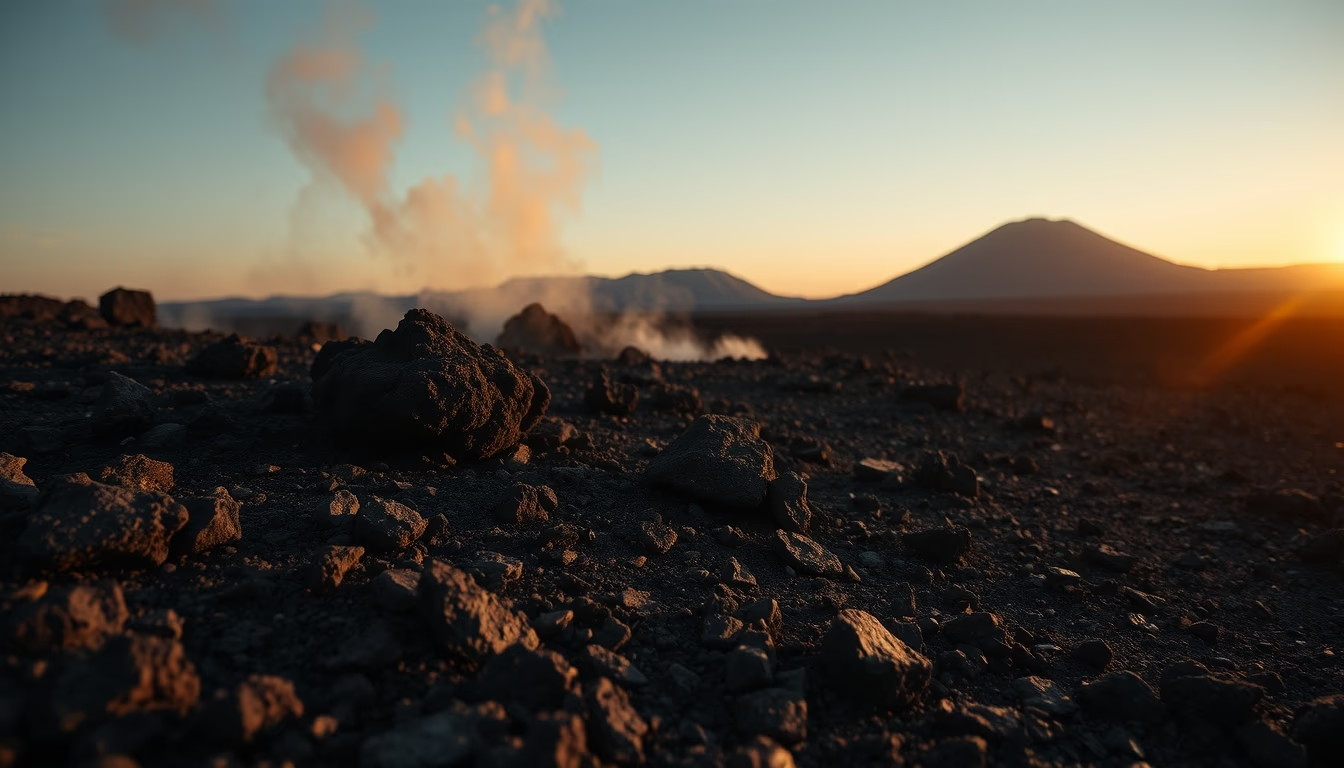
Black volcanic obsidian is a natural glass formed by the rapid cooling of silica-rich lava, known for its smooth surface and vitreous luster.
About this subject
Obsidian is an igneous rock with a glassy texture that forms when felsic (silica-rich) lava cools rapidly on the Earth's surface, without time to crystallize. This process occurs in explosive volcanic eruptions, such as those seen in the Pacific Ring of Fire. The characteristic black color is due to impurities like iron or magnesium oxides. Although amorphous (non-crystalline), obsidian may contain spherical inclusions called spherulites or flow banding.
Historically, obsidian was extensively used by ancient civilizations. The Aztecs and Maya produced obsidian blades for knives and arrowheads, which were extremely sharp and hard. On the island of Lipari, Italy, obsidian trade dates back to the Neolithic. Indigenous peoples of North America also used it for tools and ceremonial artifacts. In modern medicine, obsidian scalpels are employed in delicate surgeries because their edges can be up to 500 times sharper than steel.
Geographically, significant deposits of black obsidian are found in Iceland (especially near the Krafla volcano), Mexico (areas like Pachuca and the Valley of Mexico), the United States (Yellowstone, Oregon), and Peru. Obsidian is also valued in jewelry and lithotherapy, although its primary use remains scientific and historical. Interestingly, obsidian is not a true mineral due to lack of crystalline structure, being classified as a mineraloid.
Technically, obsidian has a hardness of 5 to 5.5 on the Mohs scale and conchoidal fracture, resulting in extremely sharp edges. Its typical chemical composition includes 70-75% SiO2, with minor amounts of Al2O3, FeO, MgO, and alkalis. Obsidian can hydrate over time, forming perlite, and is used as an abrasive material or in industrial filters.
Frequently Asked Questions
How is black obsidian formed?
Black obsidian forms when silica-rich lava cools rapidly on the surface, without crystallization. This abrupt cooling prevents crystal formation, resulting in volcanic glass.
What are the historical and modern uses of obsidian?
Historically, obsidian was used for cutting tools and weapons. Today, it is used in ultra-precise surgical scalpels and also in jewelry and decorative objects.
Where can obsidian be found in the world?
Notable deposits of black obsidian exist in Iceland, Mexico, the United States (Yellowstone, Oregon), Peru, and the Mediterranean (Aeolian Islands).
Direct URL
https://pub-c7d6a6ea828543ac903a74a341ccb2e1.r2.dev/imagens/obsidian-black-volcanic-cinematic-wide-shot-p11.avifHow to credit
Include a visible link back to UtilizAí. Copy one of the snippets below:
<a href="https://xn--utiliza-eza.com/en/midia/imagens/obsidian-black-volcanic-cinematic-wide-shot-p11">Obsidian black volcanic</a> by <a href="https://xn--utiliza-eza.com">UtilizAí</a>, licensed under <a href="https://creativecommons.org/licenses/by/4.0/">CC BY 4.0</a>.
[Obsidian black volcanic](https://xn--utiliza-eza.com/en/midia/imagens/obsidian-black-volcanic-cinematic-wide-shot-p11) by [UtilizAí](https://xn--utiliza-eza.com), CC BY 4.0
License: CC-BY-4.0