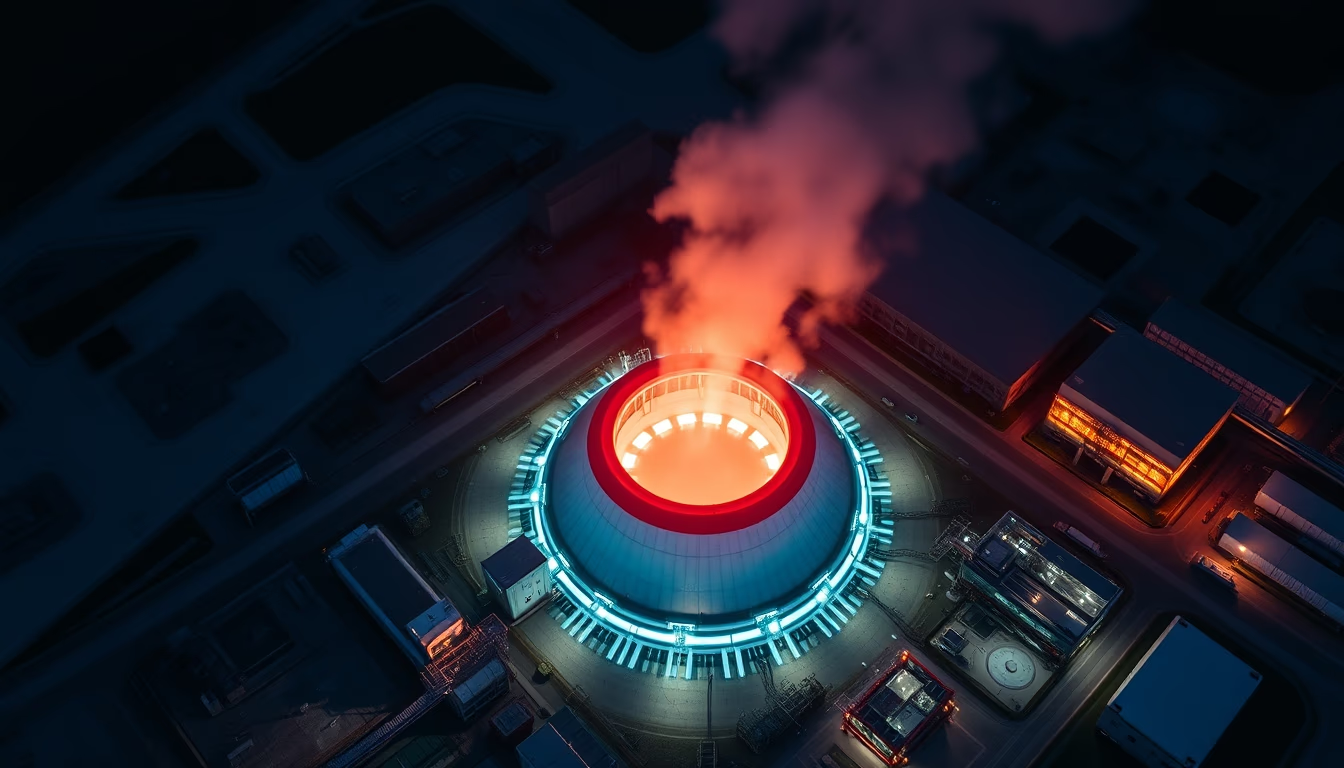
Nuclear reactor core glow
1344×768 · AVIF · CC BY 4.0

Cherenkov radiation produces the characteristic blue glow in nuclear reactor cores, caused by charged particles exceeding the speed of light in water.
About this subject
The intense blue glow observed in a nuclear reactor core is the result of Cherenkov radiation, an optical phenomenon that occurs when charged particles (such as electrons) travel through a medium at a speed greater than the speed of light in that medium. This effect is analogous to a sonic boom but with light. It primarily occurs in light-water reactors, where nuclear fuel (uranium) undergoes fission and releases high-energy particles.
The characteristic blue color arises because Cherenkov radiation emits predominantly in the ultraviolet and blue spectrum. The human eye perceives this emission as bright blue. This phenomenon does not indicate immediate danger, the water surrounding the core acts as shielding, absorbing most of the ionizing radiation. The glow is visible only when the reactor is operating and radiation levels are high, but the water protects operators.
Historically, Pavel Cherenkov discovered this effect in 1934, earning the Nobel Prize in 1958. Since then, it has become a fundamental tool in particle physics and reactor monitoring. Cherenkov radiation is also used in neutrino detectors and cosmic ray telescopes.
In research reactors and some nuclear power plants, the blue glow is often photographed by journalists and enthusiasts, generating iconic images that symbolize nuclear energy. Despite its futuristic appearance, the phenomenon is well understood and controlled, serving as a visual signal of nuclear energy release in a safe manner, provided that containment barriers are intact.
Frequently Asked Questions
What causes the blue glow in nuclear reactors?
The blue glow is caused by Cherenkov radiation, which occurs when charged particles travel through a medium (such as water) faster than light in that medium, emitting blue light.
Is Cherenkov glow dangerous?
Not directly. The glow indicates intense radiation, but the water surrounding the reactor core acts as shielding, protecting operators. Direct exposure to the core water would be dangerous, but the light itself is harmless.
Where else is Cherenkov radiation used?
Besides reactors, it is used in particle detectors (e.g., Super-Kamiokande in Japan), cosmic ray telescopes, and particle identification in accelerators.
Direct URL
https://pub-c7d6a6ea828543ac903a74a341ccb2e1.r2.dev/imagens/nuclear-reactor-core-glow-tilt-shift-miniature-p8.avifHow to credit
Include a visible link back to UtilizAí. Copy one of the snippets below:
<a href="https://xn--utiliza-eza.com/en/midia/imagens/nuclear-reactor-core-glow-tilt-shift-miniature-p8">Nuclear reactor core glow</a> by <a href="https://xn--utiliza-eza.com">UtilizAí</a>, licensed under <a href="https://creativecommons.org/licenses/by/4.0/">CC BY 4.0</a>.
[Nuclear reactor core glow](https://xn--utiliza-eza.com/en/midia/imagens/nuclear-reactor-core-glow-tilt-shift-miniature-p8) by [UtilizAí](https://xn--utiliza-eza.com), CC BY 4.0
License: CC-BY-4.0