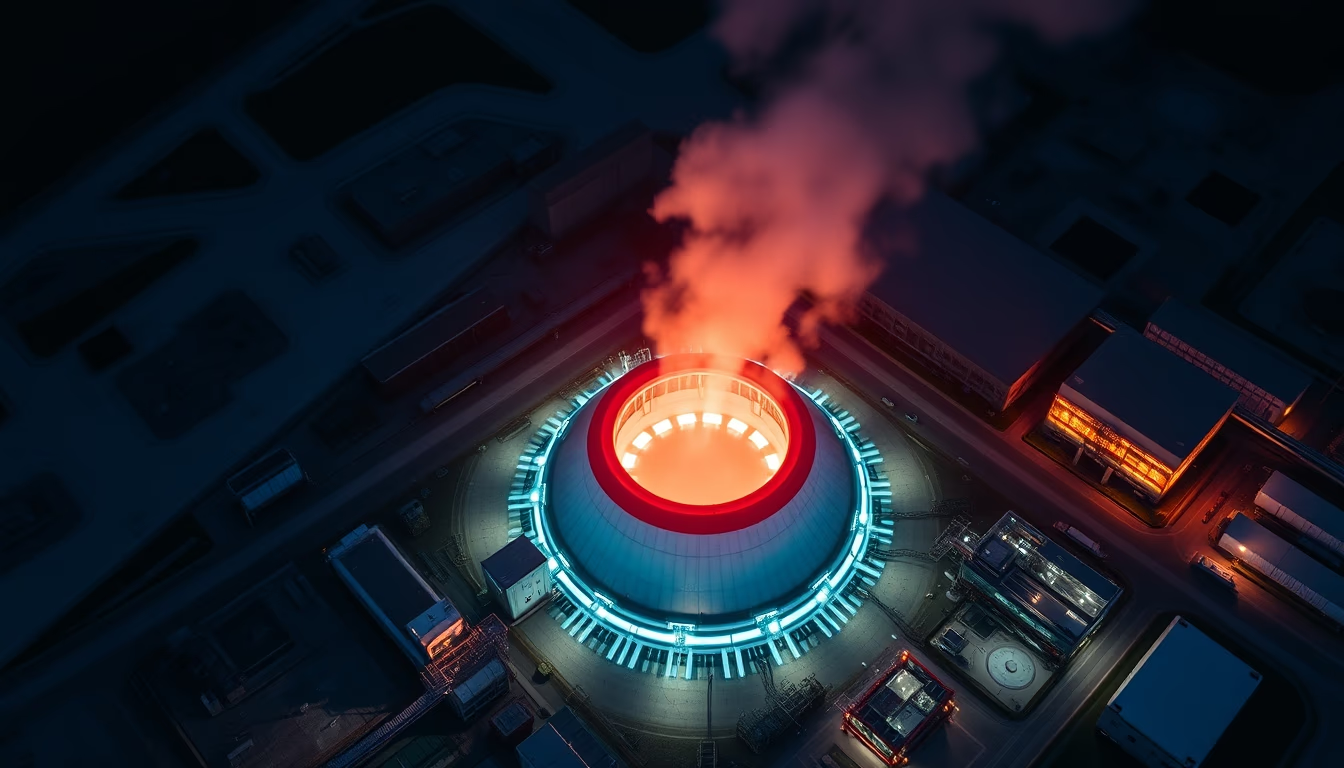
Nuclear reactor core glow
1344×768 · AVIF · CC BY 4.0

The characteristic blue glow emitted by a nuclear reactor core is the result of Cherenkov radiation, a phenomenon that occurs when charged particles exceed the speed of light in water.
About this subject
The blue glow emitted by the core of a nuclear reactor, often seen in photographs of fuel pools or research reactors, is a physical phenomenon known as Cherenkov radiation. Discovered in 1934 by Soviet physicist Pavel Cherenkov, this radiation occurs when charged particles, such as electrons, move through a dielectric medium (like water) at a speed greater than the speed of light in that medium. This generates an optical shock wave analogous to the sonic boom of a supersonic aircraft, emitting light in a continuous spectrum that appears blue to the human eye for typical reactor velocities.
Cherenkov radiation is primarily observed in water-cooled nuclear reactors, such as research reactors and spent fuel pools. In the reactor core, fission reactions produce high-energy particles that, when interacting with the surrounding water, produce the characteristic glow. This phenomenon is not limited to reactors: it is used in particle detectors, such as the Super-Kamiokande neutrino observatory in Japan, which uses huge tanks of water to capture Cherenkov radiation from neutrinos.
The blue color of Cherenkov radiation has a physical explanation. The intensity of emitted light is inversely proportional to the square of the wavelength, meaning shorter wavelengths (like blue and ultraviolet) are emitted more intensely than longer ones (red). Additionally, the human eye is more sensitive to blue than to ultraviolet, making the blue glow the most visible component. Although Cherenkov radiation itself is not dangerous (it is harmless visible light), its presence indicates high-energy particles that can be harmful, hence the need for shielding like water.
Interestingly, the intensity of the blue glow varies with particle energy and the medium. In reactors operating at high power, the glow is more intense and can even be seen during the day. Cherenkov radiation is also responsible for the blue glow in spent fuel pools, where highly radioactive fuel elements emit beta particles that generate the phenomenon. This effect serves as a visual reminder of the energy released in nuclear reactions and holds importance in both scientific research and the nuclear industry.
Frequently Asked Questions
What is the blue glow in a nuclear reactor?
It is Cherenkov radiation, emitted when charged particles (such as electrons) move through water faster than light travels in that medium. It produces a characteristic blue glow, visible in water-cooled reactors and spent fuel pools.
Is Cherenkov radiation dangerous?
Cherenkov radiation itself is just visible light and harmless. However, its presence indicates high-energy particles that can be dangerous. The water surrounding the reactor core acts as a shield against these particles.
Why is the glow blue?
The intensity of Cherenkov radiation is higher for shorter wavelengths (blue and ultraviolet) due to the physical formula of the phenomenon. The human eye is more sensitive to blue, so we perceive the glow as blue.
Direct URL
https://pub-c7d6a6ea828543ac903a74a341ccb2e1.r2.dev/imagens/nuclear-reactor-core-glow-film-grain-authentic-p2.avifHow to credit
Include a visible link back to UtilizAí. Copy one of the snippets below:
<a href="https://xn--utiliza-eza.com/en/midia/imagens/nuclear-reactor-core-glow-film-grain-authentic-p2">Nuclear reactor core glow</a> by <a href="https://xn--utiliza-eza.com">UtilizAí</a>, licensed under <a href="https://creativecommons.org/licenses/by/4.0/">CC BY 4.0</a>.
[Nuclear reactor core glow](https://xn--utiliza-eza.com/en/midia/imagens/nuclear-reactor-core-glow-film-grain-authentic-p2) by [UtilizAí](https://xn--utiliza-eza.com), CC BY 4.0
License: CC-BY-4.0