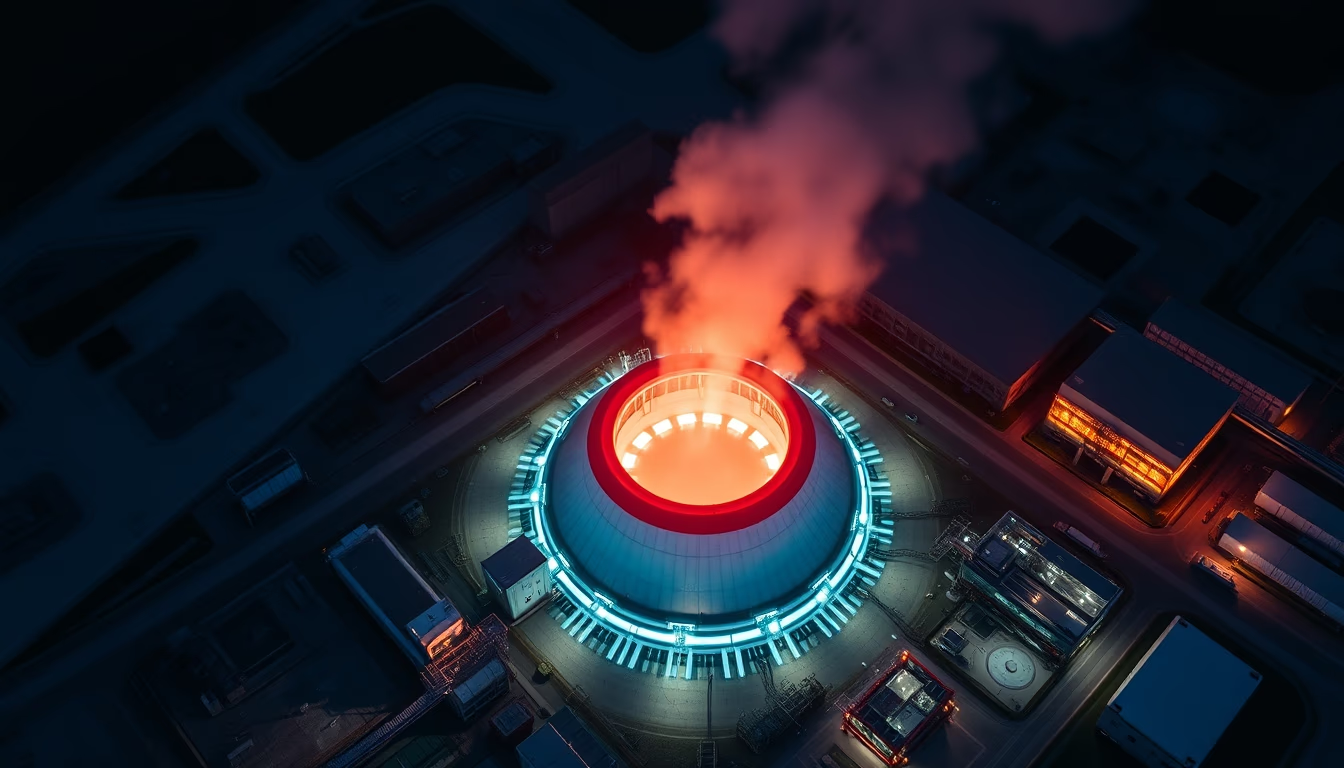
Nuclear reactor core glow
1344×768 · AVIF · CC BY 4.0

The characteristic blue glow of a nuclear reactor core is caused by Cherenkov radiation, a fascinating optical phenomenon that occurs when charged particles exceed the speed of light in water.
About this subject
The intense blue glow observed in nuclear reactor cores, especially in pool-type research reactors, is produced by Cherenkov radiation. This phenomenon occurs when charged particles, such as electrons, travel through a medium (usually water) faster than the speed of light in that medium. It is analogous to the sonic boom of a supersonic aircraft, but with light instead of sound. Cherenkov radiation emits a continuous spectrum, but the human eye perceives it as blue because the intensity is higher at shorter wavelengths, and the eye's sensitivity peaks in the blue region.
The water surrounding the reactor core acts as a moderator and shield, slowing down neutrons and absorbing radiation. During operation, the core is submerged in demineralized water, which becomes slightly radioactive due to neutron activation, but the water itself does not contain nuclear fuel. The blue glow is a visual indicator that the reactor is running, with nuclear fuel (usually enriched uranium) undergoing fission and releasing high-energy particles.
Interestingly, Cherenkov radiation is not limited to nuclear reactors. It is also observed in particle physics experiments, such as neutrino detectors (Super-Kamiokande) and particle accelerators. The phenomenon was discovered by Pavel Cherenkov in 1934, earning him the Nobel Prize in Physics in 1958. In research reactors, the glow allows visual estimation of reactor power: the brighter the glow, the higher the fission rate. However, in commercial power reactors (PWR or BWR), the core is enclosed in opaque pressure vessels, and the glow is not visible during normal operation, only during shutdowns for maintenance or in spent fuel storage pools.
It is important to note that the glow does not indicate imminent danger; Cherenkov radiation itself is not harmful, but its presence indicates that the reactor is active and associated ionizing radiation exists. The blue color is one of the most iconic visual symbols of nuclear energy, often used in films and documentaries. Documentary photography capturing this phenomenon requires special techniques, such as long exposure and filters, due to low light levels and radiation.
Frequently Asked Questions
What causes the blue glow in a nuclear reactor?
The blue glow is caused by Cherenkov radiation, which occurs when charged particles (such as electrons) move faster than light in water, emitting visible blue light.
Is the blue glow dangerous?
Cherenkov radiation itself is not dangerous, but it indicates the presence of ionizing radiation. The glow is a sign that the reactor is active and requires safety protocols.
Why is the glow blue and not another color?
Cherenkov radiation has a continuous spectrum, but the intensity is higher at shorter wavelengths (blue). Additionally, the human eye is more sensitive to blue, enhancing the perception of that color.
Direct URL
https://pub-c7d6a6ea828543ac903a74a341ccb2e1.r2.dev/imagens/nuclear-reactor-core-glow-documentary-photography-p9.avifHow to credit
Include a visible link back to UtilizAí. Copy one of the snippets below:
<a href="https://xn--utiliza-eza.com/en/midia/imagens/nuclear-reactor-core-glow-documentary-photography-p9">Nuclear reactor core glow</a> by <a href="https://xn--utiliza-eza.com">UtilizAí</a>, licensed under <a href="https://creativecommons.org/licenses/by/4.0/">CC BY 4.0</a>.
[Nuclear reactor core glow](https://xn--utiliza-eza.com/en/midia/imagens/nuclear-reactor-core-glow-documentary-photography-p9) by [UtilizAí](https://xn--utiliza-eza.com), CC BY 4.0
License: CC-BY-4.0