Neutron star pulsar
1344×768 · AVIF · CC BY 4.0
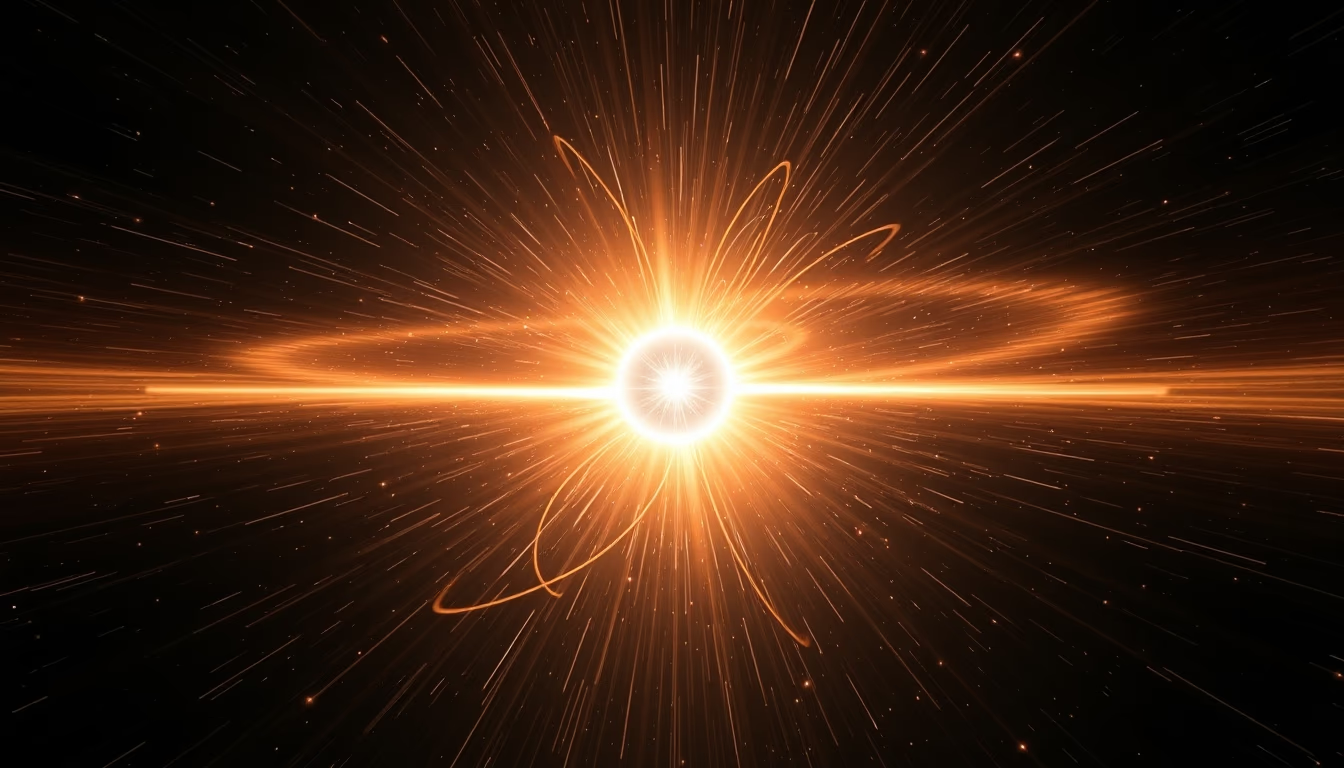
A pulsar is a neutron star that emits regular beams of radiation, acting as a cosmic lighthouse in the universe.
About this subject
Pulsars are extremely dense neutron stars that rotate rapidly, emitting beams of electromagnetic radiation from their magnetic poles. They form when a massive star collapses in a supernova, leaving a compact core with a mass between 1.4 and 2.1 times that of the Sun, compressed into a radius of only 10 to 15 kilometers. This colossal density means a teaspoon of pulsar material would weigh billions of tons.
The pulsation phenomenon occurs because the star's magnetic axis is tilted relative to its rotation axis, creating a lighthouse effect: the radiation beams sweep through space, and when they point toward Earth, they are detected as regular pulses. The first pulsar was discovered in 1967 by Jocelyn Bell Burnell, and since then thousands have been cataloged. Some pulsars, like the Crab Pulsar, spin at 30 times per second, while millisecond pulsars reach hundreds of rotations per second.
These objects serve as natural laboratories for testing physics under extreme conditions. Observations of binary pulsars enabled the first indirect detection of gravitational waves, confirming predictions of general relativity. Moreover, the extreme regularity of their pulses allows them to be used as cosmic clocks, aiding in space navigation and the study of the interstellar medium.
Frequently Asked Questions
What causes the regular pulses of a pulsar?
The pulses are caused by the lighthouse effect: the pulsar's magnetic axis is tilted relative to its rotation axis. As the star rotates, the radiation beams sweep through space, and when they point toward Earth, they are detected as regular pulses.
How dense is a neutron star?
A neutron star has extreme density, on the order of 10^17 kg/m³. A teaspoon of its material would weigh about 1 billion tons, equivalent to a mountain compressed into a small volume.
How are pulsars used in astronomy?
Pulsars serve as precise cosmic clocks, enabling studies of gravitational waves, the interstellar medium, and even as references for space navigation. The regularity of their pulses makes them unique tools for testing physical theories.
Direct URL
https://pub-c7d6a6ea828543ac903a74a341ccb2e1.r2.dev/imagens/neutron-star-pulsar-studio-editorial-portrait-p6.avifHow to credit
Include a visible link back to UtilizAí. Copy one of the snippets below:
<a href="https://xn--utiliza-eza.com/en/midia/imagens/neutron-star-pulsar-studio-editorial-portrait-p6">Neutron star pulsar</a> by <a href="https://xn--utiliza-eza.com">UtilizAí</a>, licensed under <a href="https://creativecommons.org/licenses/by/4.0/">CC BY 4.0</a>.
[Neutron star pulsar](https://xn--utiliza-eza.com/en/midia/imagens/neutron-star-pulsar-studio-editorial-portrait-p6) by [UtilizAí](https://xn--utiliza-eza.com), CC BY 4.0
License: CC-BY-4.0