Neutron star pulsar
1344×768 · AVIF · CC BY 4.0
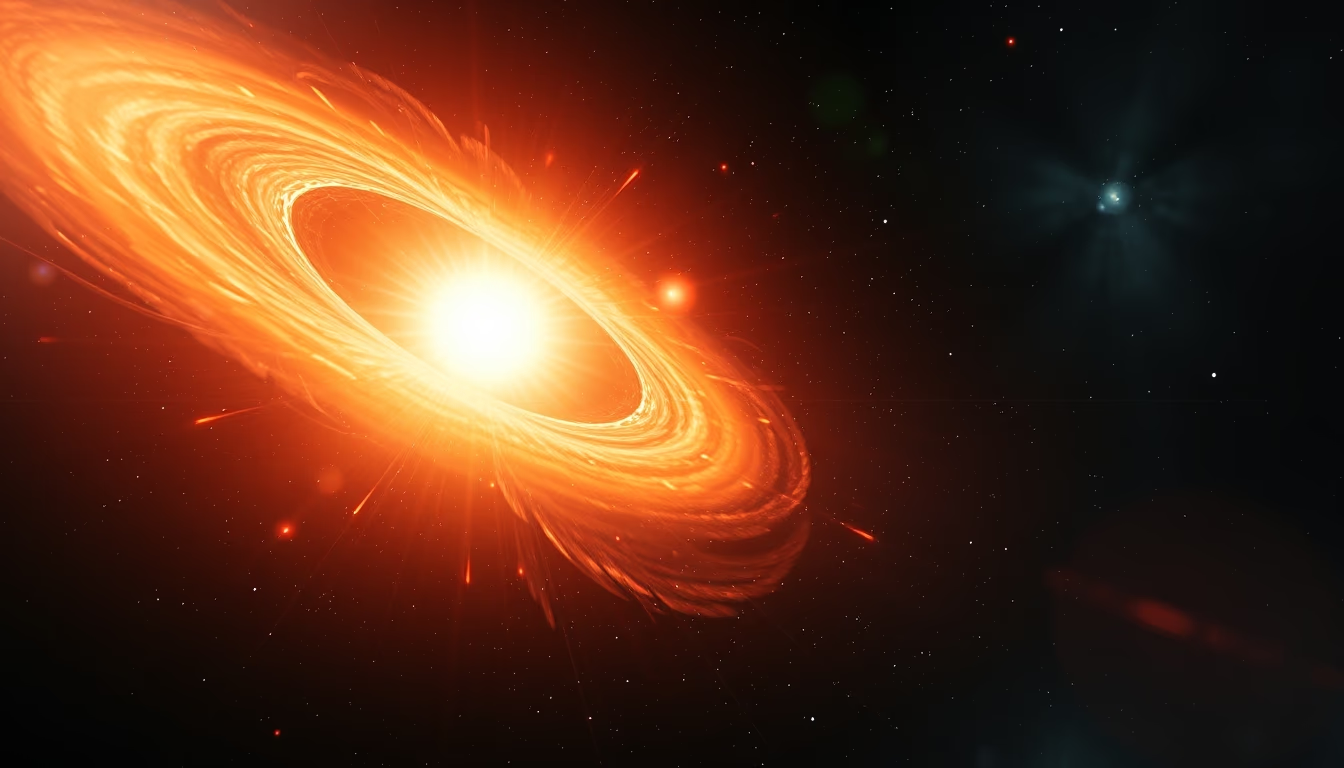
Pulsars are rapidly rotating neutron stars that emit beams of radiation, acting as cosmic lighthouses.
About this subject
Pulsars are highly magnetized neutron stars that rotate at extreme speeds, emitting beams of electromagnetic radiation from their magnetic poles. When these beams point toward Earth, they are detected as regular pulses, hence the name 'pulsar'. They form when a massive star explodes in a supernova, leaving behind a collapsed core with density comparable to that of an atomic nucleus. The most famous pulsar is the Crab Pulsar, located in the Crab Nebula, which rotates about 30 times per second and was first observed in 1968. Another notable example is the Vela Pulsar, which pulses every 89 milliseconds. These objects serve as natural laboratories for testing general relativity, as their intense gravitational field and rotation allow the study of effects such as geodetic precession and gravitational wave emission. Additionally, pulsars can be used as precise cosmic clocks, aiding in the detection of exoplanets and interstellar navigation. The discovery of the first pulsar in 1967 by Jocelyn Bell Burnell revolutionized astrophysics and led to the 1974 Nobel Prize in Physics.
Frequently Asked Questions
What causes the regular pulses of a pulsar?
The pulses are caused by the rapid rotation of the neutron star combined with its intense magnetic field. The beams of radiation from the magnetic poles sweep through space like lighthouses; when they point toward Earth, we detect a pulse.
What is the difference between a neutron star and a pulsar?
Every neutron star is the collapsed core of a supernova, but not all are pulsars. A pulsar is a neutron star that emits pulsing radiation beams, typically due to its intense rotation and magnetism.
How do pulsars help detect gravitational waves?
Extremely stable rotating pulsars, such as millisecond pulsars, are used as cosmic clocks in timing experiments. Small variations in pulse arrival times can reveal the passage of low-frequency gravitational waves, such as those from supermassive black hole mergers.
Direct URL
https://pub-c7d6a6ea828543ac903a74a341ccb2e1.r2.dev/imagens/neutron-star-pulsar-magazine-editorial-p11.avifHow to credit
Include a visible link back to UtilizAí. Copy one of the snippets below:
<a href="https://xn--utiliza-eza.com/en/midia/imagens/neutron-star-pulsar-magazine-editorial-p11">Neutron star pulsar</a> by <a href="https://xn--utiliza-eza.com">UtilizAí</a>, licensed under <a href="https://creativecommons.org/licenses/by/4.0/">CC BY 4.0</a>.
[Neutron star pulsar](https://xn--utiliza-eza.com/en/midia/imagens/neutron-star-pulsar-magazine-editorial-p11) by [UtilizAí](https://xn--utiliza-eza.com), CC BY 4.0
License: CC-BY-4.0