Neutron star pulsar
1344×768 · AVIF · CC BY 4.0
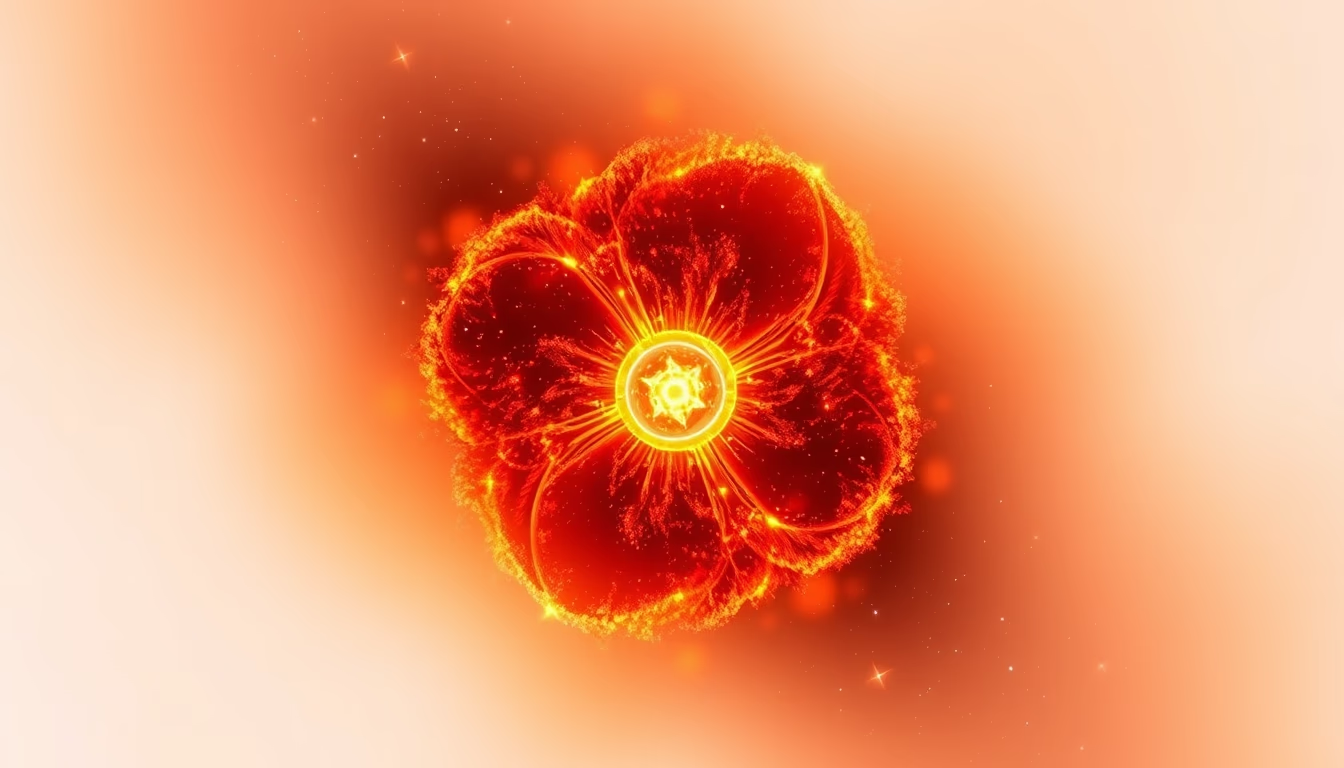
Pulsars are neutron stars that emit beams of radiation at regular intervals, acting as cosmic lighthouses.
About this subject
Pulsars are rapidly rotating neutron stars that emit beams of electromagnetic radiation from their magnetic poles. These beams sweep across space like lighthouses, and when they point toward Earth, they are detected as regular pulses. Pulsars were discovered in 1967 by Jocelyn Bell Burnell and Antony Hewish, a milestone in astrophysics that led to the Nobel Prize in Physics in 1974.
Neutron stars are the remnants of supernovae, with masses between 1.4 and 2.16 solar masses compressed into a diameter of about 20 kilometers. Their density is so extreme that a teaspoon of material would weigh billions of tons. Pulsars lose rotational energy over time, decreasing their pulse frequency. There are millisecond pulsars, which are much faster and can rotate hundreds of times per second, often found in binary systems where they accrete matter from a companion star.
The most famous pulsar lies at the center of the Crab Nebula, the remnant of a supernova observed in 1054. It pulses about 30 times per second. Pulsars are used as highly precise cosmic clocks and to test theories of gravity, such as general relativity. They also help map the interstellar medium and detect gravitational waves. The first binary pulsar system, discovered by Russell Hulse and Joseph Taylor in 1974, provided indirect evidence for gravitational waves, later confirmed.
Frequently Asked Questions
What causes the regular pulses of a pulsar?
The pulses are caused by the radiation beam emitted from the magnetic poles of the rotating neutron star. When the beam points toward Earth during each rotation, we detect a pulse.
What is the density of a neutron star?
A neutron star has extreme density: a teaspoon of its material would weigh about billions of tons, equivalent to a mountain compressed into a tiny volume.
How are pulsars used in astronomy?
Pulsars are used as highly precise cosmic clocks to test gravitational theories, map the interstellar medium, and detect gravitational waves by monitoring their pulses.
Direct URL
https://pub-c7d6a6ea828543ac903a74a341ccb2e1.r2.dev/imagens/neutron-star-pulsar-isometric-flat-lay-p1.avifHow to credit
Include a visible link back to UtilizAí. Copy one of the snippets below:
<a href="https://xn--utiliza-eza.com/en/midia/imagens/neutron-star-pulsar-isometric-flat-lay-p1">Neutron star pulsar</a> by <a href="https://xn--utiliza-eza.com">UtilizAí</a>, licensed under <a href="https://creativecommons.org/licenses/by/4.0/">CC BY 4.0</a>.
[Neutron star pulsar](https://xn--utiliza-eza.com/en/midia/imagens/neutron-star-pulsar-isometric-flat-lay-p1) by [UtilizAí](https://xn--utiliza-eza.com), CC BY 4.0
License: CC-BY-4.0