Motherboard atx detail
1344×768 · AVIF · CC BY 4.0
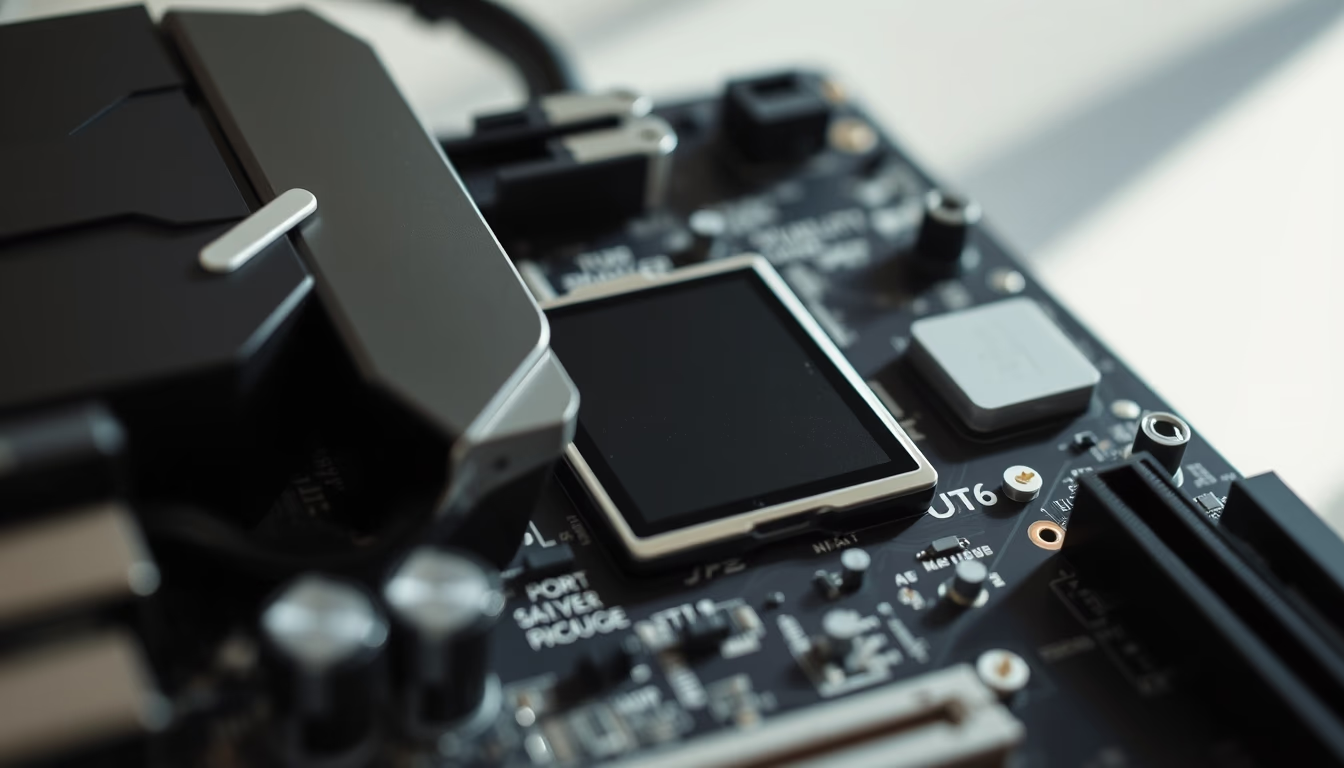
ATX motherboard detail reveals the standardized layout that defines connectivity and expansion for modern desktop computers.
About this subject
The ATX (Advanced Technology eXtended) motherboard is a standardized form factor introduced by Intel in 1995 to replace the older AT standard. Its official dimensions are 305 mm by 244 mm (12 x 9.6 inches), allowing up to seven expansion slots and a layout optimized for airflow and component placement. The standard was developed to address AT limitations such as difficult access to connectors and poor cooling.
A close-up of an ATX motherboard reveals the CPU socket location, typically near the RAM (DIMM) slots and the chipset (northbridge and southbridge, or modern single chipset). Expansion slots follow a specific order, with PCI Express x16 for graphics cards and x1 for other add-on cards. The main 24-pin power connector and an auxiliary 4 or 8-pin CPU power connector ensure stable power delivery. Additionally, the motherboard integrates audio, Ethernet, and USB controllers.
The ATX form factor spawned variants such as microATX (244 mm x 244 mm) and Mini-ITX (170 mm x 170 mm), retaining mounting hole and connector compatibility. Component placement aims to reduce electromagnetic interference and improve cooling. Notably, the standard specifies the exact location of the rear I/O panel, ensuring perfect fit between cases and motherboards. Over two decades later, ATX remains the most common form factor for desktop computers, supporting everything from low-power processors to high-performance workstations.
Frequently Asked Questions
What is the standard size of an ATX motherboard?
The standard size of an ATX motherboard is 305 mm wide by 244 mm deep (12 x 9.6 inches).
Who created the ATX standard?
The ATX standard was created by Intel in 1995, first implemented with the Pentium processor and the 430FX chipset.
What expansion slots does an ATX motherboard typically have?
A typical ATX motherboard has PCI Express (PCIe) x16 slots for graphics cards, PCIe x1 slots for other peripherals, and possibly legacy PCI slots or M.2 slots for SSDs.
Direct URL
https://pub-c7d6a6ea828543ac903a74a341ccb2e1.r2.dev/imagens/motherboard-atx-detail-minimalist-composition-p11.avifHow to credit
Include a visible link back to UtilizAí. Copy one of the snippets below:
<a href="https://xn--utiliza-eza.com/en/midia/imagens/motherboard-atx-detail-minimalist-composition-p11">Motherboard atx detail</a> by <a href="https://xn--utiliza-eza.com">UtilizAí</a>, licensed under <a href="https://creativecommons.org/licenses/by/4.0/">CC BY 4.0</a>.
[Motherboard atx detail](https://xn--utiliza-eza.com/en/midia/imagens/motherboard-atx-detail-minimalist-composition-p11) by [UtilizAí](https://xn--utiliza-eza.com), CC BY 4.0
License: CC-BY-4.0