Modernist staircase spiral
1344×768 · AVIF · CC BY 4.0
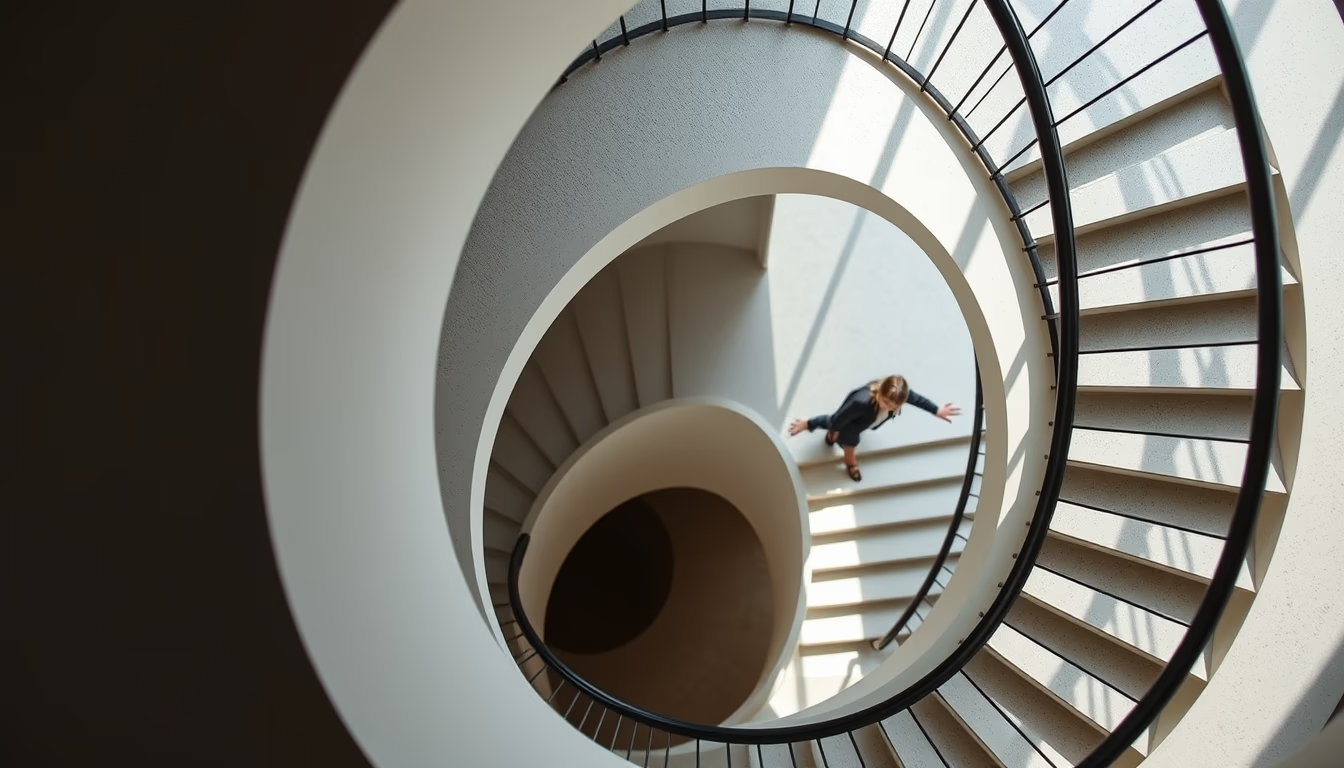
The modernist spiral staircase combines functionality and artistic expression, becoming an icon of 20th-century architecture.
About this subject
The modernist spiral staircase is one of the most striking elements of modern movement architecture. Popularized in the early decades of the 20th century, it reflects the principles of functionality, lightness, and spatial integration advocated by architects such as Le Corbusier, Oscar Niemeyer, and Frank Lloyd Wright. Unlike traditional staircases, the spiral saves space and creates a unique visual dynamic, often serving as a focal point in residential, commercial, and institutional buildings.
From a technical standpoint, the modernist spiral staircase is typically built from reinforced concrete, steel, or wood, with steps projecting from a central axis. The absence of surrounding columns or walls emphasizes fluidity and transparency, key features of modernism. A famous example is the helical staircase at the São Paulo Museum of Art (MASP), designed by Lina Bo Bardi, which became a symbol of Brazilian architecture. Another example is the staircase at the Copan Building in São Paulo, designed by Oscar Niemeyer, which uses the spiral to connect different residential blocks.
Culturally, the modernist spiral staircase represents a break from historicism and the pursuit of a new rational aesthetic. It is also associated with urban growth and verticalization, especially in Brazilian cities during the 1950s and 1960s. In terms of influence, the design has inspired everything from light fixtures to toys, showcasing its versatility. Today, the spiral staircase continues to be reinterpreted in contemporary projects using materials like glass and corten steel, maintaining its status as an architectural icon.
Frequently Asked Questions
What is the difference between a spiral staircase and a helical staircase?
A spiral staircase has steps that rotate around a central axis, while a helical staircase has a continuous curved shape without a central axis, usually supported by walls or beams.
What are the main materials used in modernist staircases?
Reinforced concrete, steel, and wood are the most common. Concrete allows organic shapes, steel offers lightness, and wood provides warmth.
How does a spiral staircase contribute to sustainable architecture?
It optimizes space usage, reducing the footprint. Additionally, it can be made with recyclable materials and, in projects with natural lighting, reduces energy consumption.
Direct URL
https://pub-c7d6a6ea828543ac903a74a341ccb2e1.r2.dev/imagens/modernist-staircase-spiral-magazine-editorial-p5.avifHow to credit
Include a visible link back to UtilizAí. Copy one of the snippets below:
<a href="https://xn--utiliza-eza.com/en/midia/imagens/modernist-staircase-spiral-magazine-editorial-p5">Modernist staircase spiral</a> by <a href="https://xn--utiliza-eza.com">UtilizAí</a>, licensed under <a href="https://creativecommons.org/licenses/by/4.0/">CC BY 4.0</a>.
[Modernist staircase spiral](https://xn--utiliza-eza.com/en/midia/imagens/modernist-staircase-spiral-magazine-editorial-p5) by [UtilizAí](https://xn--utiliza-eza.com), CC BY 4.0
License: CC-BY-4.0