Modernist staircase spiral
1344×768 · AVIF · CC BY 4.0
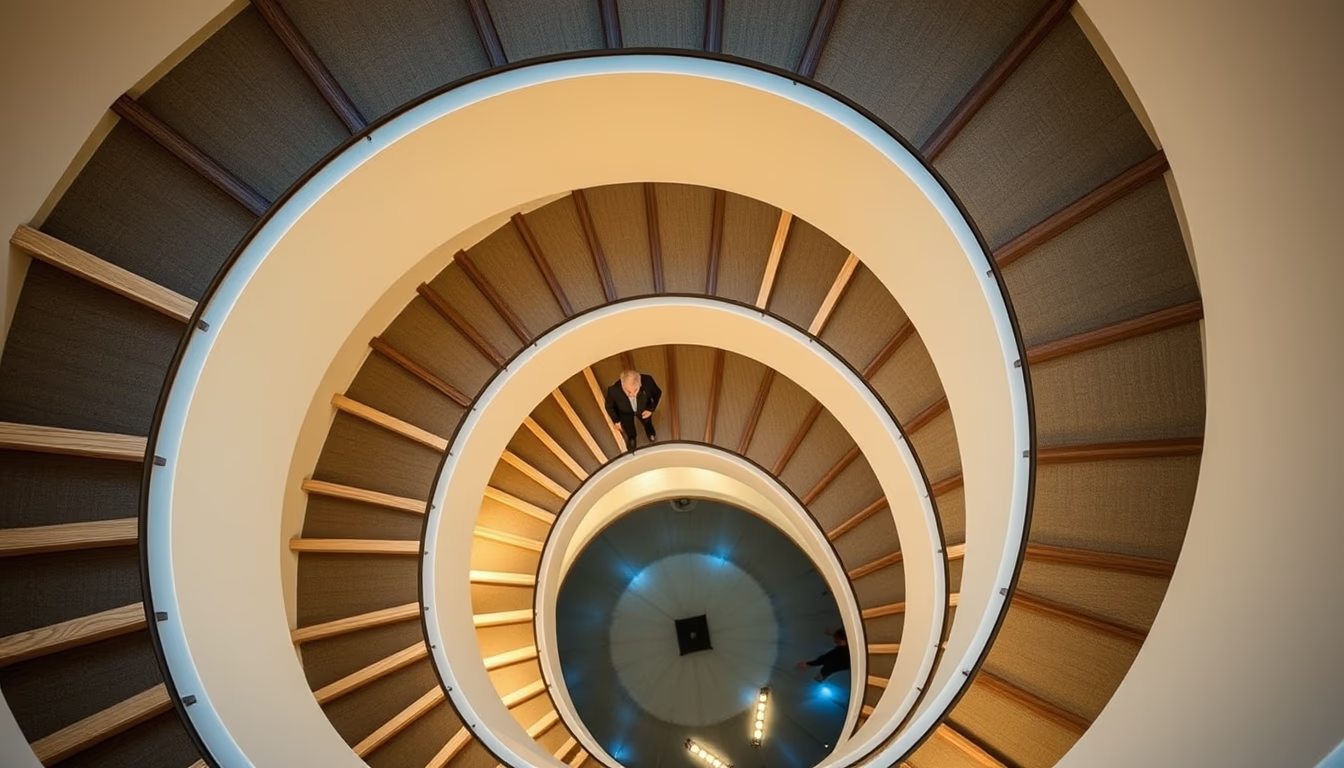
The modernist spiral staircase, an icon of 20th century architecture, combines form and function in gravity-defying structures.
About this subject
The modernist spiral staircase is one of the most distinctive elements of modern movement architecture, especially between the 1920s and 1960s. Inspired by concepts of fluidity and spatial efficiency, it was widely used by architects such as Oscar Niemeyer, Le Corbusier, and Frank Lloyd Wright. In Brazil, Niemeyer employed it in works like the Palácio da Alvorada and the Niterói Contemporary Art Museum, where the spiral integrates with the landscape and reinforced concrete.
The structure is typically made of concrete, steel, or a combination of both, with steps projecting from a central core, eliminating the need for internal columns. This innovation allowed for greater visual lightness and free floor plans. Beyond aesthetics, the spiral optimizes vertical flow in compact spaces, being common in residential, commercial, and institutional buildings.
Culturally, the modernist spiral staircase represents a break from historical ornamentation and a valorization of pure lines and geometry. In countries like France and Italy, it adorns villas and museums, while in Latin America it becomes a symbol of modernity and progress. A notable example is the staircase of the Copan building in São Paulo, which snakes for over 30 floors.
Interestingly, aerial drone photography reveals the beauty of the spiral from above, highlighting its mathematical design and interaction with light. Many of these staircases are designed to be viewed both from inside and outside, creating a dynamic visual experience that has become an icon of modernist design.
Frequently Asked Questions
What characterizes a modernist spiral staircase?
It features steps projecting from a central core, typically in concrete or steel, without internal columns. It prioritizes pure lines, fluidity, and integration with the environment, unlike the ornate staircases of previous periods.
Which famous architects used modernist spiral staircases?
Oscar Niemeyer, Le Corbusier, and Frank Lloyd Wright are among the main ones. Niemeyer used them in works like the Palácio da Alvorada and MAC Niterói. Wright created the iconic spiral ramp of the Guggenheim Museum.
Why is aerial drone photography ideal for recording these staircases?
The top-down view highlights the geometric design and symmetry of the spiral, which is difficult to capture from the ground. Drones provide angles that reveal structural complexity and interaction with light and surroundings.
Direct URL
https://pub-c7d6a6ea828543ac903a74a341ccb2e1.r2.dev/imagens/modernist-staircase-spiral-aerial-drone-shot-p1.avifHow to credit
Include a visible link back to UtilizAí. Copy one of the snippets below:
<a href="https://xn--utiliza-eza.com/en/midia/imagens/modernist-staircase-spiral-aerial-drone-shot-p1">Modernist staircase spiral</a> by <a href="https://xn--utiliza-eza.com">UtilizAí</a>, licensed under <a href="https://creativecommons.org/licenses/by/4.0/">CC BY 4.0</a>.
[Modernist staircase spiral](https://xn--utiliza-eza.com/en/midia/imagens/modernist-staircase-spiral-aerial-drone-shot-p1) by [UtilizAí](https://xn--utiliza-eza.com), CC BY 4.0
License: CC-BY-4.0