Milky way over mountain
1344×768 · AVIF · CC BY 4.0
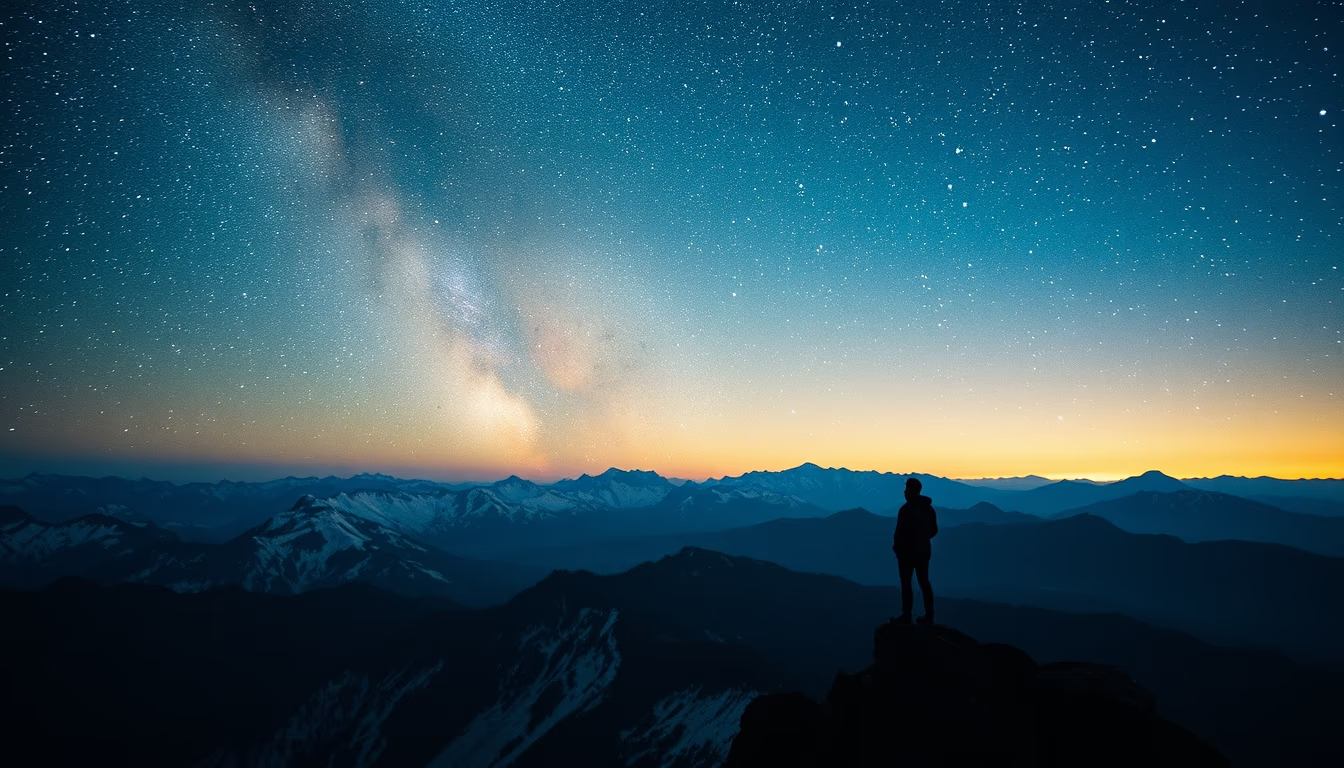
The Milky Way over mountains is one of the most stunning celestial sights, revealing the spiral arm of our galaxy on nights without light pollution.
About this subject
The Milky Way, our galaxy, is a massive spiral structure composed of billions of stars, gas, and dust. When observed over mountains, the contrast between the galaxy's diffuse glow and the dark silhouettes of the peaks creates a breathtaking image. This phenomenon is best seen in remote locations with low light pollution and clear skies, such as high-altitude areas where the atmosphere is thinner and visibility improves.
Mountains play a key role in amateur and professional astronomy. Many observatories are situated on high mountains because altitude reduces atmospheric interference. For instance, the Atacama Observatory in Chile and Mauna Kea in Hawaii are at altitudes above 4,000 meters, providing exceptional conditions for observing the Milky Way. In Brazil, places like Serra da Capivara (Piauí) and Lençóis Maranhenses National Park are known for dark skies ideal for this observation.
The best time to see the Milky Way in the Southern Hemisphere is between March and October, peaking in June and July. To photograph it, a camera with a wide-angle lens, tripod, and long exposure is recommended. The Milky Way phenomenon reminds us of our place in the universe: we lie in one of the spiral arms, about 26,000 light-years from the galactic center, which harbors a supermassive black hole called Sagittarius A*.
Frequently Asked Questions
What is the best time to observe the Milky Way in the Southern Hemisphere?
The best period is from March to October, with June and July being optimal when the galactic center is highest in the sky.
Why are mountains good for observing the Milky Way?
Mountains provide high altitudes, which reduce light pollution and atmospheric interference, along with wider horizons and drier air.
Can the Milky Way be seen with the naked eye?
Yes, in areas with little light pollution and dark skies, the Milky Way appears as a milky band of stars and dust stretching across the sky.
Direct URL
https://pub-c7d6a6ea828543ac903a74a341ccb2e1.r2.dev/imagens/milky-way-over-mountain-film-grain-authentic-p3.avifHow to credit
Include a visible link back to UtilizAí. Copy one of the snippets below:
<a href="https://xn--utiliza-eza.com/en/midia/imagens/milky-way-over-mountain-film-grain-authentic-p3">Milky way over mountain</a> by <a href="https://xn--utiliza-eza.com">UtilizAí</a>, licensed under <a href="https://creativecommons.org/licenses/by/4.0/">CC BY 4.0</a>.
[Milky way over mountain](https://xn--utiliza-eza.com/en/midia/imagens/milky-way-over-mountain-film-grain-authentic-p3) by [UtilizAí](https://xn--utiliza-eza.com), CC BY 4.0
License: CC-BY-4.0