Milky way over mountain
1344×768 · AVIF · CC BY 4.0
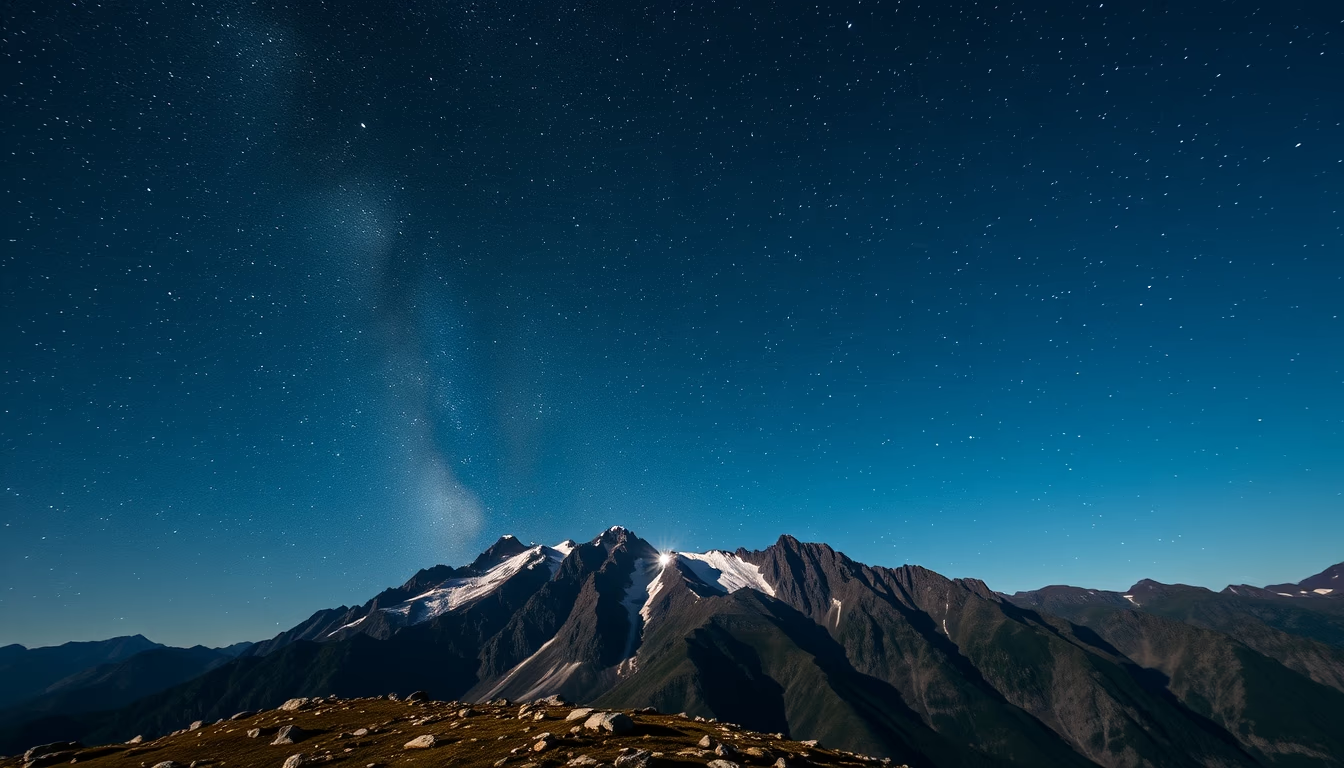
The Milky Way, our spiral galaxy, seen above mountains in a high-altitude night landscape.
About this subject
The Milky Way is a barred spiral galaxy that hosts the Solar System, with an estimated diameter of 100,000 light-years and containing between 100 and 400 billion stars. Seen from Earth, it appears as a milky band across the sky, produced by the combined light of countless stars and interstellar dust in its galactic disk. To fully appreciate its splendor, one must be in areas with low light pollution, such as remote mountainous regions, and on moonless nights, ideally during the winter of the Southern Hemisphere or summer of the Northern Hemisphere when the galactic center is more prominent.
Photographing the Milky Way over mountains requires specific techniques: long exposures, a sturdy tripod, and often an equatorial tracker to compensate for Earth's rotation. The combination of mountain silhouettes with the stellar glow creates breathtaking images that emphasize the vastness of the universe. Mountain ranges like the Himalayas, the Andes, or Brazil's Serra do Mar provide prime settings for this practice, especially at altitudes above 2,000 meters, where the air is thinner and light pollution minimal.
Culturally, the Milky Way has inspired mythologies and science for centuries. In Greek mythology, its name comes from milk spilled by Hera; among Brazil's indigenous Tupi-Guarani, it was called the Path of the Tapirs or River of Birds. Today, it is an icon of astrophotography and dark-sky tourism, with protected areas being created to preserve its visibility. A documentary image of the Milky Way over a mountain is not only visually striking but also serves as a record of the importance of protecting our night skies.
Frequently Asked Questions
Why does the Milky Way appear as a bright band across the sky?
It appears as a band because we are inside the galactic disk, viewing its stars and dust edge-on. The accumulated light of billions of stars creates a diffuse glow resembling spilled milk.
What is the best time to observe the Milky Way over mountains?
The best period is between March and September in the Southern Hemisphere, and between June and December in the Northern Hemisphere, when the galactic core is highest. Moonless nights away from cities are essential.
How to photograph the Milky Way over mountains without professional gear?
Use a camera with manual exposure (or a smartphone with night mode). Set ISO high (3200-6400), widest aperture (f/2.8 or lower), and exposure of 15-30 seconds. A tripod is indispensable to avoid blur.
Direct URL
https://pub-c7d6a6ea828543ac903a74a341ccb2e1.r2.dev/imagens/milky-way-over-mountain-documentary-photography-p5.avifHow to credit
Include a visible link back to UtilizAí. Copy one of the snippets below:
<a href="https://xn--utiliza-eza.com/en/midia/imagens/milky-way-over-mountain-documentary-photography-p5">Milky way over mountain</a> by <a href="https://xn--utiliza-eza.com">UtilizAí</a>, licensed under <a href="https://creativecommons.org/licenses/by/4.0/">CC BY 4.0</a>.
[Milky way over mountain](https://xn--utiliza-eza.com/en/midia/imagens/milky-way-over-mountain-documentary-photography-p5) by [UtilizAí](https://xn--utiliza-eza.com), CC BY 4.0
License: CC-BY-4.0