Milky way over mountain
1344×768 · AVIF · CC BY 4.0
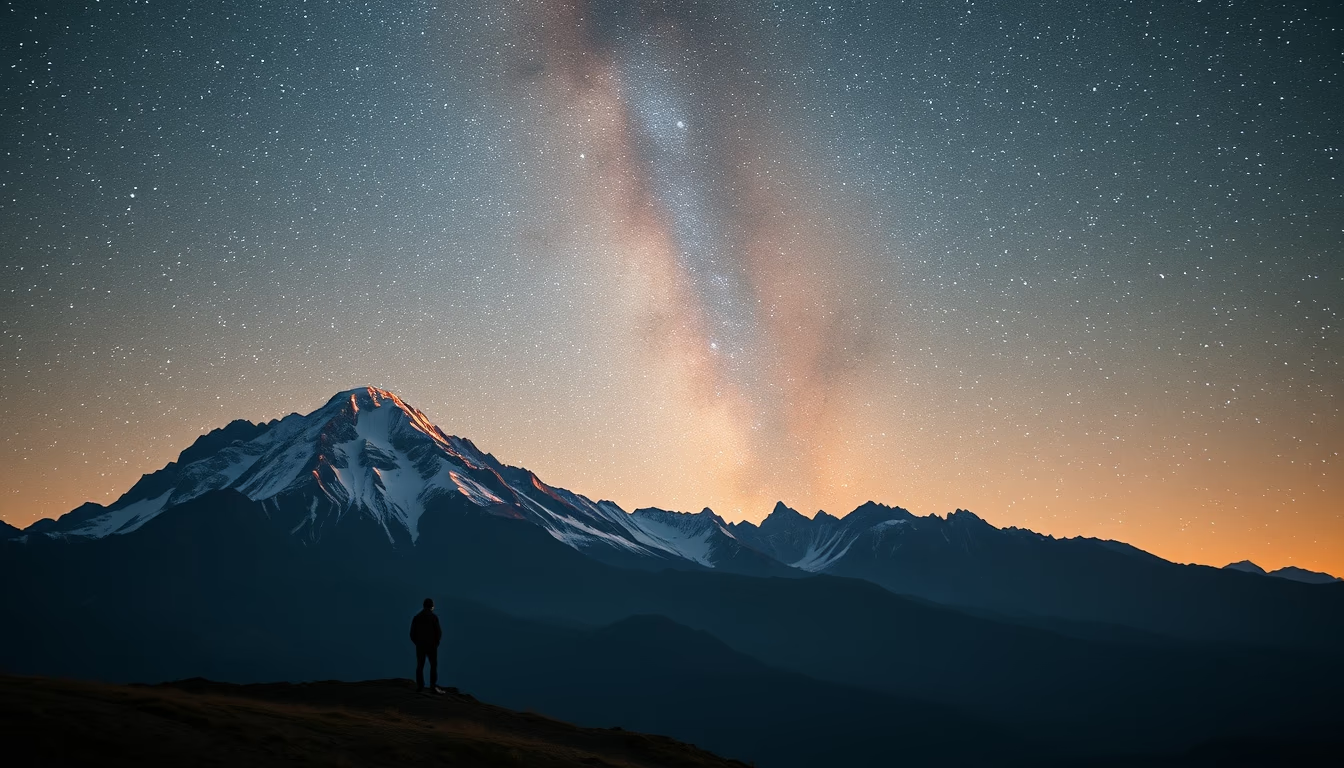
The Milky Way is the spiral galaxy containing the Solar System, with billions of stars visible to the naked eye in areas with low light pollution.
About this subject
The Milky Way is a barred spiral galaxy with an estimated diameter between 100,000 and 120,000 light-years. The Solar System is located in one of its spiral arms, the Orion Arm, about 27,000 light-years from the galactic center. On clear, moonless nights, especially in mountainous areas far from urban centers, it is possible to see the diffuse glow and elongated structure of the galaxy crossing the sky.
Culturally, the Milky Way holds great importance in various mythologies. In Greek mythology, it was believed to be milk spilled from Hera's breast, forming the bright band in the sky. In Brazil, indigenous peoples like the Tupi-Guaranis called it the "Tapir's Path" or "River of Birds". The Incas saw it as a celestial river that nourished the Earth.
For optimal viewing of the Milky Way, locations with high altitude, dry air, and minimal light pollution are recommended. Mountains in desert regions or plateaus offer exceptional conditions. In Brazil, destinations such as Chapada dos Veadeiros (Goiás) and Cariri Paraibano (Paraíba) are recognized for their dark skies and are sought after by astrophotographers and amateur astronomers.
The center of the Milky Way, located in the constellation Sagittarius, is a dense region of stars and interstellar dust. There resides Sagittarius A*, a supermassive black hole with about 4 million solar masses. Light from the galactic center takes approximately 27,000 years to reach us, and its observation is most favorable during the winter months in the Southern Hemisphere (May to August).
Frequently Asked Questions
Why is it called the Milky Way?
The name comes from Greek mythology: it was believed that the goddess Hera, while nursing Heracles, spilled milk that formed the bright band in the sky. In Latin, Via Lactea means "milky road".
What is the best time to see the Milky Way?
In the Southern Hemisphere, the best months are May to August (winter), when the galactic center is higher in the night sky. In the Northern Hemisphere, it is best between June and September.
What is at the center of the Milky Way?
At the center of the galaxy lies Sagittarius A*, a supermassive black hole with about 4 million times the mass of the Sun. It is located in the direction of the constellation Sagittarius.
Direct URL
https://pub-c7d6a6ea828543ac903a74a341ccb2e1.r2.dev/imagens/milky-way-over-mountain-cinematic-wide-shot-p6.avifHow to credit
Include a visible link back to UtilizAí. Copy one of the snippets below:
<a href="https://xn--utiliza-eza.com/en/midia/imagens/milky-way-over-mountain-cinematic-wide-shot-p6">Milky way over mountain</a> by <a href="https://xn--utiliza-eza.com">UtilizAí</a>, licensed under <a href="https://creativecommons.org/licenses/by/4.0/">CC BY 4.0</a>.
[Milky way over mountain](https://xn--utiliza-eza.com/en/midia/imagens/milky-way-over-mountain-cinematic-wide-shot-p6) by [UtilizAí](https://xn--utiliza-eza.com), CC BY 4.0
License: CC-BY-4.0