Milky way galaxy long exposure
1344×768 · AVIF · CC BY 4.0
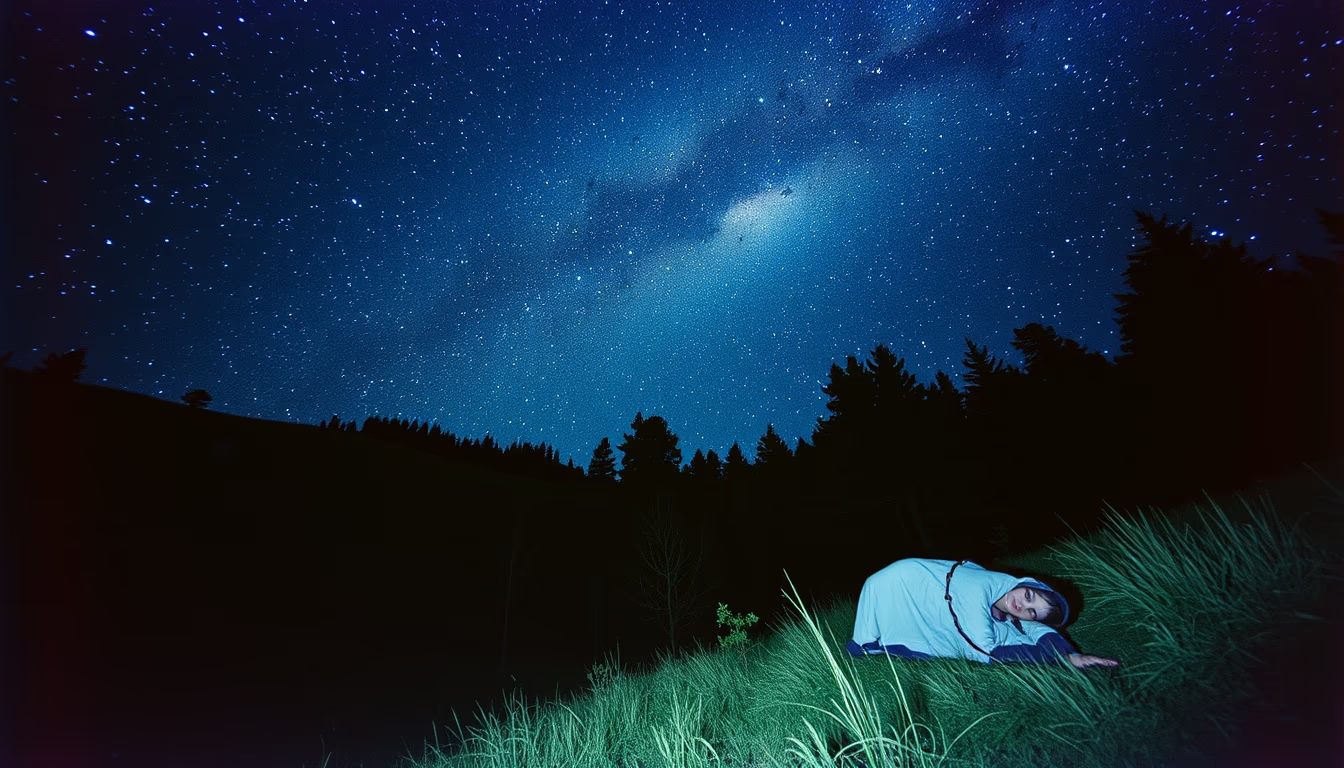
The Milky Way is a spiral galaxy containing our solar system, visible in long-exposure night shots as a starry band.
About this subject
The Milky Way is a barred spiral galaxy with an estimated diameter of 100,000 to 120,000 light-years, containing 100 to 400 billion stars. Our solar system resides in the Orion Arm, about 26,000 light-years from the galactic center. Its structure includes a central bulge, spiral arms, and a halo of stars and clusters.
To capture the Milky Way in its full glory, long-exposure techniques are essential. Astrophotographers use sturdy tripods, sensitive camera sensors, and fast wide-angle lenses, often with f/2.8 aperture. Typical settings include ISO 1600 to 3200 and exposures of 20 to 30 seconds to avoid star trails. Post-processing, such as stacking multiple exposures, enhances faint details. A recent trend involves lo-fi or disposable cameras, which produce grainy, vignetted images that evoke a nostalgic, authentic style.
Culturally, the Milky Way has fascinated humanity for millennia. For the Tupi-Guarani people, it was the "path of shadows," while medieval Europeans called it the "Way of Saint James." In modern astronomy, it serves as a laboratory for studying star formation and black holes. Locations like the Atacama Desert, Jasper National Park, and Brazil's Seridó region are renowned for their dark skies, ideal for observation and photography.
Fun facts: The galactic center, in the constellation Sagittarius, hosts Sagittarius A*, a supermassive black hole with 4 million solar masses. Light takes 100,000 years to cross the galaxy from end to end. Lo-fi Milky Way photography has gained popularity on social media platforms like Instagram, where grain and desaturated colors evoke analog travel records.
Frequently Asked Questions
How to photograph the Milky Way?
Use a tripod, a wide-angle lens with aperture at least f/2.8, ISO between 1600 and 3200, and exposure of 20 to 30 seconds. Choose moonless nights and locations away from light pollution. Stacking multiple exposures improves the final image.
What is the best time of year to see the Milky Way?
In the Southern Hemisphere, from February to October; in the Northern Hemisphere, from March to September. The galactic center is most visible between April and August, when it is highest in the night sky.
What causes the grainy appearance in Milky Way photos?
The grain comes from the high ISO needed to capture faint starlight. Lo-fi disposable cameras amplify this effect, resulting in a vintage, textured aesthetic.
Direct URL
https://pub-c7d6a6ea828543ac903a74a341ccb2e1.r2.dev/imagens/milky-way-galaxy-long-exposure-lo-fi-disposable-camera-p1.avifHow to credit
Include a visible link back to UtilizAí. Copy one of the snippets below:
<a href="https://xn--utiliza-eza.com/en/midia/imagens/milky-way-galaxy-long-exposure-lo-fi-disposable-camera-p1">Milky way galaxy long exposure</a> by <a href="https://xn--utiliza-eza.com">UtilizAí</a>, licensed under <a href="https://creativecommons.org/licenses/by/4.0/">CC BY 4.0</a>.
[Milky way galaxy long exposure](https://xn--utiliza-eza.com/en/midia/imagens/milky-way-galaxy-long-exposure-lo-fi-disposable-camera-p1) by [UtilizAí](https://xn--utiliza-eza.com), CC BY 4.0
License: CC-BY-4.0