Milky way galaxy long exposure
1344×768 · AVIF · CC BY 4.0
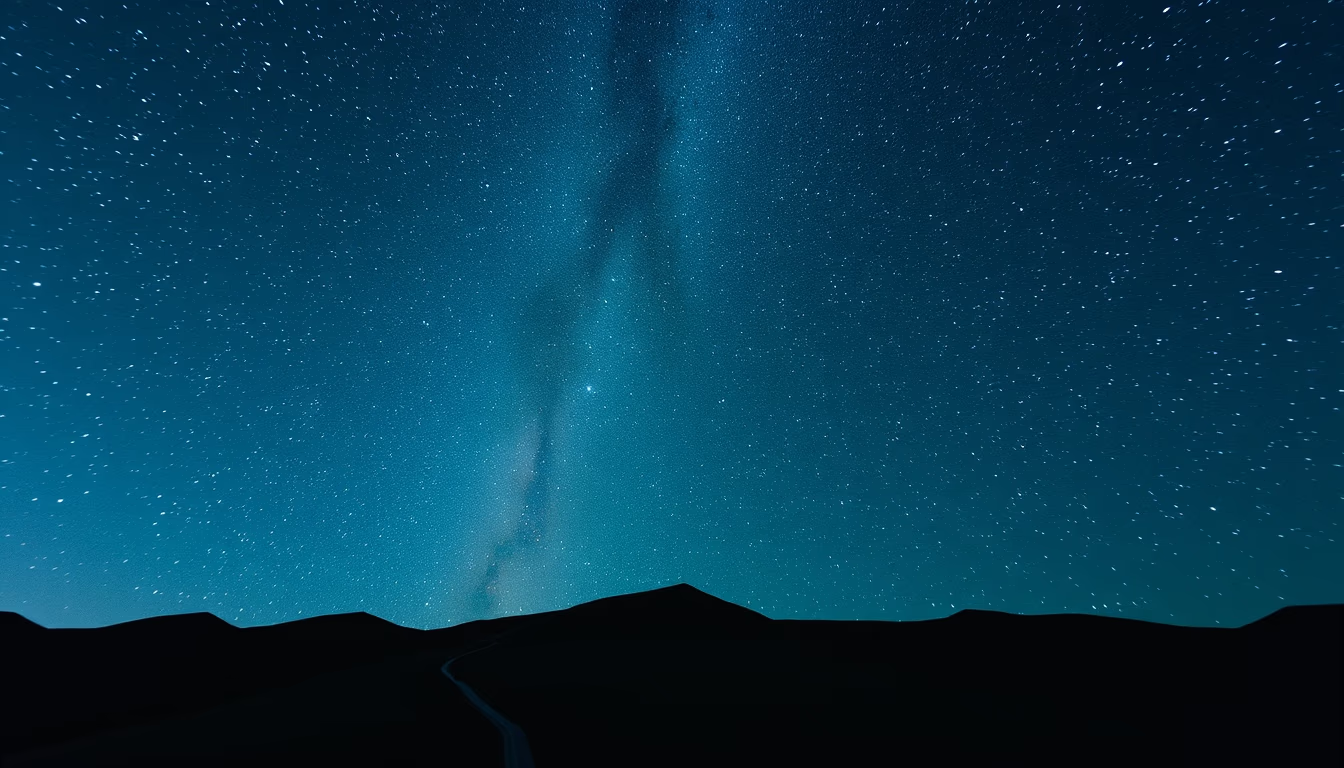
The Milky Way, our barred spiral galaxy, reveals in long exposures a dense field of stars and nebulae visible from dark sky locations.
About this subject
The Milky Way is a barred spiral galaxy containing 100 to 400 billion stars, including the Sun. Its estimated diameter is about 100,000 light-years. From Earth, it appears as a milky band of light across the night sky, composed of stars too faint to be resolved individually. The name comes from the Greek "galaxias kyklos" (milky circle).
To capture the Milky Way in long exposure, a location with low light pollution and clear skies is essential. Places like the Atacama Desert in Chile, La Palma in the Canary Islands, or remote areas in Brazil such as the Pantanal offer ideal conditions. Long exposure photography reveals details like the galactic bulge, spiral arms, and the North America Nebula.
The galaxy is in constant motion. The Solar System orbits the galactic center at about 220 km/s, completing one revolution every 230 million years, known as a galactic year. The Milky Way is part of the Local Group, a cluster of over 50 galaxies that includes Andromeda and the Triangulum Galaxy.
Culturally, the Milky Way holds great significance. Many indigenous peoples see it as a spiritual path or celestial river. In Brazil, the Tupi-Guarani call it "Caminho da Anta" or "Rio de Leite". Amateur and professional astronomers use long exposures to study star formation and interstellar medium composition.
Frequently Asked Questions
Why does the Milky Way look milky to the naked eye?
The milky appearance comes from the combined light of billions of distant stars merging into a continuous bright band. Naked eyes cannot resolve individual stars in those regions due to their enormous distance and apparent density.
What is the best time of year to observe the Milky Way?
In the southern hemisphere, winter months (June to August) offer the brightest view of the galactic bulge. In the northern hemisphere, the best window is from March to October, peaking in July and August when the galactic center is highest in the night sky.
Can I photograph the Milky Way with a smartphone?
Yes, many modern smartphones have night mode or astrophotography features that allow long exposure captures of the Milky Way. Using a tripod and disabling optical stabilization is recommended to avoid blur.
Direct URL
https://pub-c7d6a6ea828543ac903a74a341ccb2e1.r2.dev/imagens/milky-way-galaxy-long-exposure-aerial-drone-shot-p5.avifHow to credit
Include a visible link back to UtilizAí. Copy one of the snippets below:
<a href="https://xn--utiliza-eza.com/en/midia/imagens/milky-way-galaxy-long-exposure-aerial-drone-shot-p5">Milky way galaxy long exposure</a> by <a href="https://xn--utiliza-eza.com">UtilizAí</a>, licensed under <a href="https://creativecommons.org/licenses/by/4.0/">CC BY 4.0</a>.
[Milky way galaxy long exposure](https://xn--utiliza-eza.com/en/midia/imagens/milky-way-galaxy-long-exposure-aerial-drone-shot-p5) by [UtilizAí](https://xn--utiliza-eza.com), CC BY 4.0
License: CC-BY-4.0