Milky way center galactic
1344×768 · AVIF · CC BY 4.0
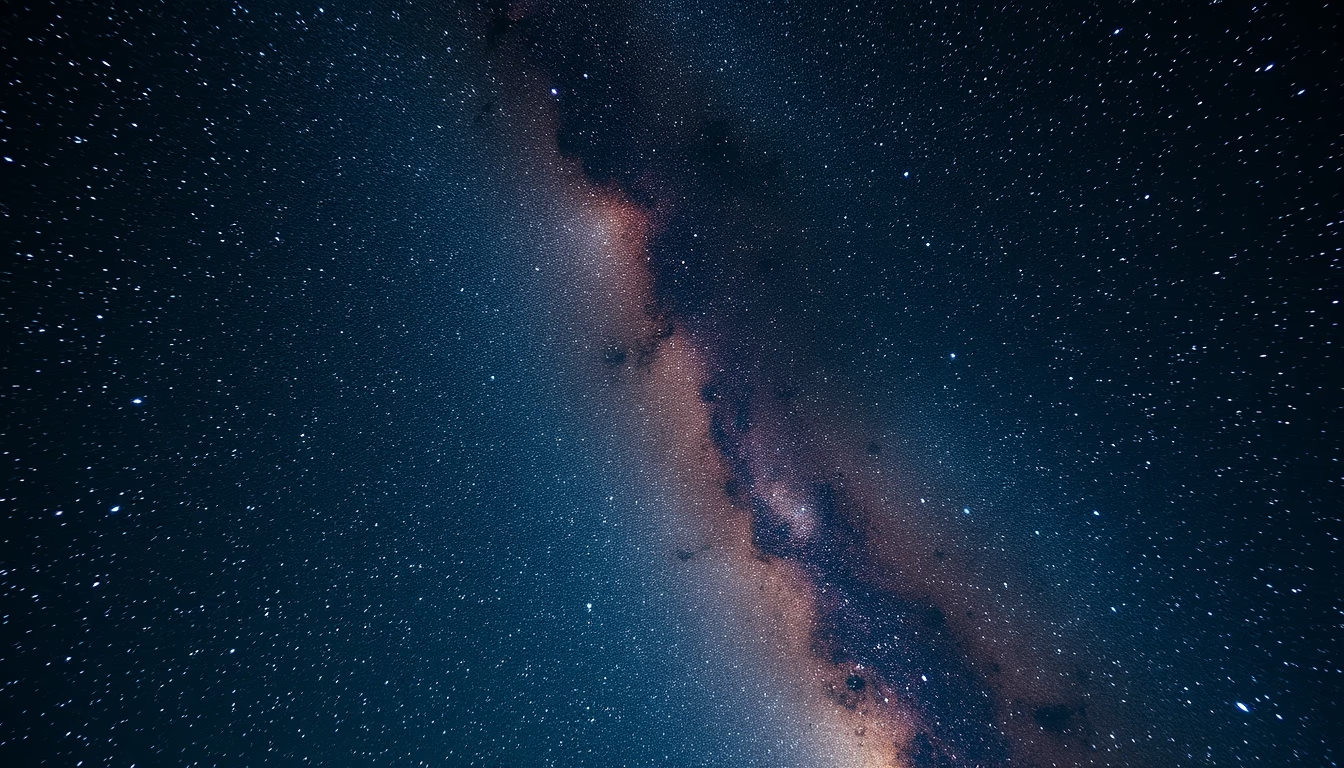
The center of the Milky Way, a dense and bright region, hosts a supermassive black hole and thousands of stars within a few light-years.
About this subject
The center of the Milky Way, located in the constellation Sagittarius, is one of the most extreme and studied regions of our galaxy. About 26,000 light-years from Earth, this area hosts Sagittarius A*, a supermassive black hole with a mass equivalent to 4 million suns. Intense radiation and powerful gravitational fields shape a unique environment where stars orbit at incredible speeds, some completing an orbit in just 16 years, like the star S2.
Observations in X-ray, infrared, and radio waves reveal a complex galactic center filled with gas and dust clouds, dense star clusters, and magnetic filaments. The region known as the "Central Molecular Zone" contains millions of solar masses of molecular gas, fueling star formation. The famous Quintuplet star cluster, near the black hole, hosts young and massive stars that challenge star formation models in hostile environments.
Recent studies with telescopes such as the Event Horizon Telescope and the James Webb Space Telescope continue to unravel the mysteries of the galactic center. In 2022, the Event Horizon Telescope team published the first image of Sagittarius A*, confirming predictions of general relativity. The region also serves as a natural laboratory to test theories of strong gravity and galactic evolution. Despite the distance, ongoing observations help understand the dynamics of active galactic nuclei and their influence on star and galaxy formation.
Frequently Asked Questions
What is Sagittarius A*?
Sagittarius A* is the supermassive black hole at the center of the Milky Way, with about 4 million solar masses. It is a compact radio source and was imaged by the Event Horizon Telescope in 2022.
How many stars are at the galactic center?
The galactic center contains thousands of stars within a few light-years, plus dense clusters like the Quintuplet and Arches clusters. Stellar density is millions of times higher than in our solar neighborhood.
Why study the center of the Milky Way?
The galactic center is a unique laboratory to test general relativity, study supermassive black holes, star formation in extreme environments, and galaxy evolution. Observations help understand phenomena like relativistic jets and matter accretion.
Direct URL
https://pub-c7d6a6ea828543ac903a74a341ccb2e1.r2.dev/imagens/milky-way-center-galactic-national-geographic-style-p1.avifHow to credit
Include a visible link back to UtilizAí. Copy one of the snippets below:
<a href="https://xn--utiliza-eza.com/en/midia/imagens/milky-way-center-galactic-national-geographic-style-p1">Milky way center galactic</a> by <a href="https://xn--utiliza-eza.com">UtilizAí</a>, licensed under <a href="https://creativecommons.org/licenses/by/4.0/">CC BY 4.0</a>.
[Milky way center galactic](https://xn--utiliza-eza.com/en/midia/imagens/milky-way-center-galactic-national-geographic-style-p1) by [UtilizAí](https://xn--utiliza-eza.com), CC BY 4.0
License: CC-BY-4.0