Mercury surface craters
1344×768 · AVIF · CC BY 4.0
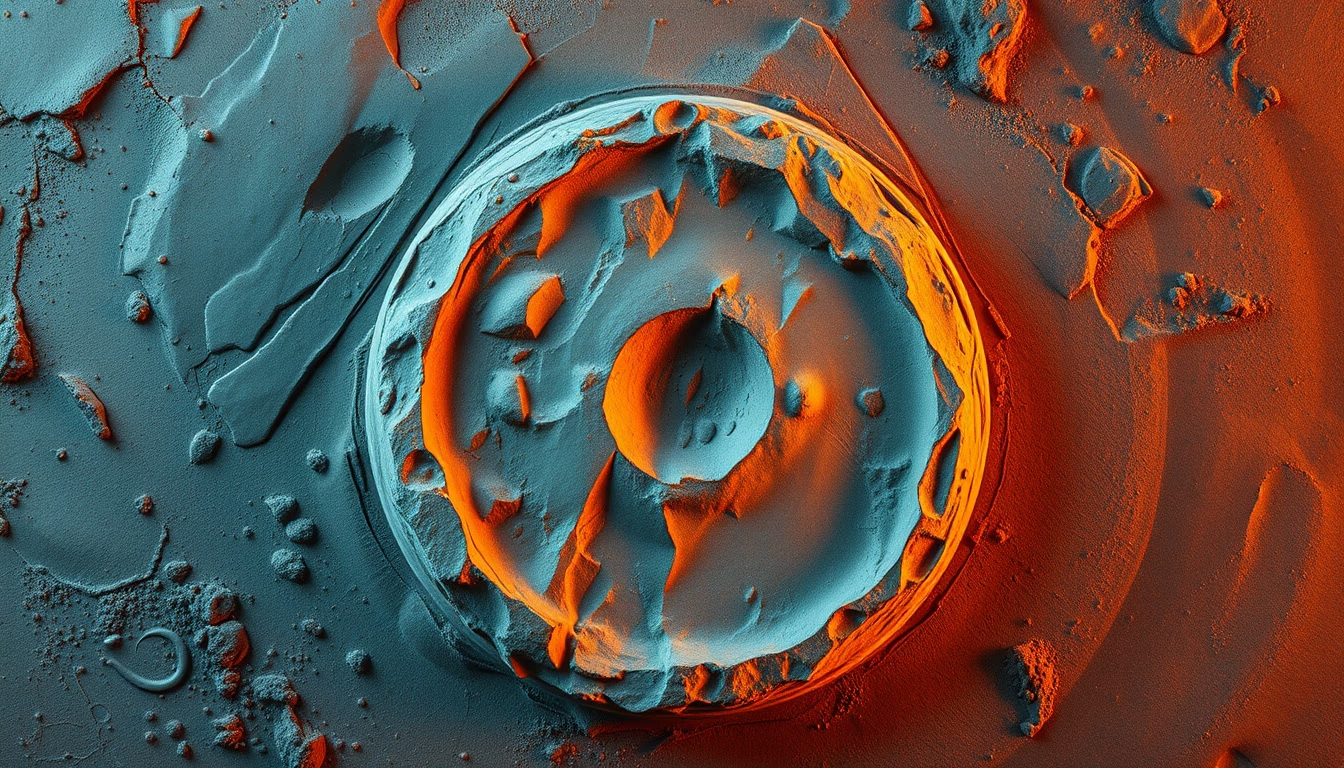
Mercury's craters are scars from meteoritic impacts that reveal the geological history of the planet closest to the Sun.
About this subject
Mercury's surface is covered by thousands of impact craters, formed over billions of years by asteroids and comets. Unlike Earth, Mercury lacks a significant atmosphere to burn or slow down these objects, so even small fragments hit the surface at high speed. The craters range from small pits to enormous basins hundreds of kilometers in diameter, such as the Caloris Basin, which spans about 1,550 km. That basin is one of the largest impact features in the Solar System, created by an object at least 100 km across roughly 3.9 billion years ago.
Craters on Mercury are named after deceased artists, musicians, painters, and writers, following the convention of the International Astronomical Union. Examples include Beethoven (after the composer) and Michelangelo craters. Unlike the Moon, Mercury's craters show fewer signs of ancient volcanic eruptions, but they exhibit unique features such as bright crater rays and irregular depressions called hollows, which may be formed by sublimation of volatile minerals exposed by the impact.
The preservation of Mercury's craters is remarkable due to the lack of geological processes like water erosion or intense tectonic activity. However, the surface is modified by subsequent impacts and by global contraction from core cooling, which creates thrust scarps (rupes). These features overlap some craters, indicating that cratering occurred before contraction. Detailed study of these structures, primarily from NASA's MESSENGER mission (2011-2015) and currently from BepiColombo (ESA and JAXA), helps scientists understand the evolution of the inner solar system and the impact frequency over time.
Frequently Asked Questions
Why does Mercury have so many craters?
Mercury has many craters because its atmosphere is extremely thin, so meteoroids are not burned up. Frequent impacts over billions of years have left the surface heavily cratered.
What is the largest crater on Mercury?
The largest is the Caloris Basin, about 1,550 km in diameter. It was formed by a giant impact roughly 3.9 billion years ago and is surrounded by mountains and fractures.
How are Mercury's craters named?
Craters are named after deceased artists, musicians, painters, and writers, following International Astronomical Union rules. Examples: Beethoven, Tolstoy, and Monet.
Direct URL
https://pub-c7d6a6ea828543ac903a74a341ccb2e1.r2.dev/imagens/mercury-surface-craters-isometric-flat-lay-p2.avifHow to credit
Include a visible link back to UtilizAí. Copy one of the snippets below:
<a href="https://xn--utiliza-eza.com/en/midia/imagens/mercury-surface-craters-isometric-flat-lay-p2">Mercury surface craters</a> by <a href="https://xn--utiliza-eza.com">UtilizAí</a>, licensed under <a href="https://creativecommons.org/licenses/by/4.0/">CC BY 4.0</a>.
[Mercury surface craters](https://xn--utiliza-eza.com/en/midia/imagens/mercury-surface-craters-isometric-flat-lay-p2) by [UtilizAí](https://xn--utiliza-eza.com), CC BY 4.0
License: CC-BY-4.0