Mercury surface craters
1344×768 · AVIF · CC BY 4.0
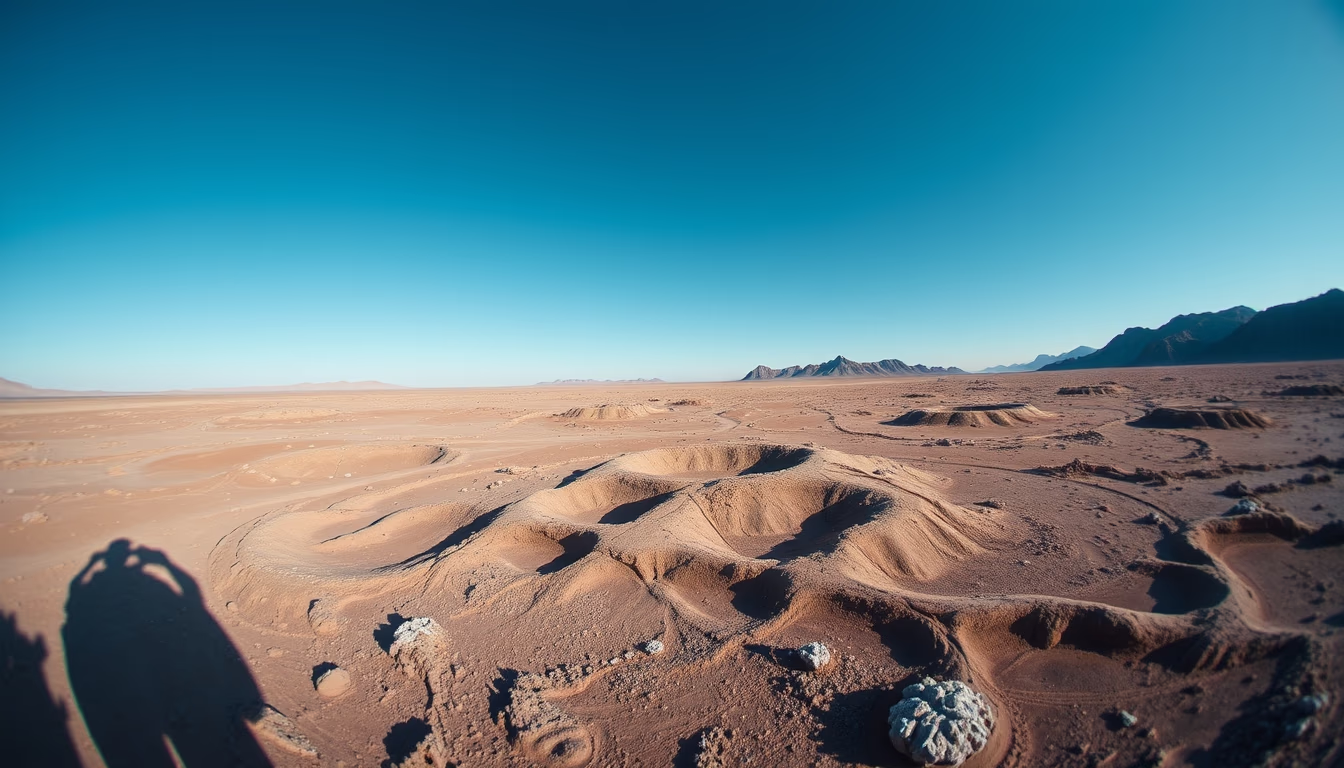
Mercury's surface is covered with impact craters, similar to the Moon, but with unique features due to its proximity to the Sun.
About this subject
Mercury, the smallest planet in the Solar System and closest to the Sun, has a surface covered with countless impact craters. These craters formed over billions of years, mainly during the Late Heavy Bombardment period about 3.9 billion years ago. Unlike the Moon, Mercury has a global magnetic field, which influences the distribution of ejecta from collisions. The most notable crater is the Caloris Basin, approximately 1,550 km in diameter, one of the largest impact structures in the Solar System. It is surrounded by concentric rings and smooth volcanic plains, indicating internal activity after the impact. Mercurian craters tend to be shallower than lunar ones due to the planet's higher gravity, which compresses the material. Furthermore, the lack of a significant atmosphere allows micrometeoroids to erode crater rims differently, creating a finer regolith. NASA's MESSENGER spacecraft, which orbited Mercury from 2011 to 2015, mapped nearly the entire surface, revealing details such as sulfur deposits and water ice in permanently shadowed craters near the poles.
Frequently Asked Questions
How many craters are there on Mercury?
Mercury has thousands of craters. The MESSENGER spacecraft cataloged over 15,000 craters with diameters larger than 10 km.
What is the difference between craters on Mercury and the Moon?
Mercurian craters are generally shallower than lunar ones due to Mercury's higher gravity. Additionally, the lack of atmosphere on Mercury results in less erosion, but micrometeoroid impacts create a finer regolith.
Why do some craters on Mercury have ice?
Craters near Mercury's poles are permanently shadowed, with temperatures below -170°C, allowing deposits of water ice and organic compounds to remain stable.
Direct URL
https://pub-c7d6a6ea828543ac903a74a341ccb2e1.r2.dev/imagens/mercury-surface-craters-fish-eye-wide-angle-p3.avifHow to credit
Include a visible link back to UtilizAí. Copy one of the snippets below:
<a href="https://xn--utiliza-eza.com/en/midia/imagens/mercury-surface-craters-fish-eye-wide-angle-p3">Mercury surface craters</a> by <a href="https://xn--utiliza-eza.com">UtilizAí</a>, licensed under <a href="https://creativecommons.org/licenses/by/4.0/">CC BY 4.0</a>.
[Mercury surface craters](https://xn--utiliza-eza.com/en/midia/imagens/mercury-surface-craters-fish-eye-wide-angle-p3) by [UtilizAí](https://xn--utiliza-eza.com), CC BY 4.0
License: CC-BY-4.0