Mercury surface craters
1344×768 · AVIF · CC BY 4.0
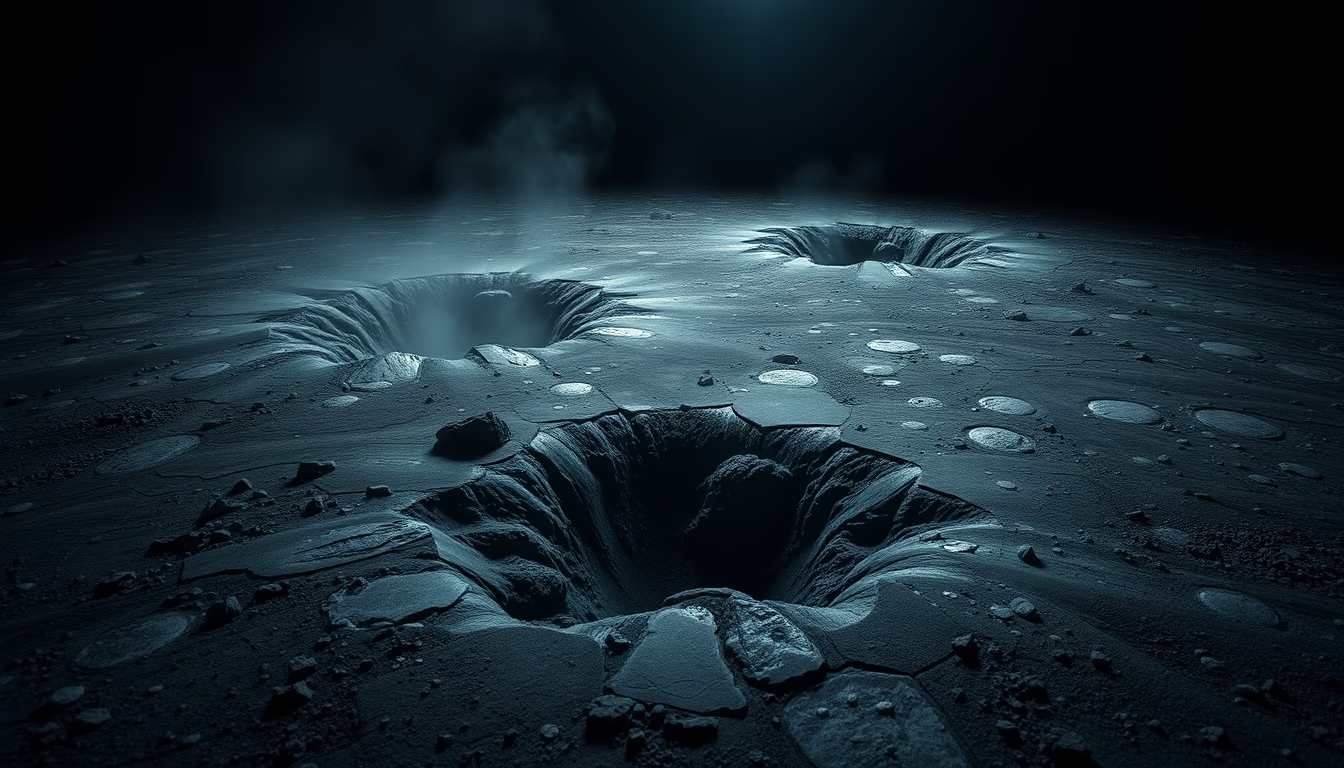
Mercury, the closest planet to the Sun, has a surface heavily cratered from billions of years of impacts, revealing its ancient geological history.
About this subject
Mercury, the smallest planet in the Solar System and the closest to the Sun, displays a landscape densely covered with impact craters, the result of billions of years of cosmic bombardment. Its surface, similar to the Moon but with unique features, preserves records of the early Solar System's history. The lack of a substantial atmosphere and erosional processes allows these craters to remain virtually intact, providing a window into the violent past of our planetary system.
The largest impact structure on Mercury is the Caloris Basin, approximately 1,550 km in diameter. Formed about 3.9 billion years ago, this circular basin is surrounded by concentric rings and has an interior filled with lava, indicating past volcanic activity. Around the basin, there is a region of chaotic terrain and mountains that rise up to 2 km in height, formed by the impact. Scientists study Caloris to understand the dynamics of major impacts in the inner Solar System.
Mercury's craters are named after famous artists, musicians, writers, and painters, a tradition established by the International Astronomical Union. Some craters exhibit bright ray systems, such as Kuiper Crater, where ejected material stands out due to high reflectivity. Furthermore, recent discoveries from the MESSENGER spacecraft revealed shallow, irregular depressions called "hollows," which may be linked to the loss of volatile compounds. These features are unique to Mercury and add complexity to the planet's geology, which continues to surprise researchers.
Frequently Asked Questions
How do Mercury's craters compare to those on the Moon?
Both bodies have heavily cratered surfaces, but Mercury's craters are generally shallower due to its higher gravity, which compresses the ejected material. Additionally, Mercury has larger impact basins like Caloris and unique features such as hollows.
What is the largest crater on Mercury?
The Caloris Basin, about 1,550 km in diameter, is the largest impact structure on Mercury. It is surrounded by mountains and concentric rings and has a lava-filled interior, indicating volcanic activity.
Why are Mercury's craters preserved?
Mercury has virtually no atmosphere and little erosion. With no wind, water, or plate tectonics, craters remain for billions of years, offering an almost unchanged record of early Solar System bombardment.
Direct URL
https://pub-c7d6a6ea828543ac903a74a341ccb2e1.r2.dev/imagens/mercury-surface-craters-fine-art-photography-p11.avifHow to credit
Include a visible link back to UtilizAí. Copy one of the snippets below:
<a href="https://xn--utiliza-eza.com/en/midia/imagens/mercury-surface-craters-fine-art-photography-p11">Mercury surface craters</a> by <a href="https://xn--utiliza-eza.com">UtilizAí</a>, licensed under <a href="https://creativecommons.org/licenses/by/4.0/">CC BY 4.0</a>.
[Mercury surface craters](https://xn--utiliza-eza.com/en/midia/imagens/mercury-surface-craters-fine-art-photography-p11) by [UtilizAí](https://xn--utiliza-eza.com), CC BY 4.0
License: CC-BY-4.0