Mercury surface craters
1344×768 · AVIF · CC BY 4.0
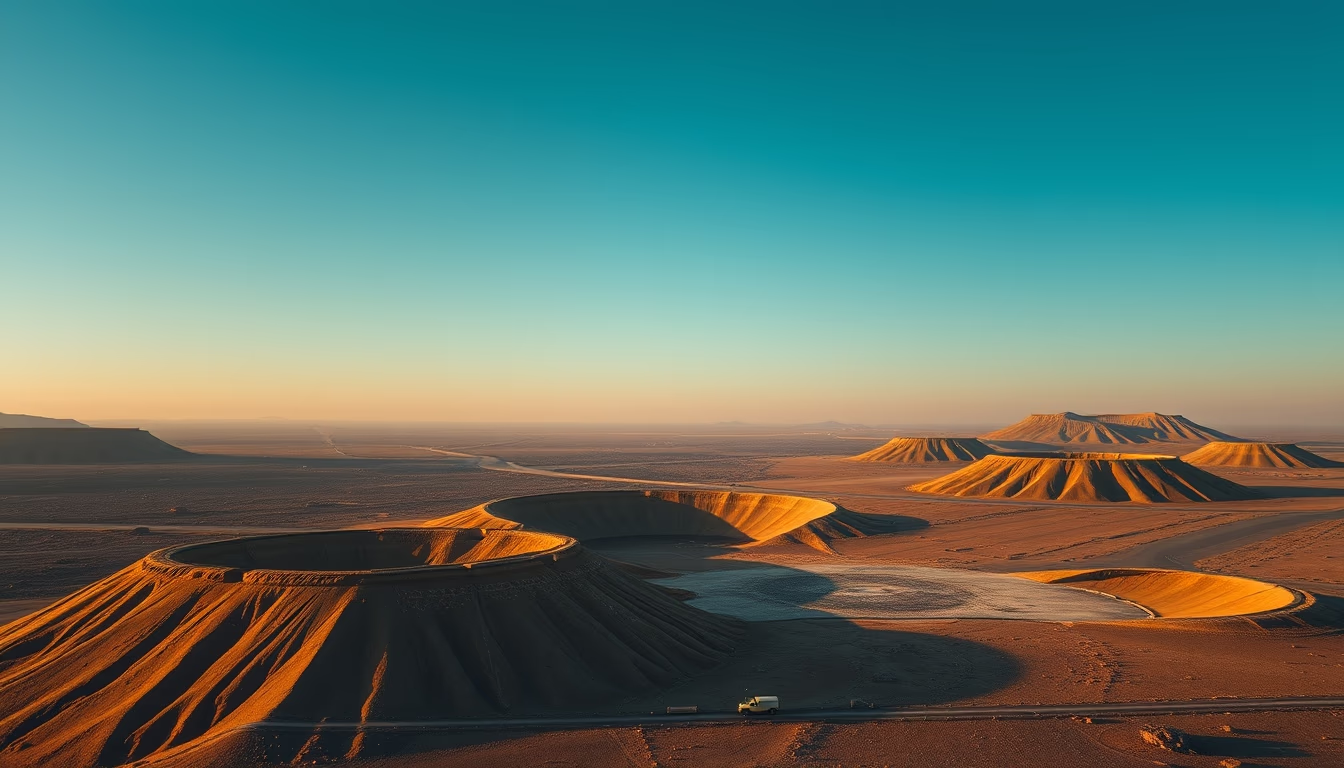
Covering much of Mercury's surface, impact craters tell the violent history of the inner Solar System.
About this subject
Mercury, the closest planet to the Sun, has a surface scarred by thousands of impact craters. Its geologically inactive crust, unchanged for billions of years, preserves records of intense bombardment during the early Solar System. The lack of a substantial atmosphere allows meteoroids to strike the ground without breaking apart, forming sharp-rimmed craters with radial ejecta. It is estimated that the planet underwent a heavy late bombardment about 3.8 billion years ago, similar to the Moon.
Among the most notable craters is the Caloris Basin, a huge depression about 1,550 km in diameter. Formed by a colossal impact, this basin is surrounded by concentric rings and has a floor filled with solidified lava. On its opposite side, a chaotic terrain called the Weird Terrain is observed, possibly resulting from seismic waves generated by the impact that converged at the antipode. Other smaller craters, such as Kuiper and Degas, display bright ray systems, indicating they are relatively young.
Unlike the Moon, Mercury's craters exhibit unique features due to its stronger surface gravity (0.38 g) and proximity to the Sun. The high daytime temperature (reaching 430°C) and low atmospheric pressure can alter the appearance of craters over time. Observations from the MESSENGER spacecraft revealed that many craters have deposits of dark material, possibly graphitic carbon, and some contain water ice in permanently shadowed areas at the bottom of polar craters.
The study of Mercury's craters helps scientists understand the impact history of the Solar System and the evolution of planetary crust. The upcoming BepiColombo mission, a partnership between ESA and JAXA, promises to map the surface at high resolution and provide new data on the composition and age of these structures.
Frequently Asked Questions
How many craters are there on Mercury?
The exact number is unknown, but there are likely hundreds of thousands of craters with diameters greater than 1 km. The Caloris Basin is the largest impact structure, about 1,550 km in diameter.
Why does Mercury have so many craters?
Because the planet has almost no atmosphere to break up meteoroids, and its crust is geologically inactive, preserving impact marks over billions of years.
Is there water on Mercury?
Yes, there is evidence of water ice in permanently shadowed craters at the poles, discovered by the MESSENGER spacecraft. This ice is thought to have been brought by comets or asteroids.
Direct URL
https://pub-c7d6a6ea828543ac903a74a341ccb2e1.r2.dev/imagens/mercury-surface-craters-cinematic-wide-shot-p6.avifHow to credit
Include a visible link back to UtilizAí. Copy one of the snippets below:
<a href="https://xn--utiliza-eza.com/en/midia/imagens/mercury-surface-craters-cinematic-wide-shot-p6">Mercury surface craters</a> by <a href="https://xn--utiliza-eza.com">UtilizAí</a>, licensed under <a href="https://creativecommons.org/licenses/by/4.0/">CC BY 4.0</a>.
[Mercury surface craters](https://xn--utiliza-eza.com/en/midia/imagens/mercury-surface-craters-cinematic-wide-shot-p6) by [UtilizAí](https://xn--utiliza-eza.com), CC BY 4.0
License: CC-BY-4.0