Mars rover detailed
1344×768 · AVIF · CC BY 4.0
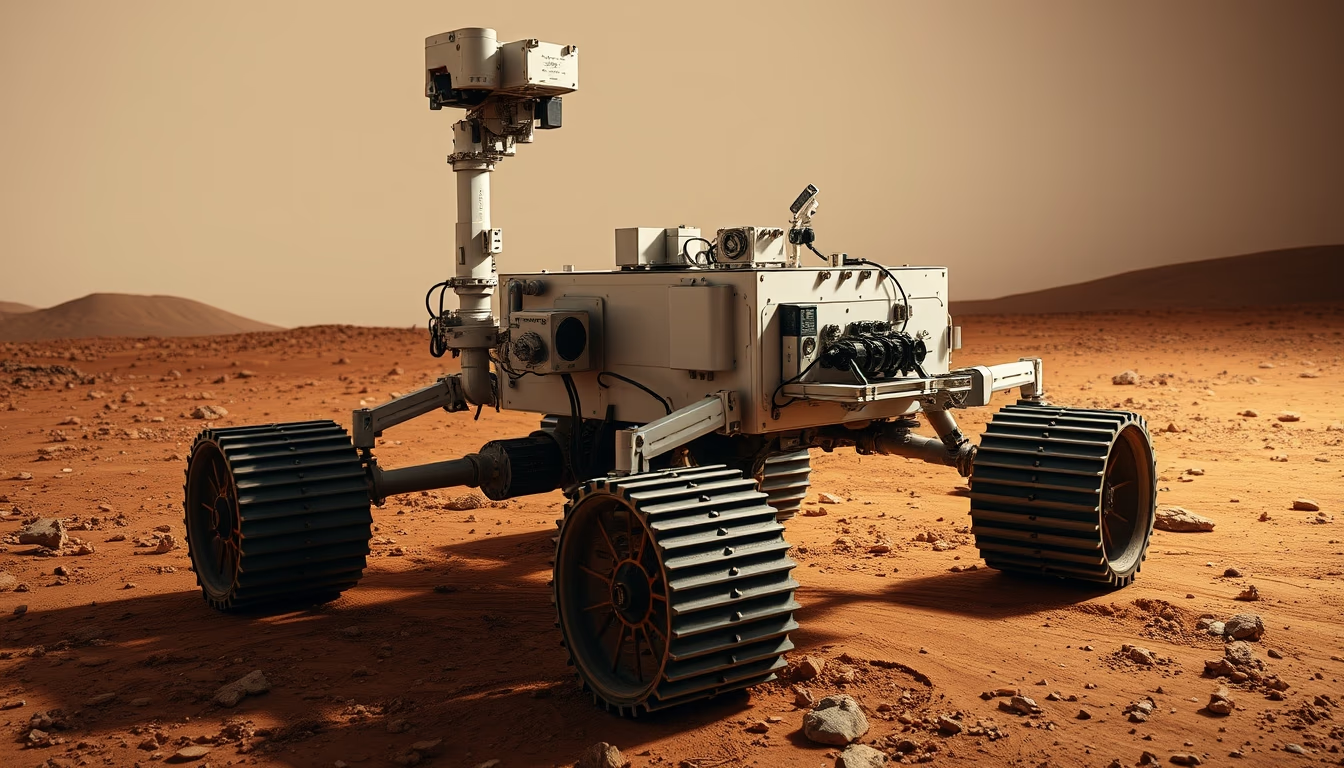
Mars rovers like Perseverance and Curiosity have been exploring the Red Planet since 2004, collecting geological data and searching for signs of past life.
About this subject
Mars rovers stand as one of the greatest achievements of space engineering. Since the launch of Sojourner in 1997, NASA has sent five mobile robots to Mars: Spirit, Opportunity, Curiosity, Perseverance, and the Ingenuity helicopter. The current flagship, Perseverance, landed in Jezero Crater in February 2021, a region that hosted a lake billions of years ago. Equipped with instruments like SuperCam and MOXIE, it drills rocks, collects samples for a future return mission, and converts carbon dioxide into oxygen, testing technologies for crewed missions. Curiosity, operational since 2012, has traveled over 28 km in Gale Crater, discovering organic molecules and evidence of habitable environments. Spirit and Opportunity, designed for 90 days, lasted years: Opportunity endured for 14 years. These robots carry high-resolution cameras, spectrometers, and weather sensors. Recent data from Perseverance suggest that Jezero Crater had an active river delta for thousands of years. The European Space Agency also plans the Rosalind Franklin rover, targeted for 2028. Robotic exploration is the cornerstone of astrobiological investigation, essential before human arrival.
Frequently Asked Questions
How many rovers are currently operating on Mars?
Currently, two NASA rovers are active: Perseverance (since 2021) and Curiosity (since 2012). The Ingenuity helicopter also operates as a technology demonstrator.
What is the primary goal of the Perseverance rover?
Its main goal is to search for signs of ancient microbial life, collect rock and soil samples for a future Mars sample return mission, and test technologies such as oxygen production from the Martian atmosphere.
Can Mars rovers communicate directly with Earth?
Yes, but they use orbiters as relays: rovers send data to satellites in Mars orbit (like Mars Reconnaissance Orbiter), which then beam it to Earth, enabling continuous communication even when rovers are on the nightside.
Direct URL
https://pub-c7d6a6ea828543ac903a74a341ccb2e1.r2.dev/imagens/mars-rover-detailed-studio-editorial-portrait-p5.avifHow to credit
Include a visible link back to UtilizAí. Copy one of the snippets below:
<a href="https://xn--utiliza-eza.com/en/midia/imagens/mars-rover-detailed-studio-editorial-portrait-p5">Mars rover detailed</a> by <a href="https://xn--utiliza-eza.com">UtilizAí</a>, licensed under <a href="https://creativecommons.org/licenses/by/4.0/">CC BY 4.0</a>.
[Mars rover detailed](https://xn--utiliza-eza.com/en/midia/imagens/mars-rover-detailed-studio-editorial-portrait-p5) by [UtilizAí](https://xn--utiliza-eza.com), CC BY 4.0
License: CC-BY-4.0