Mars rover detailed
1344×768 · AVIF · CC BY 4.0
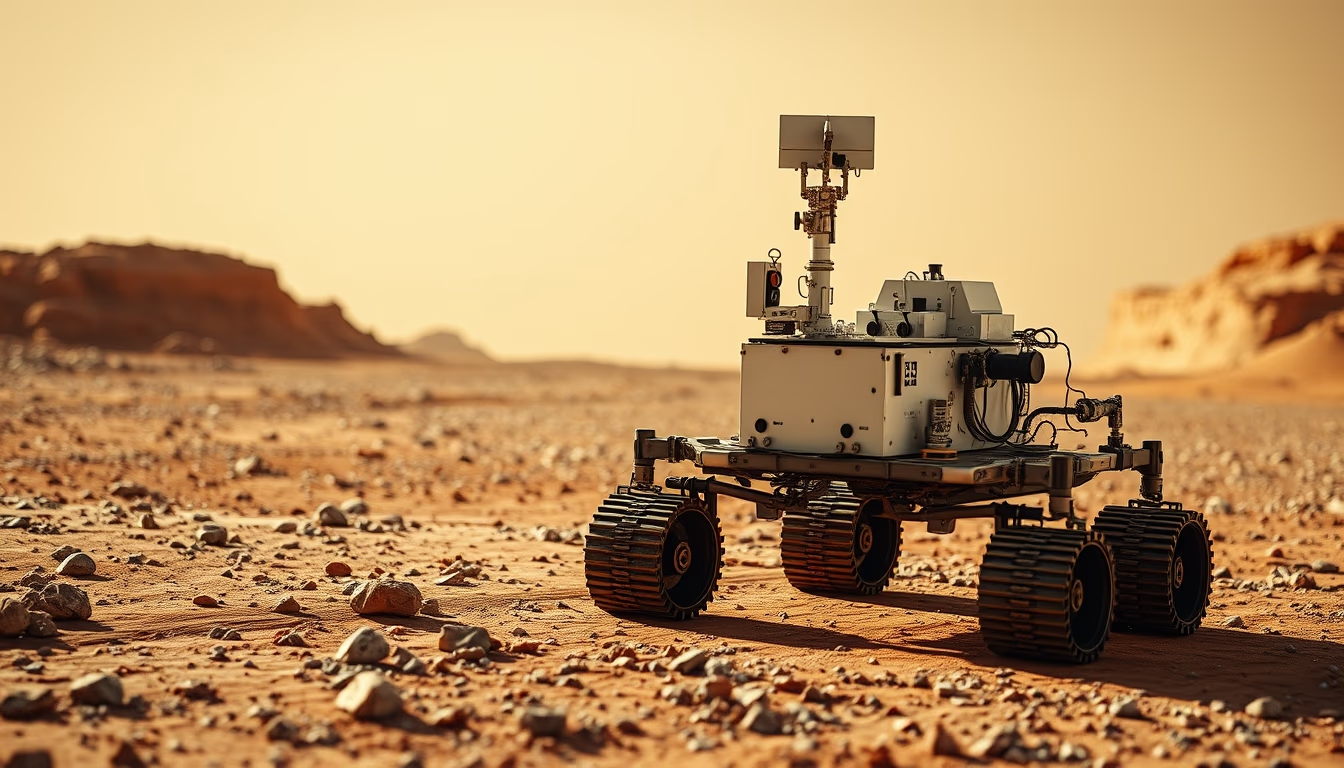
Mars rovers have revolutionized the exploration of Mars by providing detailed data on the geology and habitability of the Red Planet.
About this subject
Mars rovers are robotic vehicles designed to explore the surface of Mars. Since the first rover, Sojourner, which landed in 1997 as part of the Mars Pathfinder mission, NASA has sent increasingly advanced rovers: Spirit and Opportunity (2004), Curiosity (2012), and Perseverance (2021). Each mission has greatly contributed to understanding Mars' geology, climate, and potential for past life.
Curiosity, for example, discovered evidence of ancient lakes and organic molecules, indicating that Mars once had conditions to sustain microbial life. Perseverance is collecting rock and regolith samples for future return to Earth, and testing technologies like oxygen production from the Martian atmosphere (MOXIE). The rovers operate in a harsh environment with extreme temperatures, a thin atmosphere, and dust storms. They rely on power from solar panels (Spirit, Opportunity, Curiosity) or a radioisotope thermoelectric generator (Perseverance). Communication with Earth is done via orbiting satellites that relay data.
The importance of rovers for space exploration is immense. They act as remote field geologists, analyzing rocks and soils with cutting-edge scientific instruments like spectrometers and high-resolution cameras. The images and data collected allow scientists on Earth to study Mars like never before, paving the way for future crewed missions. In addition to the US, China also sent the Zhurong rover in 2021, which explores the Utopia Planitia region. As of 2025, only Perseverance and Zhurong are active.
Frequently Asked Questions
How many rovers have successfully landed on Mars?
As of 2025, six rovers have successfully landed: the American Sojourner, Spirit, Opportunity, Curiosity, and Perseverance, and the Chinese Zhurong.
What is the main difference between the Curiosity and Perseverance rovers?
Perseverance is more advanced: it has a sample collection system for future return, a helicopter assistant (Ingenuity), and instruments to produce oxygen. Curiosity focuses more on geology and habitability.
Are the Mars rovers still operational?
As of 2025, only Perseverance (NASA) and Zhurong (China) are active. Spirit and Opportunity have ended their missions, and Curiosity continues operating but with power limitations.
Direct URL
https://pub-c7d6a6ea828543ac903a74a341ccb2e1.r2.dev/imagens/mars-rover-detailed-minimalist-composition-p8.avifHow to credit
Include a visible link back to UtilizAí. Copy one of the snippets below:
<a href="https://xn--utiliza-eza.com/en/midia/imagens/mars-rover-detailed-minimalist-composition-p8">Mars rover detailed</a> by <a href="https://xn--utiliza-eza.com">UtilizAí</a>, licensed under <a href="https://creativecommons.org/licenses/by/4.0/">CC BY 4.0</a>.
[Mars rover detailed](https://xn--utiliza-eza.com/en/midia/imagens/mars-rover-detailed-minimalist-composition-p8) by [UtilizAí](https://xn--utiliza-eza.com), CC BY 4.0
License: CC-BY-4.0