Maritime signal flags
1344×768 · AVIF · CC BY 4.0
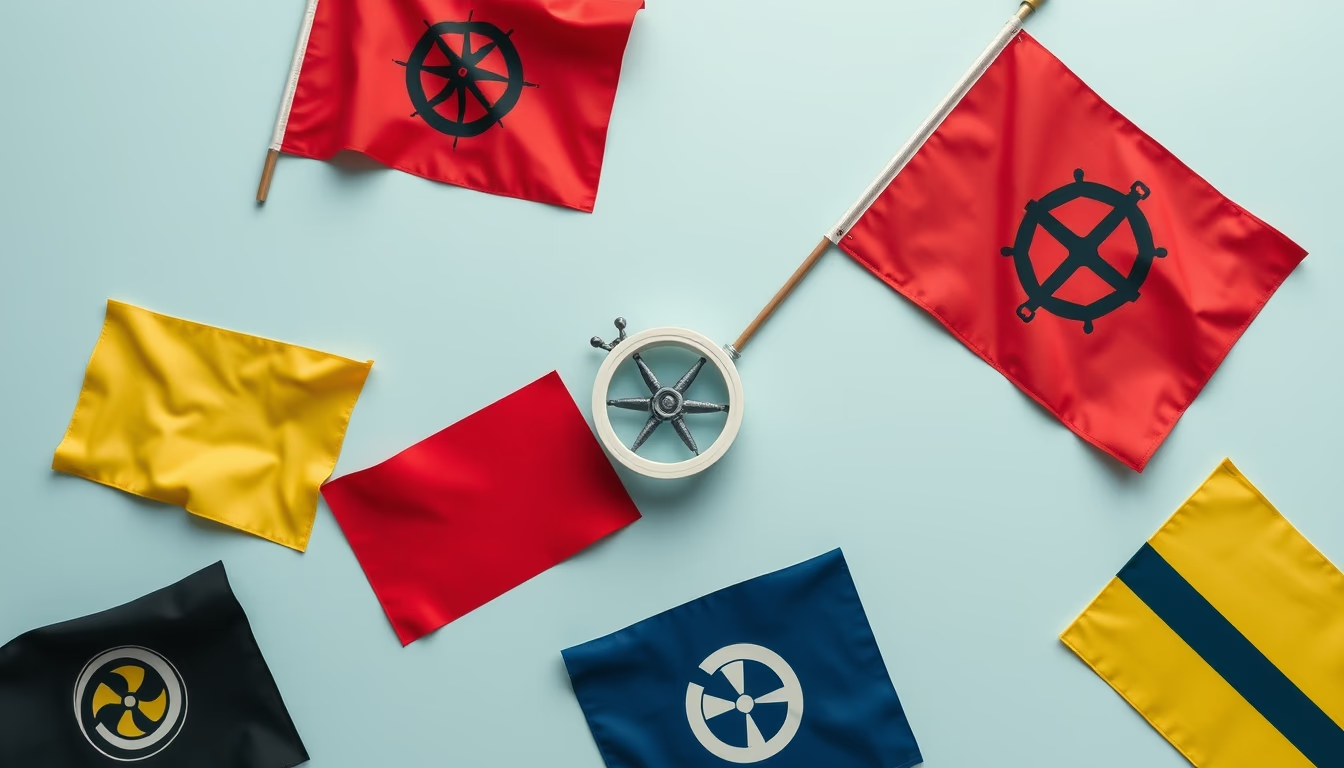
Maritime signal flags: an international visual communication system used by ships to transmit standardized messages at sea.
About this subject
Maritime signal flags are part of the International Code of Signals (ICS), adopted by the International Maritime Organization (IMO) to facilitate communication between vessels of different nationalities. Each flag represents a letter of the alphabet or a numeral, but also carries specific meanings when hoisted alone or in combinations. For example, flag 'A' (Alfa) means 'I have a diver down; keep well clear at slow speed', while flag 'B' (Bravo) indicates 'I am taking in, discharging, or carrying dangerous goods'.
The system originated in the 19th century, when global maritime trade demanded a common language. In 1855, the British Board of Trade published the first code with 18 flags, which evolved into the current ICS with 26 alphabetical flags, 10 numeral pennants, 3 repeaters, and 1 answering pennant. The flags are made of weather-resistant fabric, usually in bright colors such as red, yellow, blue, black, and white, to ensure visibility over long distances.
Beyond communication, flags are used in naval ceremonies, regattas, and historical reenactments. In recreational sailing, knowing basic signals is essential for safety. For instance, flag 'O' (Oscar) means 'Man overboard', and the combination 'NC' (November Charlie) is a distress signal. Flag 'Q' (Quebec) represents 'My vessel is healthy and I request free pratique', famously hoisted during sanitary quarantines.
Interestingly, the system has also influenced other fields, such as railway signaling and the flag code used in auto racing. In Brazil, the Brazilian Navy uses the ICS in exercises and training, and the flags are often seen in ports like Santos and Rio de Janeiro. For enthusiasts, collecting miniature replicas is a hobby that preserves naval history.
Frequently Asked Questions
How many flags are in the International Code of Signals?
The current ICS comprises 40 flags: 26 alphabetical, 10 numeral pennants, 3 repeaters, and 1 answering pennant.
What does the 'Q' (Quebec) flag mean?
Flag 'Q' means 'My vessel is healthy and I request free pratique', used to request sanitary clearance in ports.
Can maritime signal flags be used on land?
Yes, they are used in naval ceremonies, regattas, and even in auto racing as a flag code.
Direct URL
https://pub-c7d6a6ea828543ac903a74a341ccb2e1.r2.dev/imagens/maritime-signal-flags-isometric-flat-lay-fresh12.avifHow to credit
Include a visible link back to UtilizAí. Copy one of the snippets below:
<a href="https://xn--utiliza-eza.com/en/midia/imagens/maritime-signal-flags-isometric-flat-lay-fresh12">Maritime signal flags</a> by <a href="https://xn--utiliza-eza.com">UtilizAí</a>, licensed under <a href="https://creativecommons.org/licenses/by/4.0/">CC BY 4.0</a>.
[Maritime signal flags](https://xn--utiliza-eza.com/en/midia/imagens/maritime-signal-flags-isometric-flat-lay-fresh12) by [UtilizAí](https://xn--utiliza-eza.com), CC BY 4.0
License: CC-BY-4.0