Malachite green pattern
1344×768 · AVIF · CC BY 4.0
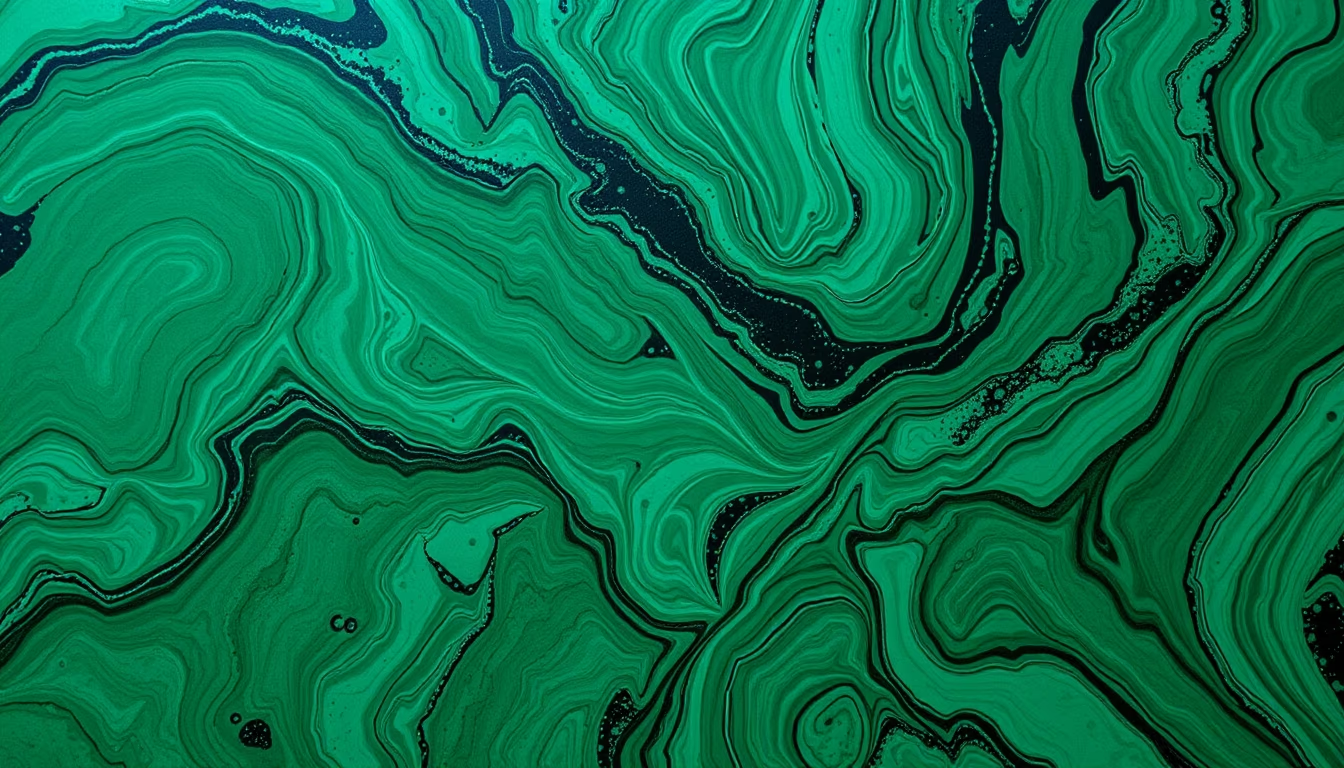
Malachite, a green copper carbonate mineral, forms unique wavy and banded patterns, prized in jewelry and as a historic pigment.
About this subject
Malachite is a secondary copper mineral, with chemical formula Cu₂CO₃(OH)₂, renowned for its vivid green color and characteristic concentric or wavy banded patterns. It forms in oxidation zones of copper deposits, notably in the Democratic Republic of the Congo, Russia (Ural Mountains), Chile, and the United States (Arizona). Its genesis involves the alteration of other copper minerals like chalcopyrite in the presence of water and carbon dioxide.
Historically, malachite has been used as a pigment in Egyptian and Renaissance paintings, and has been carved into decorative objects and jewelry. In Tsarist Russia, large blocks were crafted into vases and interior cladding, such as in the Winter Palace in St. Petersburg. Its moderate hardness (3.5, 4 on Mohs scale) makes it easy to polish but requires care to avoid scratches.
The wavy patterns, often resembling eyes or tree rings, result from rhythmic deposition of microcrystalline layers during formation. The intensity of green varies with copper concentration and impurities. Although beautiful, malachite is sensitive to acids and can lose luster with prolonged exposure to heat or chemicals.
Beyond ornamental use, powdered malachite is still employed as a pigment in art conservation, and raw specimens are collected by museums and enthusiasts. Due to its copper content, it is also used in small-scale metal processing.
Frequently Asked Questions
Is malachite toxic?
Yes, malachite contains copper and can be toxic if ingested or inhaled as fine dust. It is recommended to wash hands after handling and avoid grinding or sanding without protection.
What is the difference between malachite and azurite?
Malachite is green copper carbonate, while azurite is blue. Both are secondary copper minerals and often occur together in oxidized deposits.
How to identify genuine malachite?
Genuine malachite shows natural, non-uniform banded patterns and effervesces in dilute hydrochloric acid. Synthetic imitations often have more homogeneous colors and textures.
Direct URL
https://pub-c7d6a6ea828543ac903a74a341ccb2e1.r2.dev/imagens/malachite-green-pattern-magazine-editorial-p6.avifHow to credit
Include a visible link back to UtilizAí. Copy one of the snippets below:
<a href="https://xn--utiliza-eza.com/en/midia/imagens/malachite-green-pattern-magazine-editorial-p6">Malachite green pattern</a> by <a href="https://xn--utiliza-eza.com">UtilizAí</a>, licensed under <a href="https://creativecommons.org/licenses/by/4.0/">CC BY 4.0</a>.
[Malachite green pattern](https://xn--utiliza-eza.com/en/midia/imagens/malachite-green-pattern-magazine-editorial-p6) by [UtilizAí](https://xn--utiliza-eza.com), CC BY 4.0
License: CC-BY-4.0