Liquid metal flowing
1344×768 · AVIF · CC BY 4.0
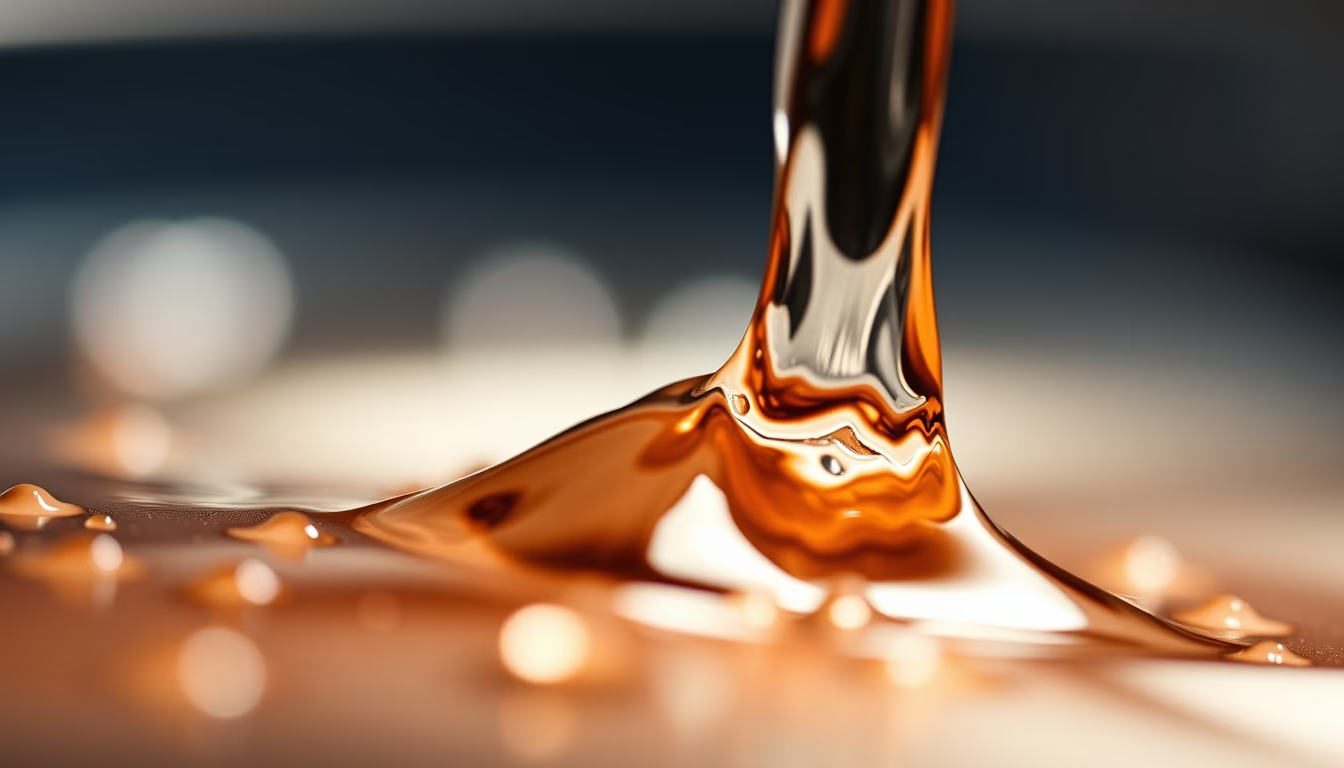
Flowing liquid metal reveals dynamic fluid patterns, with unique viscosity and thermal conductivity properties.
About this subject
Liquid metal is a state of matter that occurs when a metal is heated above its melting point. Unlike solids, atoms in liquid metal have mobility, allowing the material to flow and take the shape of its container. This property is essential in industrial processes such as casting, welding, and alloy manufacturing. Metals like mercury, gallium, and low-melting-point alloys (such as Wood's metal) are common examples of liquid metals at or near room temperature.
The flow behavior of liquid metal is governed by fluid mechanics, but with significant differences compared to common liquids like water. The high surface tension and variable viscosity of liquid metals influence the formation of waves, droplets, and splashes. In macro close-ups, one can observe hydrodynamic instability patterns such as Rayleigh-Taylor fingers or vortices, which are of great interest to scientists and engineers.
In industry, controlling liquid metal flow is critical for the quality of cast parts. Temperature and chemical composition directly affect fluidity and solidification. For example, in aluminum casting, adding elements like silicon improves fluidity, allowing complex molds to be filled. Molten steel requires careful rheology to avoid defects such as porosity and cracks.
Beyond industrial applications, liquid metals possess unique electrical and thermal conductivity properties. Liquid sodium, for instance, is used as a coolant in fast nuclear reactors due to its high thermal conductivity. In laboratories, gallium is often used for galvanotropism experiments because it expands upon solidification, unlike most metals. These characteristics make the study of liquid metal flow an interdisciplinary field spanning physics, chemistry, and engineering.
Frequently Asked Questions
What determines the fluidity of a liquid metal?
Fluidity is influenced by temperature, chemical composition, and impurities. Metals with low viscosity and high temperature relative to the melting point tend to flow more easily.
What are the main challenges in handling liquid metals?
Challenges include temperature control to avoid premature solidification, prevention of oxidation and contamination, and safety due to high temperatures and reactivity of some metals like sodium.
How is liquid metal flow studied in the laboratory?
Techniques include X-ray visualization, computational fluid dynamics simulations, and experiments with low-melting-point metals like gallium, which allow real-time observation.
Direct URL
https://pub-c7d6a6ea828543ac903a74a341ccb2e1.r2.dev/imagens/liquid-metal-flowing-macro-closeup-p4.avifHow to credit
Include a visible link back to UtilizAí. Copy one of the snippets below:
<a href="https://xn--utiliza-eza.com/en/midia/imagens/liquid-metal-flowing-macro-closeup-p4">Liquid metal flowing</a> by <a href="https://xn--utiliza-eza.com">UtilizAí</a>, licensed under <a href="https://creativecommons.org/licenses/by/4.0/">CC BY 4.0</a>.
[Liquid metal flowing](https://xn--utiliza-eza.com/en/midia/imagens/liquid-metal-flowing-macro-closeup-p4) by [UtilizAí](https://xn--utiliza-eza.com), CC BY 4.0
License: CC-BY-4.0