Liquid cooling loop
1344×768 · AVIF · CC BY 4.0
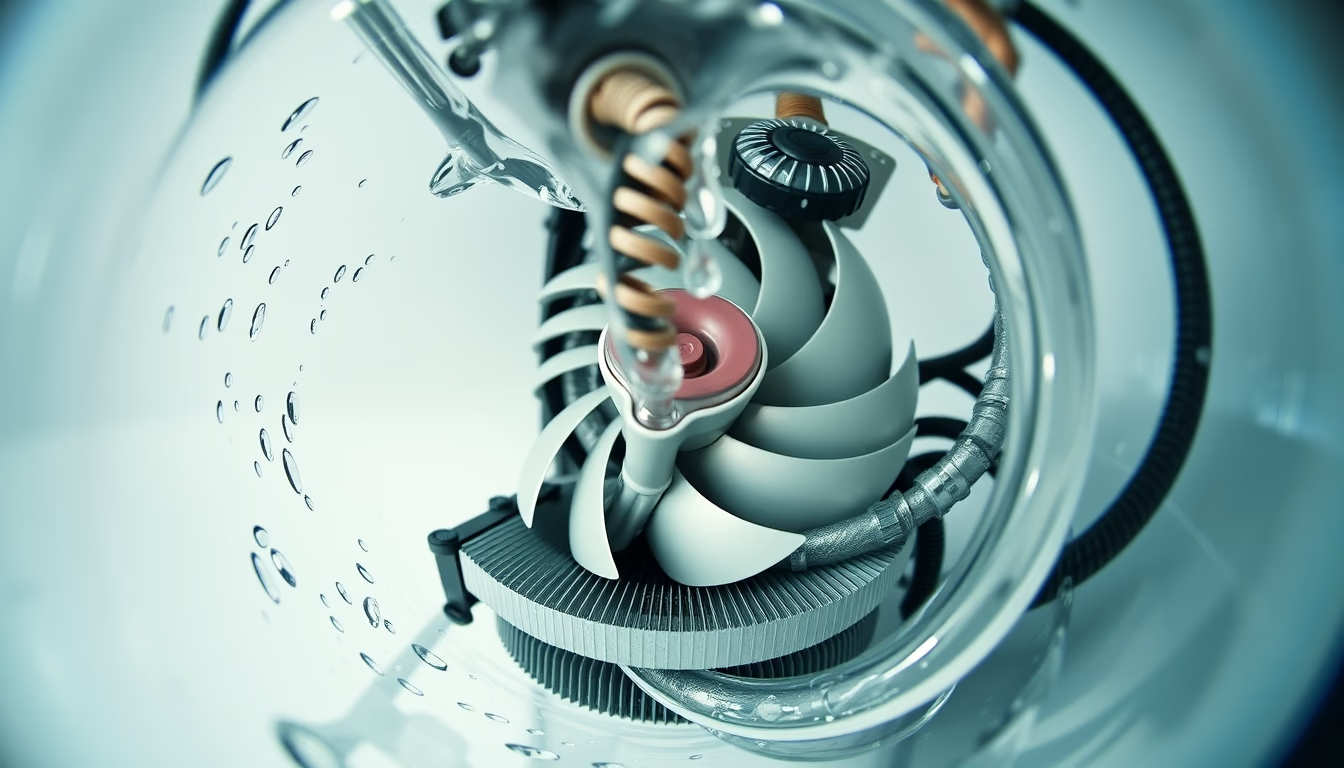
Liquid cooling loops for computers use water or dielectric fluid to dissipate heat from components like CPU and GPU, ensuring stable performance.
About this subject
A liquid cooling loop, or water cooling system, is a closed circuit that transports coolant fluid through metal blocks attached to hot components such as CPUs and GPUs. Heat transfers to the liquid, which then flows to a radiator where air removes the thermal energy. Compared to traditional air coolers, these systems offer higher dissipation capacity, enabling more aggressive overclocking and quieter operation.
Key components include a pump to circulate the fluid, a radiator with fans, water blocks, and tubing. The coolant can be distilled water with anticorrosive additives or dielectric fluids like propylene glycol. Some enthusiasts use colored or UV-reactive fluids, but the primary function is efficient heat exchange.
Building a custom loop requires careful planning: selecting the right radiator size for the case, ensuring connector compatibility, and leak testing. Although more expensive and complex than air cooling, liquid cooling is common in high-performance workstations and gaming or 3D rendering rigs.
Interestingly, the first use of liquid cooling in computers dates back to the 1980s, in IBM mainframes. Since then, the technique has evolved into all-in-one (AIO) solutions that simplify installation, making liquid cooling accessible even to home users.
Frequently Asked Questions
What is the difference between an AIO water cooler and a custom loop?
AIO water coolers are pre-assembled, sealed, and easy to install, while custom loops require manual assembly, allowing for more customization and performance but with higher cost and leakage risk.
Does the liquid in a water cooler need to be replaced?
In AIO systems, usually not, as they are sealed. In custom loops, it is recommended to replace the fluid every 6 to 12 months to prevent corrosion and algae growth.
Is liquid cooling better than air cooling?
Yes, in terms of thermal capacity and noise, especially during overclocking. However, high-end air coolers can be competitive and are simpler and cheaper.
Direct URL
https://pub-c7d6a6ea828543ac903a74a341ccb2e1.r2.dev/imagens/liquid-cooling-loop-fish-eye-wide-angle-p1.avifHow to credit
Include a visible link back to UtilizAí. Copy one of the snippets below:
<a href="https://xn--utiliza-eza.com/en/midia/imagens/liquid-cooling-loop-fish-eye-wide-angle-p1">Liquid cooling loop</a> by <a href="https://xn--utiliza-eza.com">UtilizAí</a>, licensed under <a href="https://creativecommons.org/licenses/by/4.0/">CC BY 4.0</a>.
[Liquid cooling loop](https://xn--utiliza-eza.com/en/midia/imagens/liquid-cooling-loop-fish-eye-wide-angle-p1) by [UtilizAí](https://xn--utiliza-eza.com), CC BY 4.0
License: CC-BY-4.0