Kuiper belt distant
1344×768 · AVIF · CC BY 4.0
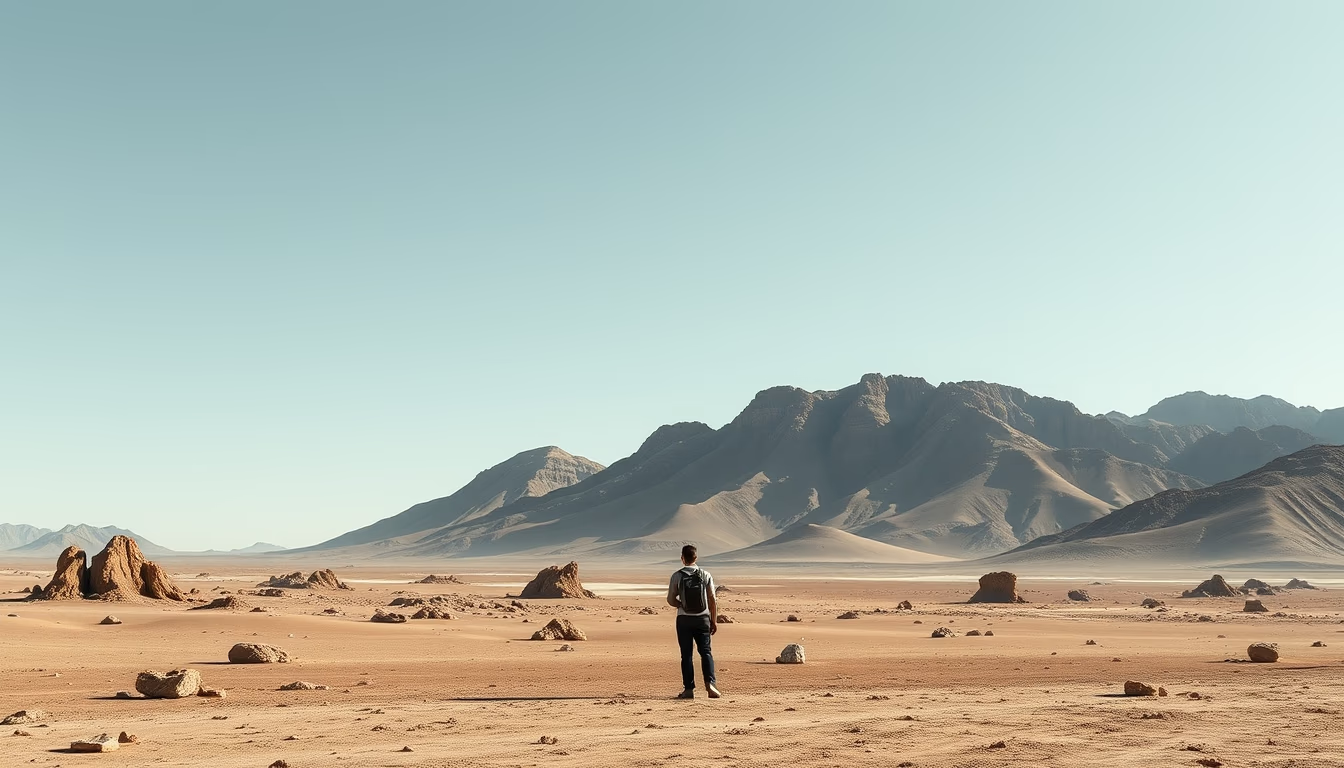
The Kuiper Belt is a region of the Solar System beyond Neptune, filled with icy bodies and dwarf planets like Pluto.
About this subject
The Kuiper Belt is a vast, disk-shaped region located beyond Neptune's orbit, extending roughly from 30 to 50 astronomical units (AU) from the Sun. It contains hundreds of thousands of icy bodies, including dwarf planets such as Pluto, Eris, Makemake, and Haumea. Unlike the asteroid belt, which is mostly rock and metal, Kuiper Belt objects are rich in volatile ices like water, methane, and ammonia.
The concept was proposed by astronomer Gerard Kuiper in 1951, but the first object was only discovered in 1992, named 1992 QB1. Since then, thousands have been cataloged, and it is estimated there are over 100,000 objects larger than 100 km in diameter. The largest and most famous is Pluto, reclassified as a dwarf planet in 2006, partly due to the discovery of Eris, another large Kuiper Belt object.
Short-period comets, like Halley, originate from the Kuiper Belt, perturbed by Neptune's gravity and sent into the inner Solar System. Studying these objects helps scientists understand the formation and evolution of the Solar System, as they are nearly pristine remnants of the primordial nebula. There is also an intriguing feature known as the "Kuiper cliff," a sharp drop in object density at about 50 AU, the cause of which is still debated.
Frequently Asked Questions
What is the Kuiper Belt?
It is a region of the Solar System beyond Neptune, filled with icy bodies and dwarf planets. It extends from 30 to 50 AU from the Sun.
Who discovered the Kuiper Belt?
Astronomer Gerard Kuiper proposed its existence in 1951. The first object was discovered in 1992 by David Jewitt and Jane Luu.
Why is the Kuiper Belt important?
It is the source of short-period comets and contains primitive objects that help study the formation of the Solar System.
Direct URL
https://pub-c7d6a6ea828543ac903a74a341ccb2e1.r2.dev/imagens/kuiper-belt-distant-minimalist-composition-p1.avifHow to credit
Include a visible link back to UtilizAí. Copy one of the snippets below:
<a href="https://xn--utiliza-eza.com/en/midia/imagens/kuiper-belt-distant-minimalist-composition-p1">Kuiper belt distant</a> by <a href="https://xn--utiliza-eza.com">UtilizAí</a>, licensed under <a href="https://creativecommons.org/licenses/by/4.0/">CC BY 4.0</a>.
[Kuiper belt distant](https://xn--utiliza-eza.com/en/midia/imagens/kuiper-belt-distant-minimalist-composition-p1) by [UtilizAí](https://xn--utiliza-eza.com), CC BY 4.0
License: CC-BY-4.0