Kuiper belt distant
1344×768 · AVIF · CC BY 4.0
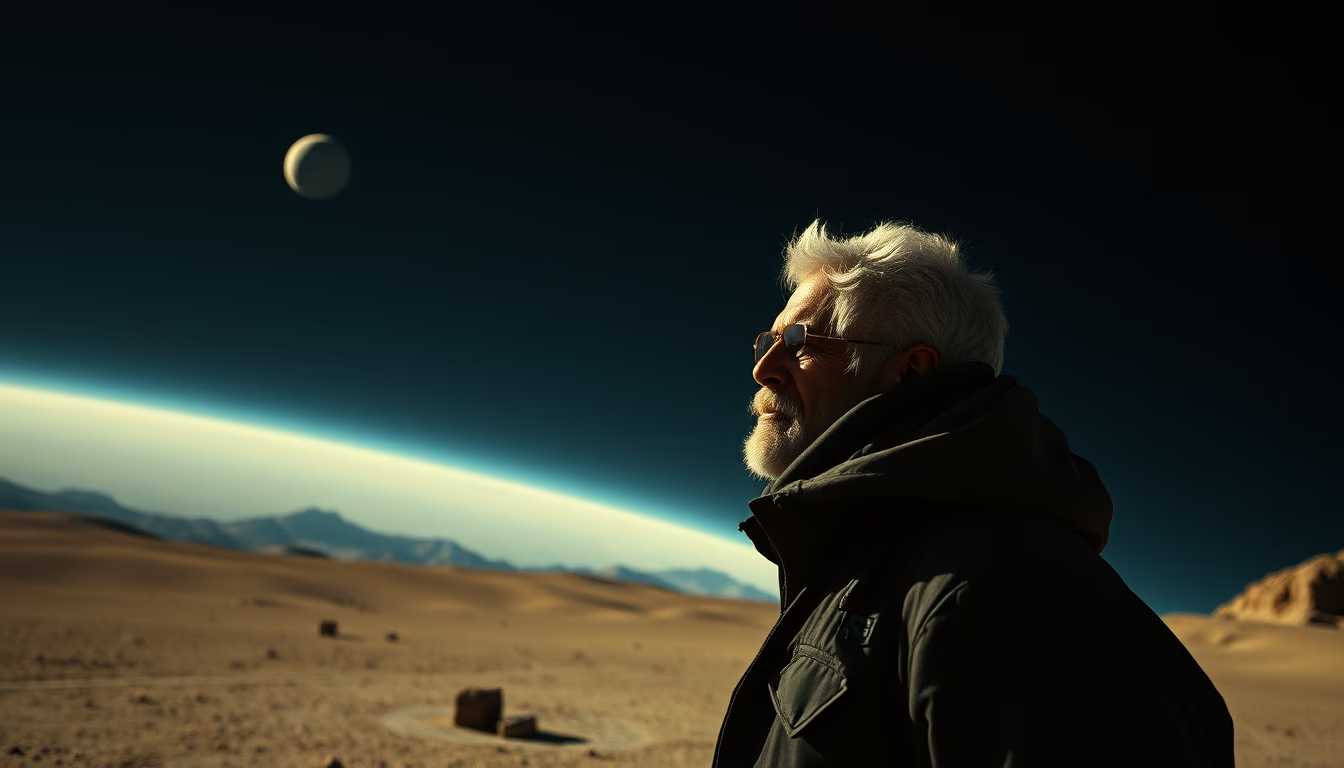
The Kuiper Belt is a region of the solar system beyond Neptune, filled with icy bodies and dwarf planets like Pluto.
About this subject
The Kuiper Belt is a vast, disk-shaped region of the solar system extending from roughly 30 to 50 astronomical units (AU) from the Sun, beyond the orbit of Neptune. Formally discovered in 1992 with the identification of object 1992 QB1 by astronomers David Jewitt and Jane Luu, it contains hundreds of thousands of icy bodies composed mainly of methane, ammonia, and water. It is estimated that there are over 100,000 objects larger than 100 km in diameter in this zone.
The most famous object in the Kuiper Belt is Pluto, reclassified as a dwarf planet in 2006 by the International Astronomical Union. Other notable bodies include Eris, Makemake, and Haumea. These objects are considered fossils of the early solar system, preserving material from the dawn of planetary formation. NASA's New Horizons mission, which flew by Pluto in 2015 and later the object Arrokoth in 2019, provided crucial data on the belt's composition and dynamics.
The Kuiper Belt should not be confused with the Oort Cloud, a spherical and much more distant region. Many short-period comets, such as Halley's Comet, are believed to originate in the Kuiper Belt. The structure and boundaries of the belt remain subjects of active research, influencing theories on the evolution of the solar system.
Frequently Asked Questions
What is the Kuiper Belt?
It is a region of the solar system beyond Neptune, filled with icy bodies and dwarf planets. It extends from 30 to 50 AU from the Sun.
Who discovered the Kuiper Belt?
The first object beyond Pluto was discovered in 1992 by astronomers David Jewitt and Jane Luu. The belt was theoretically suggested earlier by Gerard Kuiper in 1951.
Is Pluto in the Kuiper Belt?
Yes, Pluto is the largest known object in the Kuiper Belt. Its reclassification as a dwarf planet in 2006 was due to the discovery of other similar-sized bodies in the region.
Direct URL
https://pub-c7d6a6ea828543ac903a74a341ccb2e1.r2.dev/imagens/kuiper-belt-distant-film-grain-authentic-p9.avifHow to credit
Include a visible link back to UtilizAí. Copy one of the snippets below:
<a href="https://xn--utiliza-eza.com/en/midia/imagens/kuiper-belt-distant-film-grain-authentic-p9">Kuiper belt distant</a> by <a href="https://xn--utiliza-eza.com">UtilizAí</a>, licensed under <a href="https://creativecommons.org/licenses/by/4.0/">CC BY 4.0</a>.
[Kuiper belt distant](https://xn--utiliza-eza.com/en/midia/imagens/kuiper-belt-distant-film-grain-authentic-p9) by [UtilizAí](https://xn--utiliza-eza.com), CC BY 4.0
License: CC-BY-4.0